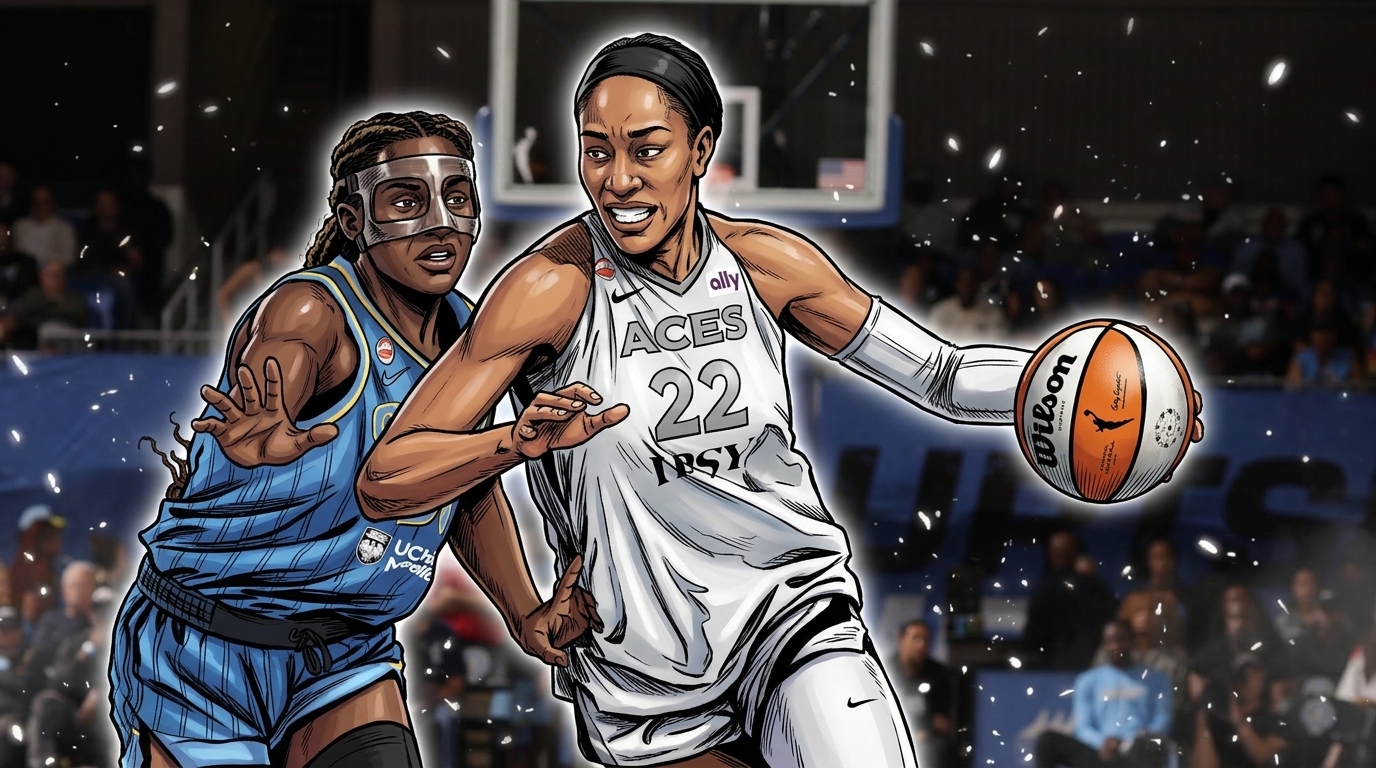

Try naming another WNBA player who has swept the conference Player of the Month award in one season, then done it again in a completely different one. Nobody comes to mind because nobody exists. A’ja Wilson is the only player to sweep the honor across two separate, non-consecutive seasons, and her fourth award of 2026, confirmed this week, pushes her career total to a record 17 and completes that second clean sweep.
Seventeen is the number every recap will lead with. It’s the wrong number to fixate on. The Las Vegas Aces star swept May, June, July and August this year the same way she swept August and September in 2020, and the six years between those two clean sweeps are doing more work than the raw count ever could. One monster season with hardware attached is real, but it’s also familiar. Repeating it on a roster that’s turned over almost entirely, under a different coach, is the part that actually separates her from everyone else who’s had a great month or four.
What a Sweep Actually Requires
A sweep means Wilson won every monthly award she was eligible for in a given season, no gaps, no runner-up finishes to fill in the calendar. In August that meant averaging 25.0 points a game on 49.5% shooting, plus 8.8 rebounds, 3.2 assists and 2.1 blocks, while Las Vegas went 7-5 across an 11-game stretch. Translate the shooting number: a center hitting just under half her attempts, while also drawing the defense’s full attention as the primary scoring option, is staying efficient while serving as the entire offensive plan, not padding stats against a soft schedule.
Zoom out and the season-long picture backs it up. Wilson currently leads the WNBA in scoring at 26.0 points a game and in blocks at 2.0 a game, with four regular-season contests left after the World Cup break. A player doesn’t lead the league in two disconnected categories, one offensive and one defensive, by accident this deep into a career. It reads like someone still adding new dimensions to her game, years past the point when highlight reels alone would have carried the reputation.
The Aces have been here before this season. Back in June, after Wilson’s second monthly award of the year, the team’s own account barely bothered to sound surprised:
https://x.com/LVAces/status/2073060668107071755
That was award number 15, two months before the sweep was even complete. The lack of surprise is the actual story. Nobody in the WNBA treats a Wilson monthly award as breaking news anymore, and that kind of routine dominance is harder to sustain over years than one loud, shocking stretch.
How Does A’ja Wilson’s 2026 Compare to Her 2020 MVP Season?
Her August 2026 stretch is scoring more efficiently and doing more across the board than her 2020 MVP season did, which suggests she isn’t just repeating that peak. She’s improved on it, six years and one full roster cycle later, against defenses built specifically to stop her.
The 2020 numbers came in a bubble season: 20.5 points, 8.5 rebounds, 2.0 blocks a game across 22 games, a career-high 48% shooting at the time, and 43 of 47 first-place MVP votes in a shortened, condensed schedule. That August-and-September run came with Las Vegas going a combined 17-2. The August 2026 split is a smaller sample, but it’s stronger on shooting percentage, rebounding and assists, and it arrives deeper into a career where opposing coaches have had six extra years to scheme against her specifically. That surprised me when I first lined the two stat lines up. Getting better against smarter defenses later in a career is supposed to be the harder trick, not the more statistically dominant one.
The Roster and Bench That Changed Around Her
The coach didn’t survive the gap between the two sweeps. Bill Laimbeer ran the Las Vegas Aces in 2020; Becky Hammon took over in December 2021 and has since won back-to-back titles with the franchise in 2022 and 2023. The rotation changed too. Angel McCoughtry, Dearica Hamby and Danielle Robinson, all regulars around Wilson in 2020, are no longer with the team. Kelsey Plum is the only other player who’s been present for both sweeps, and she didn’t even play in 2020. She was hurt that season and watched the first one from the bench.
That detail matters more than it sounds like on first read. A coaching change usually resets an offensive system, and system resets tend to cost a star player a season of production while everyone relearns how to build around her. Wilson’s numbers didn’t dip during that transition. They climbed. The conference around her has gotten tougher too, with the Golden State Valkyries building a real case as the WNBA’s best team this season, and Wilson has spent that stretch adding new categories to her game instead of coasting on old ones.
Why the Six-Year Gap Is the Hard Part
A great season is a snapshot. A great season that repeats itself six years and one full roster cycle later is closer to proof, evidence the first one wasn’t a product of circumstance, timing or one specific coach’s system. Wilson has cleared that bar twice now, with a pair of championships and an almost entirely new supporting cast sitting between the two clean sweeps.
I ran the era-to-era comparison a few different ways (shooting efficiency, two-way statistical leadership, the caliber of coaching and personnel around her) and landed on the same conclusion each time. This isn’t a counting-stat milestone dressed up as history. It’s evidence of a specific kind of durability the league hasn’t seen from a dominant post player before, one that survives a full generational turnover of teammates and still shows up in the box score every month.
Four games remain before the postseason, and nothing about August suggests a quiet finish. Expect Wilson’s name back in the MVP conversation before the regular season closes, and keep watching the Western Conference race tighten from here. For more on how that race is shaping up, check out the rest of our WNBA coverage.