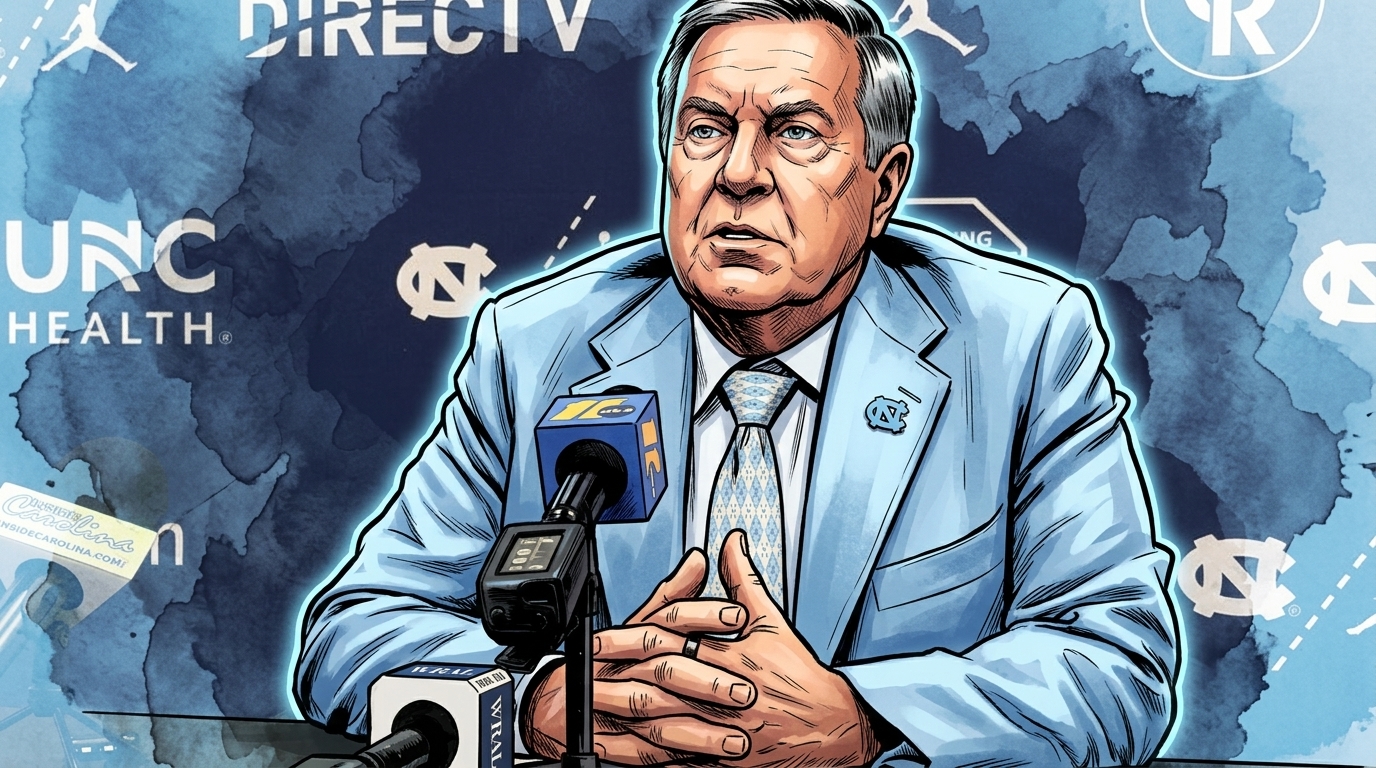

Bill Belichick stood in front of a room full of reporters last Monday and said, with a straight face, that his football program runs on an environment of compliance, and I want you to sit with how insane that sentence is coming from a man whose defensive coordinator has been on medical leave since August while outside lawyers ask around campus about drugs and player relationships. That’s not a distraction from the UNC football investigation. That’s the whole story, condensed into one press-conference non-answer, delivered by the single person in Chapel Hill with a contractual obligation to say it out loud.
Michael Lombardi, the general manager Belichick brought with him to build the North Carolina Tar Heels program from scratch, went on paid administrative leave in late July and resigned this month, saying he needed to step aside so the team could focus on the ‘26 season. He walked away owing UNC nothing under his own contract, and UNC owed him nothing back, a detail buried in the coverage of his resignation that matters more than it sounds. Nobody had to negotiate a buyout because nobody wanted this on the record any longer than it already was. Lombardi’s resignation didn’t come out of nowhere — the university had already sidelined him the moment investigators started circling his part of the building.
The specifics, as much as anyone outside Barnes & Thornburg’s billable hours actually knows them: outside attorneys are asking whether Steve Belichick, Bill’s son and UNC’s defensive coordinator, used drugs at team facilities or provided drugs to at least one player. Investigators are separately asking whether a member of the recruiting staff had a sexual relationship with a player, and whether assistant coaches got involved with recruiting staffers too. None of that is proven, and I’m not going to pretend it is. But it’s why Steve Belichick hasn’t coached a snap since August 6, on medical leave for reasons his father has declined to discuss beyond calling it a private medical situation, and why the defense has had no real boss since August.
A reporter in Chapel Hill asked the only question that mattered: did Belichick believe his program maintains an atmosphere of compliance. His answer, in full:
“Yeah, totally.”
Two words, and not even complete ones, from a 74-year-old man whose employment contract literally requires him to promote an atmosphere of compliance in this exact program. He followed it up with a line about “our high standard here of our code of conduct and doing things the right way,” a sentence you produce automatically after saying it in enough meetings that your brain no longer has to clock in for it.
Reporters kept pushing. The first thirteen minutes of that press conference were questions about Lombardi, about Steve, about the investigation, before a single person asked about ETSU. Belichick’s fallback line got just as much rotation as the compliance one: “My focus is on getting the team ready to play ETSU. I’m not involved in any other part of the process.” That’s a remarkable claim from the head coach who built this org chart from the coordinator’s chair up, about an investigation into his own son and his own hand-picked general manager. You don’t get to design the reporting structure and then plead a total absence of visibility into it.
A reporter live-tweeting the presser caught the exchange as it happened, question and non-answer both:
https://twitter.com/PatrickWelter/status/2097019864015581396
Watch it back and count how many times Belichick reroutes a question about his son’s leave into a sentence about tackling fundamentals or third-down execution. It isn’t clumsy. It’s a rerouting he’s clearly run before, and it works exactly as often as reporters let it.
Lombardi’s attorney, Tom Mars, has told anyone who’ll listen that he considers the whole review a snipe hunt with billable hours, a fantastic line from a man whose client just walked away from his return to college football rather than sit through more of it. UNC’s official position is that the university will continue its ongoing investigation and will consider all appropriate corrective actions responsive to whatever it learns, a sentence engineered entirely out of load-bearing vagueness. Lombardi needed a lawyer just to get UNC to answer a question, and when the university’s answer finally came, it was a paragraph of bureaucratic bullshit that commits to nothing.
The people actually eating this aren’t some abstract fanbase arguing about vibes on a message board. They’re the players who showed up in Chapel Hill because Bill Belichick’s name still means something, and the assistant coaches and support staff running practice every day under a coordinator who isn’t there and a general manager who no longer exists. Nobody drug-tests a freshman linebacker’s ability to focus through this. Nobody buys out his season. He’s the one taking reps for a coaching staff down its coordinator and its GM, inside a program whose head coach used his one live microphone this month mostly to talk about spacing on outside zone.
Belichick built a career on saying less than the room needed, and for two decades in New England that reticence read as discipline. In Chapel Hill it reads like something else: a coach protecting the org chart he built by talking about zone spacing while the people underneath him on it find out what compliance actually costs, one subpoena at a time. “Yeah, totally” is not a policy. It’s a deflection with a press pass.