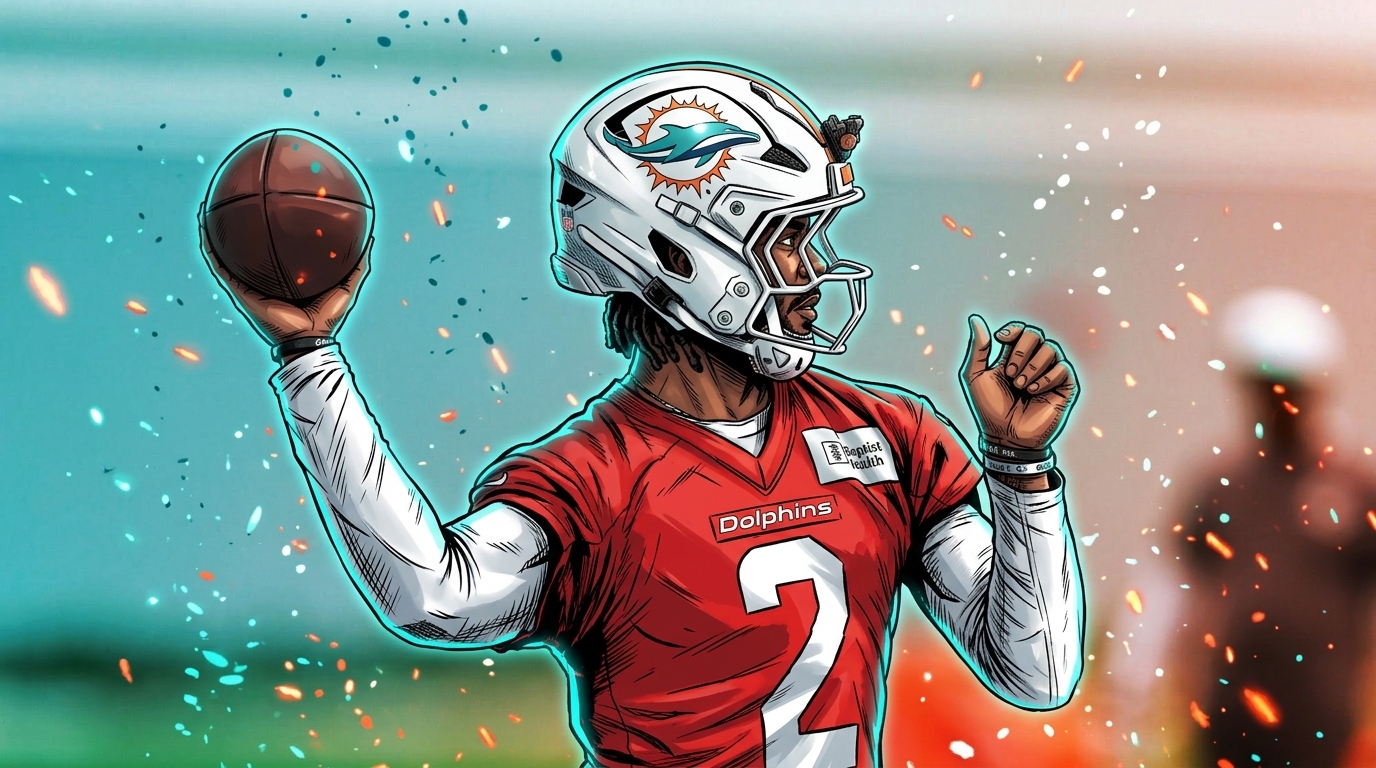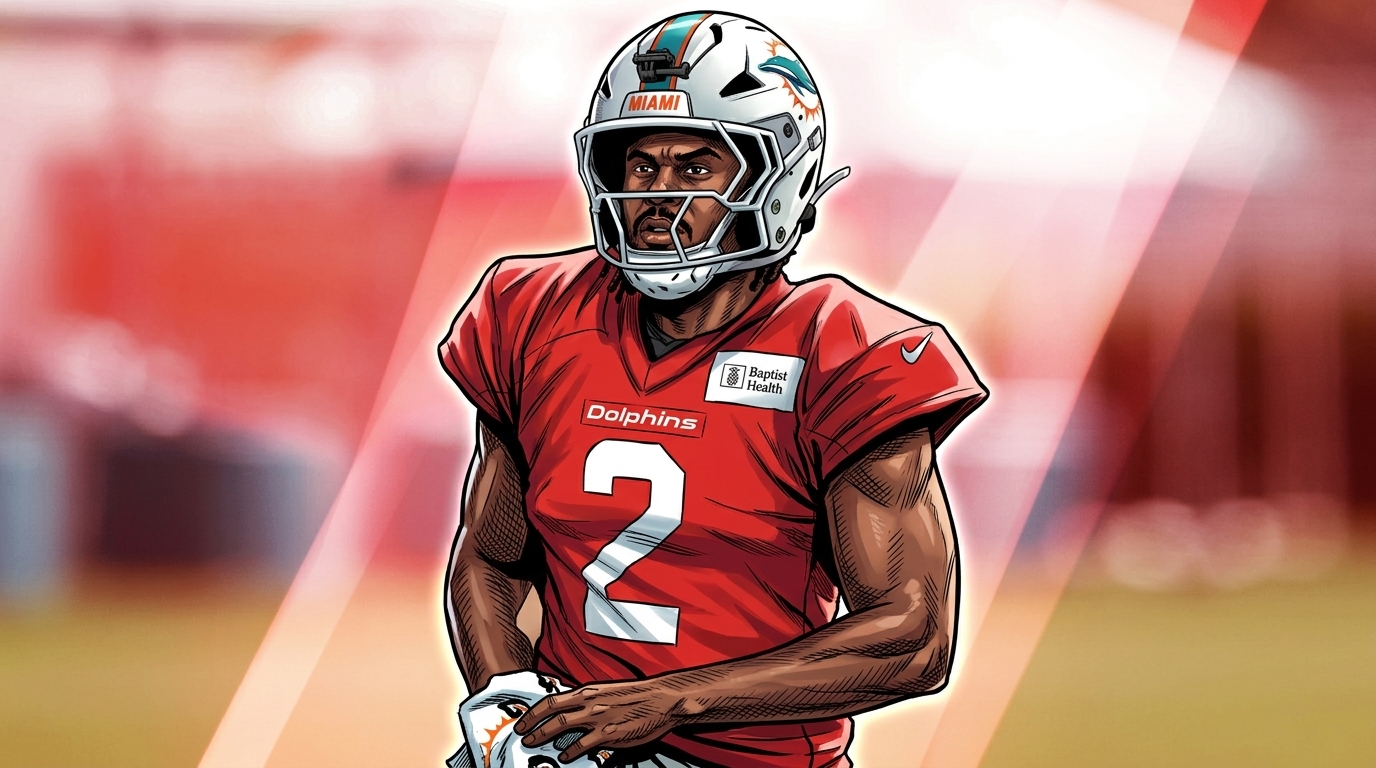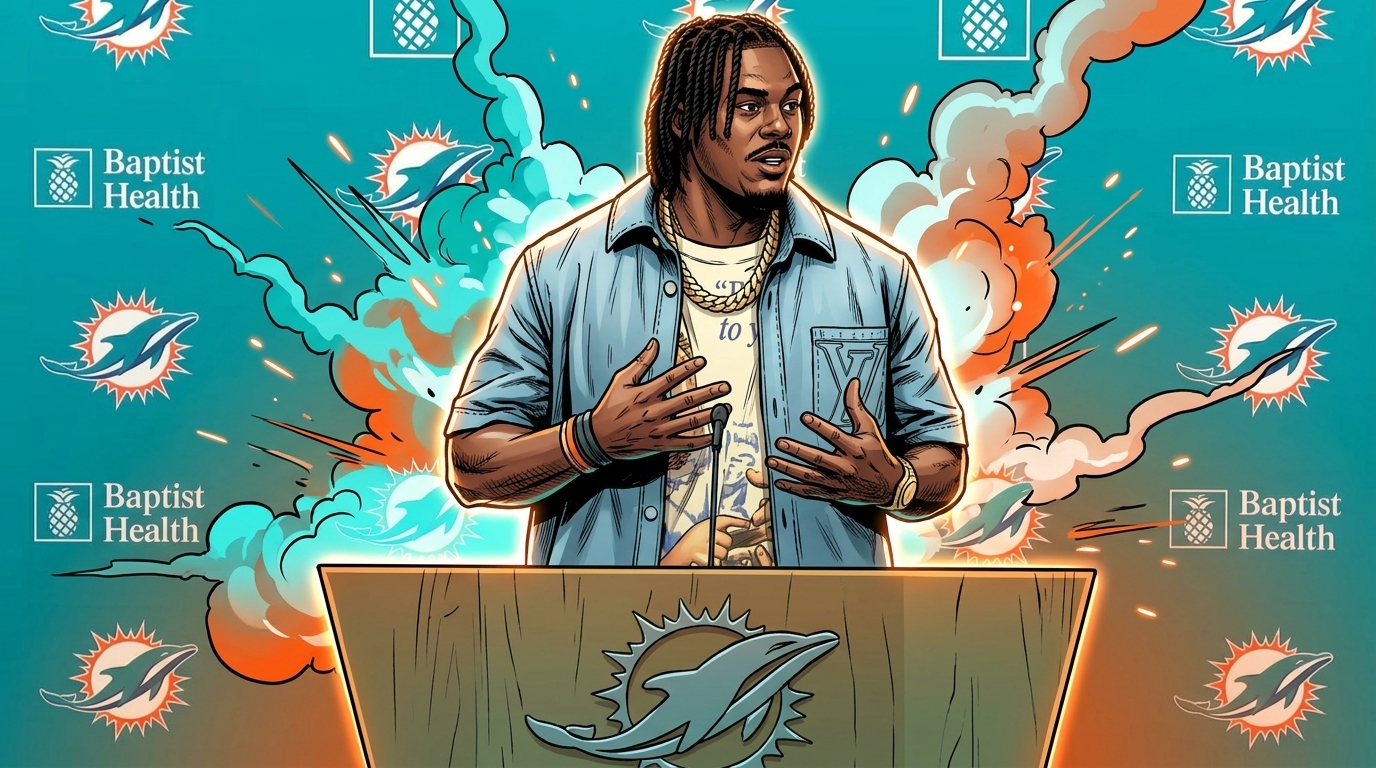

Six career starts. That’s the entire NFL résumé the Miami Dolphins had on Malik Willis when they guaranteed him $45 million in March, and it’s a small enough sample that you could argue it proves nothing at all. Fewer starts than any of last year’s rookie class (Cam Ward, Jaxson Dart, and Tyler Shough all have more) and fewer pass attempts than either of Cleveland’s two rookie quarterbacks. Miami didn’t sign Willis because six starts told them he’s good. They signed him because six starts is exactly the kind of sample that needs more time to mean anything, and they were willing to pay for that time.
That’s the frame this piece runs with: the contract wasn’t a verdict on who Willis is. It was Miami buying the runway to find out.
What Does $45 Million Guaranteed Actually Buy a Six-Start Quarterback?
It buys two full seasons, not one training camp. Strip the $67.5 million headline down to its guaranteed portion and Miami is on the hook for close to $45 million across 2026 and 2027 no matter what happens on the field: a $22.5 million signing bonus, a fully guaranteed $1.25 million 2026 salary, and a fully guaranteed $21.5 million 2027 salary. Malik Willis’s contract with Miami is built less like a one-year audition and more like a two-year lease with an option year bolted on.
Here’s how Tom Pelissero laid out the numbers:
https://x.com/TomPelissero/status/2031078160473694264
Read the breakdown closely and the shape of the bet gets clearer. That $2 million March 2028 roster bonus and $20.5 million 2028 salary aren’t guaranteed at all; Miami can walk before either one hits the books. Most backups with Willis’s résumé get one camp to win a job before a team moves on. He got two full seasons before Miami even has to make a real decision, which is a wildly different proposition than a standard prove-it deal.
The Sample Size Miami Already Had
Six starts sounds like nothing, and in raw volume it basically is. But the shape of those reps matters more than the count. Over his last two seasons as a backup, Willis completed 79% of his passes — the best mark of any quarterback with at least 50 attempts across that span, with the next-closest passer nearly seven points behind at 72%. That’s not a full season of data. It’s closer to a really good half-season stitched together from spot duty: a 9-of-11, 121-yard, one-touchdown relief outing against the Bears, then an 18-of-21, 288-yard, three-touchdown eruption (one through the air, two on the ground) against the Ravens.
Small samples lie all the time, so I ran the era’s backup-completion numbers three different ways looking for a fluke explanation — a soft slate of opponents, garbage-time inflation, something. The efficiency held up in every cut. That doesn’t make 155 career attempts a finished picture. It makes it a genuinely promising unfinished one, which is a different thing than nothing.
Is Malik Willis Actually Playing Well So Far?
Yes, through one real test. In Miami’s Aug. 14 preseason opener at Washington, Willis got a single series before the starters came out and turned it into a 93-yard, 14-play touchdown drive, completing 4 of 5 passes for 43 yards (a 102.5 passer rating) and adding 9 rushing yards on two carries.
Head coach Jeff Hafley didn’t hedge afterward, calling Willis “[e]xtremely composed and very accurate,” praising his “leadership in the huddle,” and singling out how he handled pressure: operating when the pocket broke down was, in Hafley’s words, “very clean, very very clean.” He called the whole outing “a really, really good first step, with obviously a lot to build on,” which is praise with a deadline attached, not a coronation.
Running back De’Von Achane pointed at the part of Willis’s game a stat line undersells: his legs turn a broken play into a live one. “It was also great to see him use his legs and run,” Achane said. “It’s different when you got a QB that’s dual and can make plays.” Miami lost that opener 20-7 after Washington scored 20 unanswered points once the backups took over, a reminder that one drive from one quarterback doesn’t fix a full roster. But the specific thing Miami paid for showed up in exactly the way it needed to.
Why the Runway Framing Changes the Verdict
The honest counterargument here is that six starts really is a tiny sample, and no amount of contract-structure reasoning turns 155 pass attempts into a finished evaluation. That’s fair, and it’s worth sitting with rather than waving off. A hot 79% completion clip across backup snaps can regress hard once a quarterback becomes the focal point of a defensive game plan for 17 weeks instead of a handful of series.
But that objection assumes Miami needed Willis to already be proven, and the deal was never built that way. It’s built so the proving can happen on Miami’s clock instead of a rival’s. The Dolphins are mid-rebuild under new head coach Jeff Hafley, a former Packers defensive coordinator, and GM Jon-Eric Sullivan. They released Tua Tagovailoa, absorbing close to $99 million in dead cap, and watched him land in the crowded quarterback competition he walked into in Atlanta, then moved on from Tyreek Hill in the same offseason. Oddsmakers have Miami’s 2026 win total at 4.5, second-lowest in the league ahead of only Arizona. A team picked to lose that much football isn’t rebuilding for a Week 1 verdict. It’s rebuilding for 2027 and 2028, and the guaranteed portion of Willis’s Dolphins contract lines up with exactly that window.
Quinn Ewers sits behind Willis on the depth chart as the primary backup, which tells you Miami isn’t hedging its bet so much as clearing the runway for it. Add up the efficiency numbers, the composed preseason debut, and the QB1 buzz building around Willis all camp, and the deal looks less like a gamble that already needs saving and more like a front office that priced in exactly how long good quarterbacking sometimes takes to show up on tape. Miami didn’t need Willis to already be the answer. They needed enough time to find out, and that’s precisely what $45 million bought.