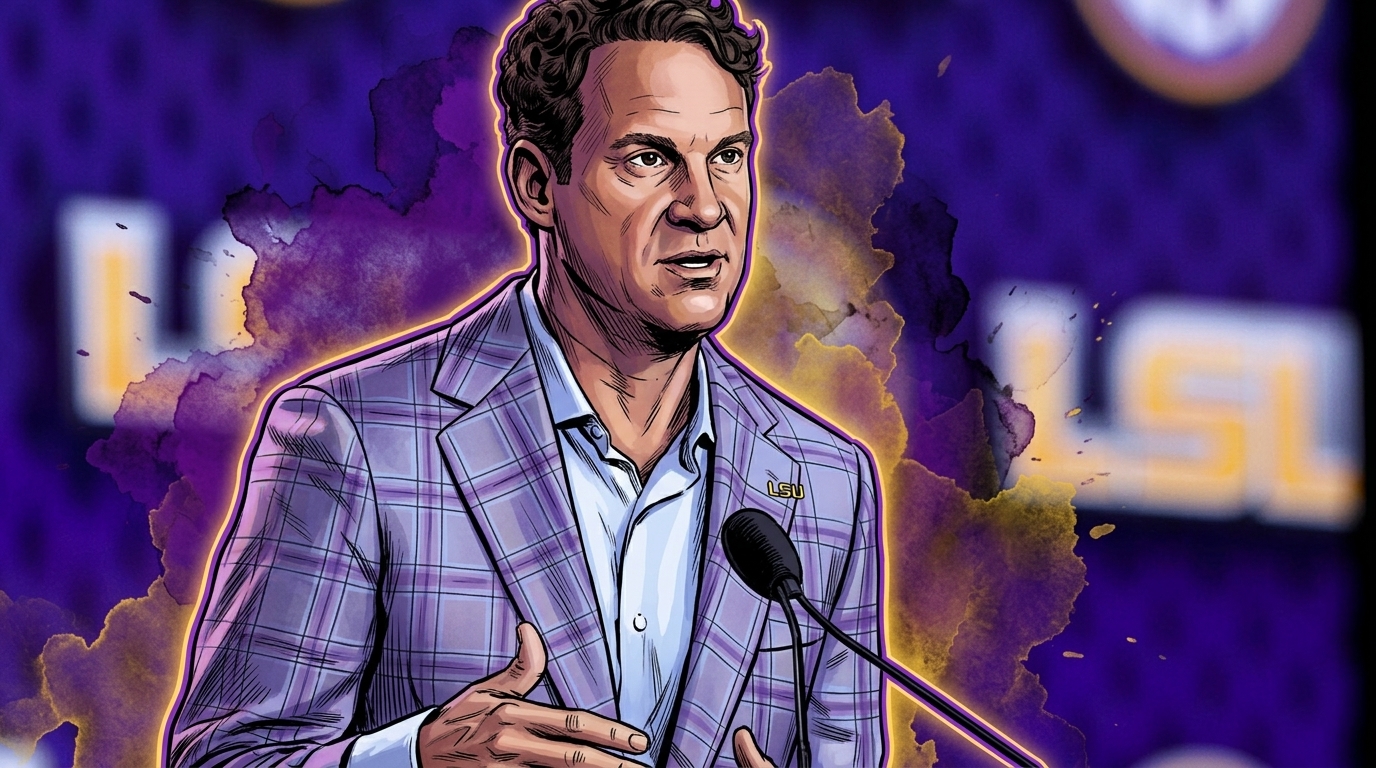

The Southeastern Conference filed a federal lawsuit this week against one of its own member schools and that member school’s head coach, which is the funniest possible way for a sixteen-team cartel to admit its rulebook is written in disappearing ink. LSU and Lane Kiffin are now defendants in a suit brought by their own conference office, filed in the U.S. District Court for the Northern District of Alabama, over Kiffin’s habit of recruiting players who already have NFL contracts. The conference didn’t send a memo, didn’t dock scholarships, didn’t bother with the usual committee theater. It hired a lawyer instead of writing another one.
The SEC’s bylaws work the way a home security system works when the sign in the yard is real but the wiring behind the drywall never got installed. Nobody tests it because nobody has reason to; the sign alone does the deterring, right up until somebody kicks in the door anyway and finds nothing but a sticker and the vague hope that manners will hold. That’s the conference’s enforcement mechanism for the rule it wrote in August 2026, banning athletes who’d already signed pro contracts from suiting up for member schools. Kiffin found the unwired door. He recruited Zxavian Harris, who’d signed with the New Orleans Saints before getting cut in August, and Dae’Quan Wright, who bounced from the Eagles to the Browns before also getting cut — both had played for Kiffin at Ole Miss, both walked right back into his building, and the conference discovered its alarm system was decorative.
Here’s the part where the sign gets tested and fails in the most on-brand way imaginable: the complaint itself. The SEC’s complaint alleges that LSU and Kiffin “waged a deliberate and coordinated campaign to recruit professional athletes to play football for LSU during the 2026-27 season, including players who had signed NFL contracts with the Cleveland Browns, New Orleans Saints, and Tampa Bay Buccaneers.” Waged a campaign. Like Kiffin ran a small, purple-and-gold shadow front office out of the Ole Miss alumni Rolodex, and the conference is furious not that he did it, but that he did it well enough to need a federal filing to stop him.
The conference’s core legal theory for controlling one of its own sixteen members is the same one a person invokes to avoid a bad Thanksgiving: freedom of association. The SEC is seeking an injunction on the grounds that it has a First Amendment right not to be forced to associate with a program that won’t follow its own rules. Somewhere between filing and hearing, the complaint quietly stopped being a bylaw-enforcement argument and became a request to be legally allowed to stop returning LSU’s calls.
News of the filing spread the way these things do now:
https://twitter.com/On3/status/2095555292859646137
Harris and Wright, for what it’s worth, already have their own separate TROs keeping them eligible, with a preliminary-injunction hearing on those set for today, the same day the SEC’s suit against LSU and Kiffin landed. Kiffin’s posture through all of it has been a shrug wearing a headset; he’s said LSU will comply with whatever the court eventually orders, while also defending the strategy as good for the players and good for the team, the position of a man who already knows he’s won the news cycle regardless of what a judge in Alabama decides. LSU still has to submit its 105-player roster 24 hours before kickoff against Clemson, and somewhere in a conference office in Birmingham, someone is refreshing a court docket instead of watching game film.
None of this hinges on Harris or Wright, or even on Kiffin specifically; it’s what happens when a conference’s power was always conversational rather than structural, propped up by the assumption that member schools wanted to stay on good terms with the people who run the television deal. LSU has enough NIL money and enough swagger not to care, and once one program proves the phone call doesn’t actually do anything, the illusion is gone for everyone else, too. That’s the real stakes buried under the recruiting-dispute framing: not whether two recently cut pro players suit up in Baton Rouge this fall, but whether the SEC’s entire self-governance model, the one built on gentlemen’s agreements and shared revenue and nobody wanting to be the school that gets sued, survives contact with a coach who has never once cared what anyone thinks of him.
The earlier chapters of this saga are still worth knowing, including the SEC’s statement on the loophole it first tried to close with words instead of filings, and the eligibility lawsuit the players filed first against the very conference now suing their coach back. LSU, for its part, spent the same week setting records for media credentials issued for its Clemson debut, which tells you plenty about which version of this story the athletic department would rather you read.
The SEC built its entire enforcement apparatus on the premise that its members would simply behave, and Lane Kiffin has now cost the conference the one thing bylaws can’t buy back: the appearance that anyone’s in charge. A judge in Alabama is being asked to do a commissioner’s job this week, and if that doesn’t sound like a conference in control of its own membership, it’s because it isn’t one.