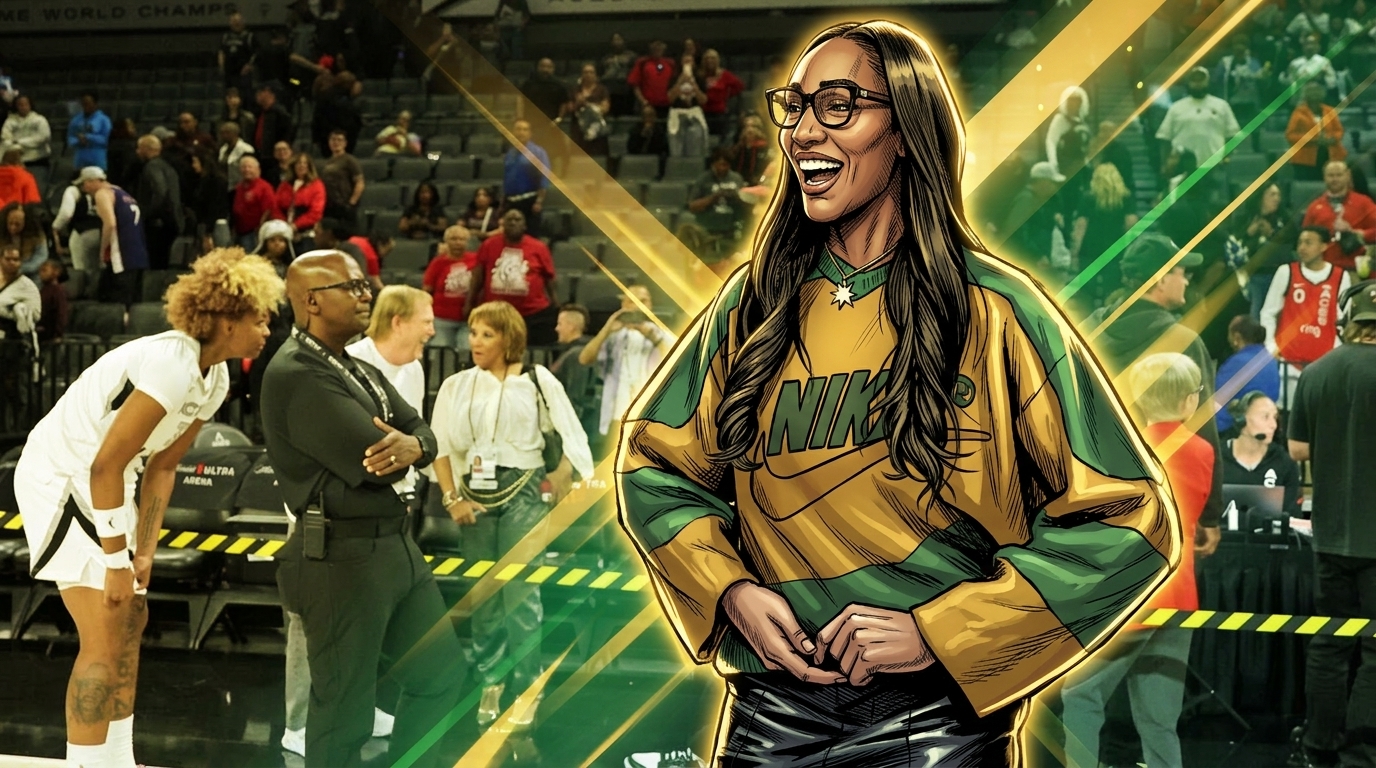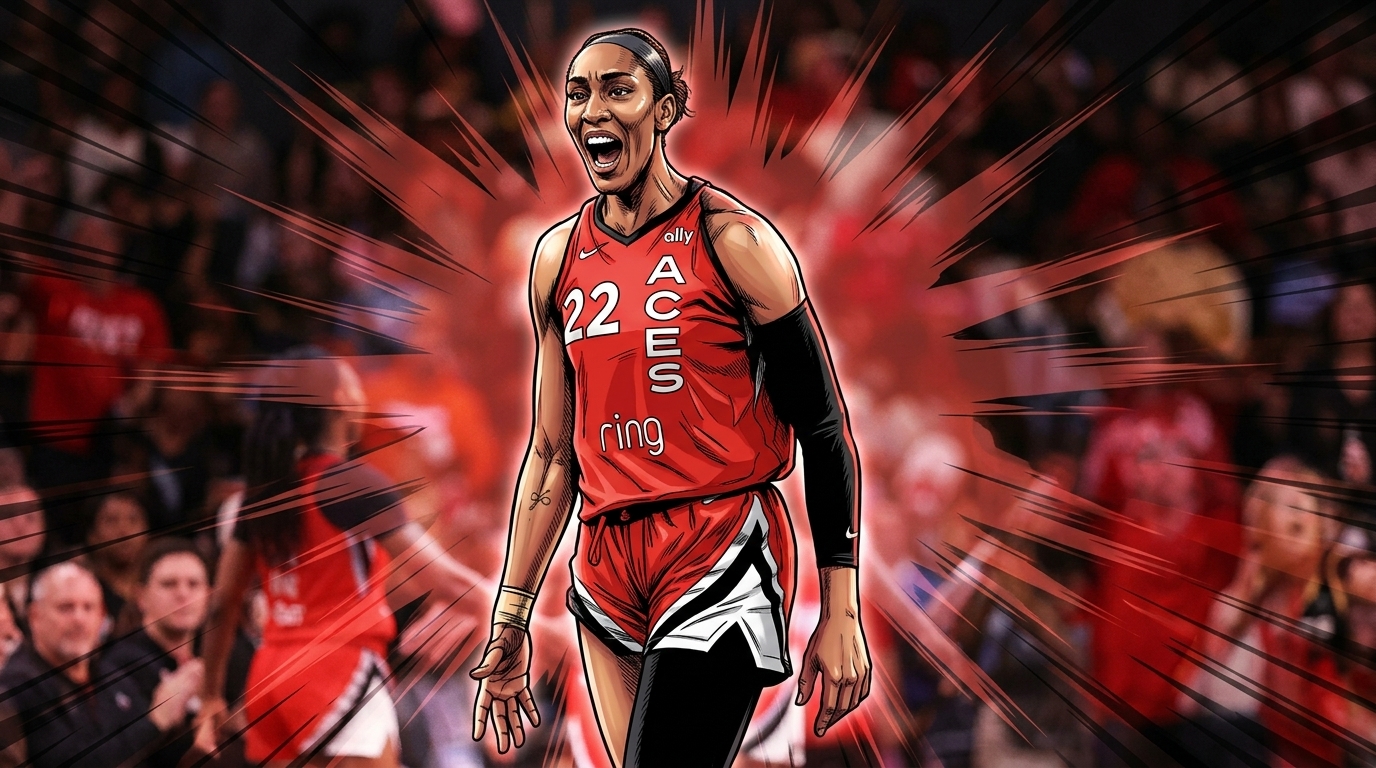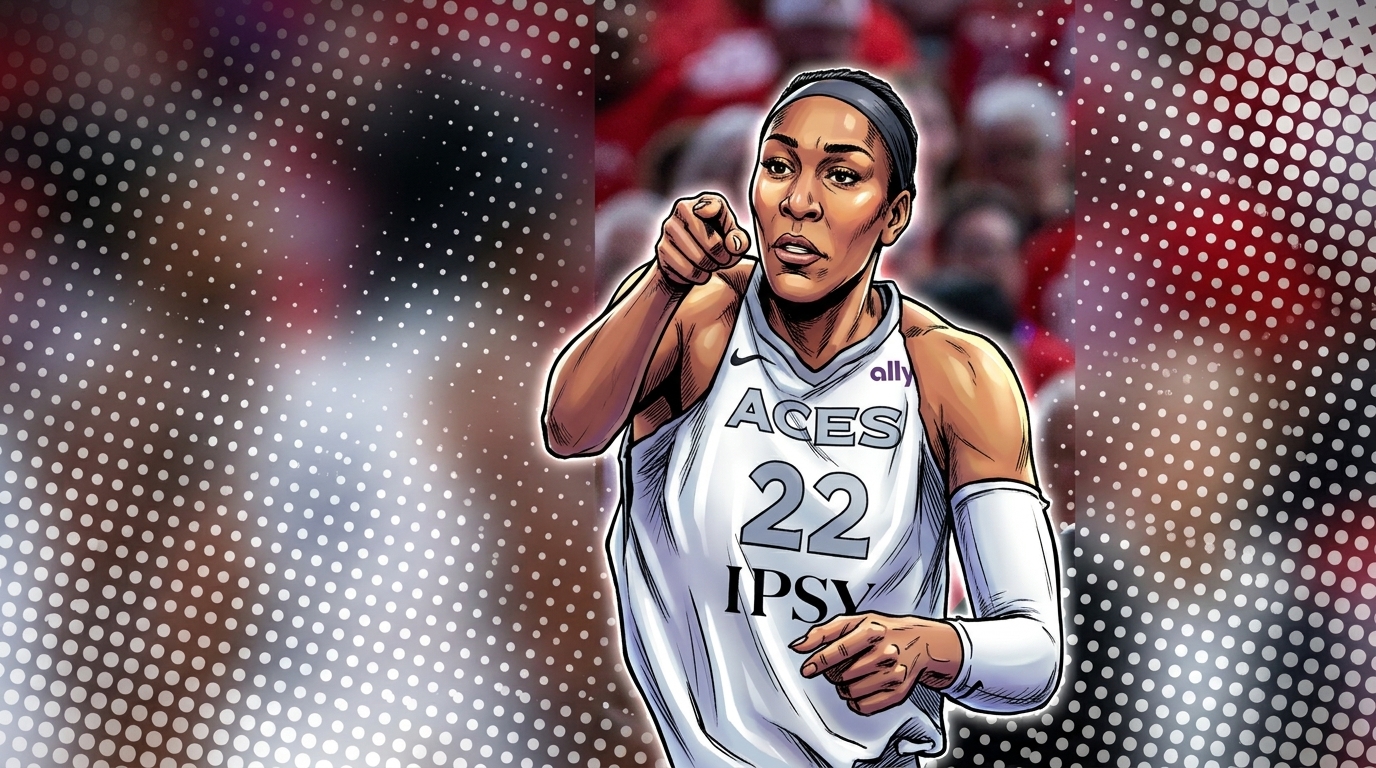

A’ja Wilson and five of her Las Vegas Aces teammates broke two separate WNBA rules within the same four minutes Tuesday night, and the league’s entire response was one technical foul and a $500 fine, the standard rate for barking at a referee over a missed call.
The scene has been replayed enough times you’ve probably seen it. With about four minutes left in a Game 2 the Indiana Fever would win 99-89 to even the series at one game apiece, Wilson, already on the court and mid-possession, was called for a foul, pulled her mouthguard, and walked toward the stands to confront a fan near the baseline who’d reportedly been pointing and shouting at her. Teammates and officials pulled her back before it went further. That fourth-quarter detour overshadowed a game that deserved better; Game 2 itself was a track meet, decided as much by who could still be trusted to guard anybody by the final buzzer as by who could score.
Wilson’s own explanation afterward was almost administrative in its bluntness: the fan had stepped toward her and pointed, and that, to her, was unacceptable. Fair enough as a human reaction. The trouble is the WNBA’s own rulebook has a section written for exactly this moment, and the league left it closed.
One technical foul. No ejection. A $500 fine that has nothing to do with this incident specifically, it’s the flat, boilerplate number attached to any technical, the same amount a player owes for talking shit to a ref during a regular-season game nobody remembers a month later. Calling it Wilson’s punishment gives the league too much credit; a fee triggered automatically by any technical isn’t discipline, it’s overhead.
Think of the WNBA’s rulebook the way you’d think of a fire extinguisher bolted to a hallway wall: inspected on schedule, photographed for the media guide, pointed at during tours as proof the building takes safety seriously. Nobody actually expects the pin to get pulled. There’s a rule that a player who deliberately enters the spectator stands is subject to automatic ejection, the first row of seats counts, and the video appears to show Wilson advancing well past it. There’s some argument about which exact row triggers the rule. There’s no argument about which pin stayed in.
The extinguisher has a second nozzle that gets mentioned less: leaving the bench during an altercation, for a player not currently in the game, carries an automatic minimum one-game suspension, no discretion built in anywhere. Five Aces players left that bench Tuesday and converged on the confrontation, Chelsea Gray, Jackie Young, Cheyenne Parker-Tyus, Kierstan Bell, and Kalani Brown among them. None of them missed so much as a shootaround. Six players, two rules, each written with a mandatory minimum precisely so no official has to use judgment in real time, and the league maneuvered around both in the same sequence anyway. An extinguisher nobody in the building has ever pulled the pin on stops being a safety feature and starts being furniture.
Even the technical itself doesn’t have a settled explanation. The crew chief called it unsportsmanlike conduct without citing a specific rule section, which is a little like a judge reading a sentence and citing vibes. Aces coach Becky Hammon told reporters officials gave her a different reason entirely: Wilson was flagged for stepping off the court, a third explanation for the same clash, and nobody in a position of actual authority can agree on which one is true.
None of this is subtle online, either. One fan-shot clip of the moment Wilson went into the stands has circulated with its own built-in commentary:
https://twitter.com/BrickCenter_/status/2105135823788405117
And the counter-read showed up almost as fast, the case that the fan did nothing worth confronting in the first place:
https://twitter.com/JonnyRoot_/status/2105147339501707713
Both readings can be true at once, and neither one is really the point. The league does know how to suspend somebody over a courtside blowup when it decides to; it’s done exactly that before. This one produced three conflicting explanations instead and a fine that wouldn’t cover the parking. Game 3 decides the series. The rulebook, it turns out, was already decided; it just never got read.