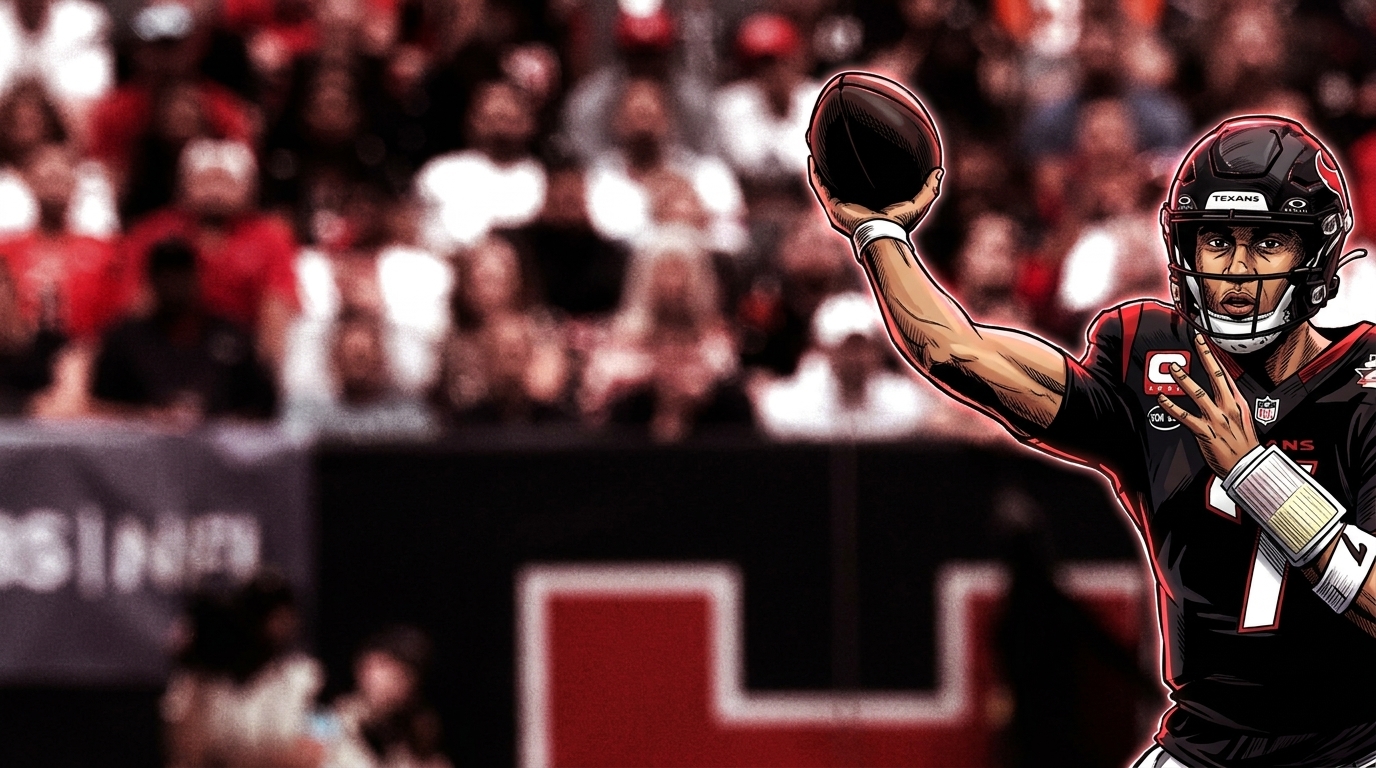

CJ Stroud is about to let a $50 million answer slip by without giving one. The Texans have set a Sept. 13 deadline, their own season opener against Buffalo, and the last five years of quarterback contracts suggest Stroud’s stall is closer to a rational market read than the reckless gamble it looks like from the outside.
That doesn’t guarantee Stroud a bigger check in 2027. The market itself has been the best thing going for him so far, and the Texans’ offer reflects where quarterback pay sat months ago, not where it’s likely to land after one more cycle of deals.
What Houston Actually Offered CJ Stroud
General manager Nick Caserio isn’t hiding the stakes. Caserio told reporters that if a deal isn’t in place before kickoff, “then it’ll be something we address in the offseason.” That’s the real deadline: a scheduling reality attached to Houston’s own season opener, not a clause buried in a contract.
The number attached to that ultimatum is roughly $50 million a year, which ESPN’s Jeremy Fowler described as putting Stroud among “the 12 quarterbacks in the $50 million club.” Twelve quarterbacks means Stroud would join a crowded top tier without resetting it to a new number. Houston’s offer keeps him inside that group instead of pushing the ceiling higher on his behalf.
This isn’t the first time Houston has bought itself time instead of committing fully. Houston already leaned on a fifth-year option instead of a deal once this year, a pattern that makes Stroud’s patience look less like stubbornness and more like a read of how his own front office operates. Stroud’s comment on the standoff was measured, not combative: “I think I’ve held my bargain up. Whatever happens, happens.” Houston already made its big offseason financial swing in May, extending edge rusher Will Anderson Jr. That was a second major decision the front office wanted to get right the first time, not an afterthought.
Is the Quarterback Market Really Still Climbing?
As of Stroud’s Sept. 13 deadline, six of the last seven ascending-QB extensions landed at or above the $52.5 million floor set in 2023, climbing as high as a $60 million ceiling in 2024 — only Brock Purdy’s 2025 deal landed flat, so the trend favors Stroud’s bet without guaranteeing it.
Here’s the actual sequence: seven deals, and all but one landed at or above the going rate at signing. Justin Herbert reset the market in July 2023 at $52.5 million a year over five years. Two months later, Joe Burrow topped that at $55 million a year, briefly the highest-paid player in football history. Trevor Lawrence matched it in June 2024, and Jordan Love matched it again a month after that. Then Dak Prescott broke the ceiling entirely, landing $60 million a year with an $80 million signing bonus, signed hours before the Cowboys’ own season opener that year. It’s the closest precedent Stroud has for negotiating against a season-opening clock. Josh Allen re-signed in March 2025 at $55 million a year with $250 million guaranteed. That’s six deals in a row at $52.5 million or above.
Then comes Brock Purdy, and this is the part of the story that keeps the bet honest instead of triumphant. His deal was advertised at $53 million a year, but once you unwind the bonus proration, the real structure is closer to $45 million a year — the first deal in this run to land at or below the prior tier instead of resetting it upward. It’s a real crack in the “always climbs” case, and pretending otherwise would be dishonest.
Ian Rapoport’s read on where that leaves Stroud lines up with the math: quarterbacks at his tier are currently landing $52 million to $55 million a year, not the $70 million some reports floated, a number Houston-market reporter Aaron Wilson has pushed back on directly.
https://twitter.com/RapSheet/status/2094926239261700369
For a sense of how far the top of this market has drifted from anything resembling performance-based pricing, the Rams just paid $55 million a year for one season of a 38-year-old quarterback. If that’s the going rate for a player on the back half of his career, the rate for a 24-year-old former Offensive Rookie of the Year has no obvious reason to fall.
Why Waiting Isn’t the Same as Risking Free Agency
But that’s not even the most interesting part of the calculation. The riskiest part of betting on yourself at quarterback is usually the threat of hitting the open market unprotected. Stroud doesn’t carry that risk. Houston already exercised his fifth-year option in April, locking in $25.9 million guaranteed for 2027 no matter what happens this fall. His actual choice is $50 million today against a guaranteed roster spot at a fixed price, while the rest of the league keeps setting comps around him.
To be fair, the counterargument is real, and it isn’t small. Stroud’s most recent season was a statistical step back from his Offensive Rookie of the Year year: a 92.9 passer rating, 3,041 yards, 19 touchdowns and 8 interceptions over 14 games, and a 72.9 PFF grade that ranked 21st among 43 qualified passers. His EPA swung from plus-35.3 in 2023 to minus-42.3 the following year, roughly the gap between a quarterback whose decisions consistently help his team and one whose decisions consistently cost it. If that decline continues into 2026, Houston’s $50 million offer stops looking conservative and starts looking generous, and Stroud loses the leverage this whole bet depends on.
Here’s where the fifth-year option changes the math, though. The downside for Stroud isn’t his job or his standing in Houston. It’s one more year on an underpriced deal before signing at whatever number the market settles on next, a far smaller bet than quarterbacks made a decade ago, when a bad platform year could cost tens of millions in career earnings. Stroud’s floor is a guaranteed roster spot. His ceiling is a market that has climbed or held its line in six of its last seven chances to reset itself.
So Is Stroud’s Bet Actually Rational?
Six of the last seven ascending-quarterback extensions landed at or above the going rate already on the books. Only Purdy’s broke that pattern, landing below it once the real structure is unwound. That’s the honest version of the trend: no guarantee, but a real lean in Stroud’s favor. And the mechanism that turns a bad bet catastrophic for most players, the risk of reaching free agency and finding no market at all, never touches him. Houston already locked in his 2027 through the option.
If Stroud plays like the quarterback Houston drafted, the number he’s chasing clears $50 million easily, and the Texans will have spent a year negotiating against a version of the market that no longer exists by the time they get back to the table. If he doesn’t, $25.9 million guaranteed is still waiting for him regardless. Somewhere in the middle of five years of quarterback pay climbing toward the salary cap’s edge, waiting stopped being a punt and became a plan. Watch the rest of the NFL contract cycle over the next year — whatever the next star quarterback signs for will say more about whether Stroud guessed right than anything he does in Week 1.