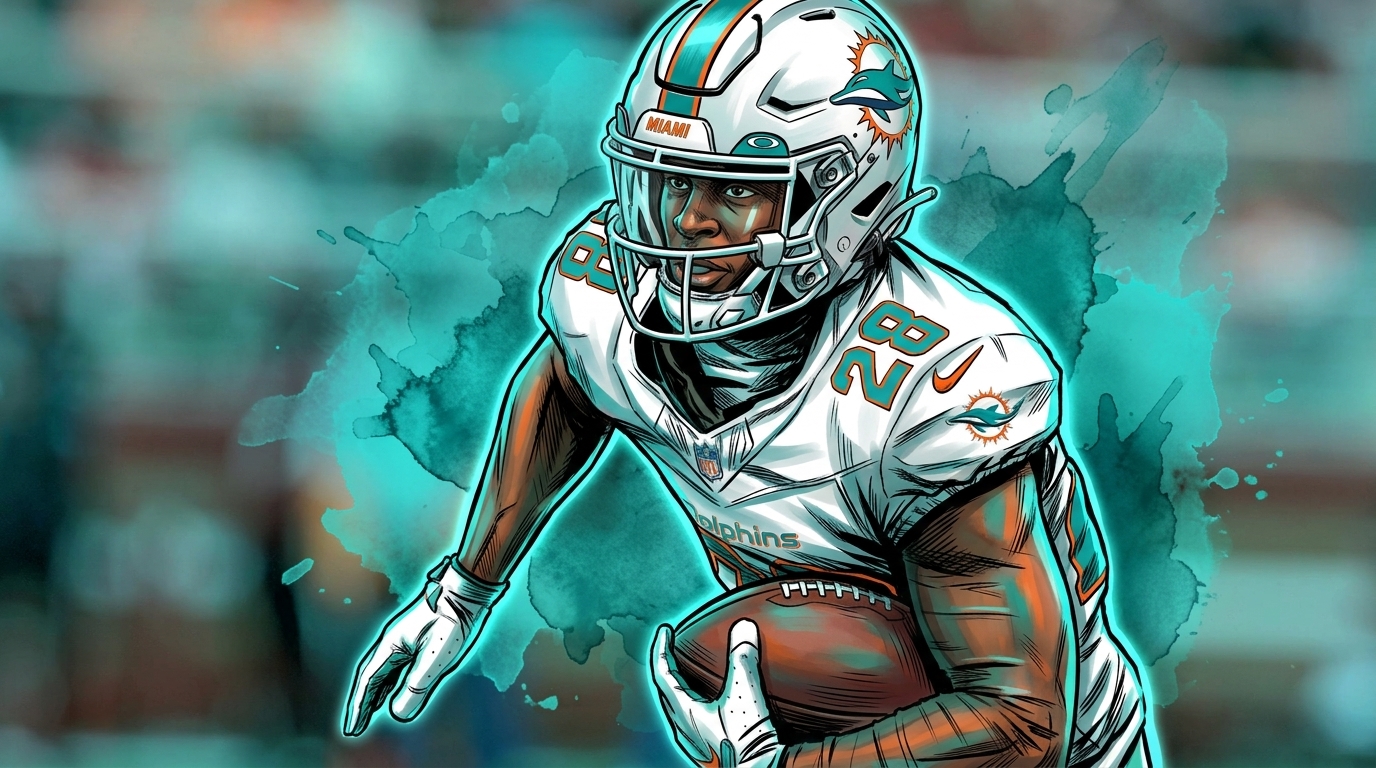

De’Von Achane’s right knee gave out on a routine cut Sunday against the Kansas City Chiefs, and by Monday it was official: a torn ACL, a season on injured reserve, and a tidy explanation for why the Miami Dolphins offense has been miserable to watch. The numbers say that explanation is about three weeks late.
Through three games, Miami scored 36 total points. That’s 12 a game, and the Dolphins never cleared 14 in any single one of them, including the 24-10 loss to the Chiefs in which Achane got hurt. They were already 0-3. None of that happened because the offense’s best weapon limped to the sideline on his third carry of the day. It happened before he ever got there this season.
What Did the Dolphins Offense Actually Look Like Before Achane’s Injury?
Genuinely bad, independent of Achane. Through three games, Miami scored 36 total points, or 12.0 per game, and sat with the fewest total touchdowns in the league. The offense hadn’t cleared 14 points in a single outing all year. Achane getting hurt didn’t create that profile. It just gave it a headline.
Three total touchdowns through three weeks is the kind of line that shows up on ESPN’s team stats page and reads like a typo. It isn’t. Twelve points a game is the difference between an offense that’s a little inefficient and one that flat-out can’t finish drives, and Miami was already on the wrong side of that line before Achane ever left the field. He wasn’t exactly torching the league on his way out, either: 127 yards on 34 carries for the season, a 3.7-yard average that’s barely two-thirds of the 5.7 yards a carry that led the NFL a year ago.
Why Achane’s ACL Tear Makes a Convenient Villain
None of that is Achane’s fault, which is exactly why the injury works as a story. He signed a four-year, $64 million extension in May, $32 million guaranteed, third among running backs behind only Saquon Barkley and Christian McCaffrey. He earned it. A career-high 1,350 yards on 238 carries in 2025, a league-leading 5.7 yards a carry, his first Pro Bowl. That’s a $64 million investment that just went down for the year, and it’s a real, sympathetic loss for a team that has plenty else to answer for.
The injury itself was about as clean a break as a torn ACL can be: he planted to cut on his third carry of the game, and his leg gave out before a Chiefs defender even got to him. He walked off under his own power. Miami placed him on injured reserve Monday. Coach Jeff Hafley said afterward it “didn’t sound very optimistic,” then softened that some in the days after: “I have a lot of confidence in these backs, so this isn’t like we can’t run the ball anymore.”
I had my second screen open to the play-by-play feed when the injury note came through, and it beat the broadcast to the story by a good ten seconds. Ian Rapoport had the same read before Miami even confirmed it:
https://twitter.com/RapSheet/status/2104579442764837228
A star running back losing a season to a non-contact injury isn’t good news for anyone, and it’s fair to feel for Achane specifically. It’s also fair to ask why an offense averaging two touchdowns’ worth of scoring a game needed him at full health just to be respectable.
Is Malik Willis or the Offensive Line the Real Problem in Miami?
Miami’s rebuild wasn’t limited to the backfield. The team released Tua Tagovailoa in March at an NFL-record $99 million dead-cap hit, sent him to Atlanta, and handed the offense to Malik Willis on a three-year, $67.5 million contract with $45 million guaranteed. That’s the two-year runway Miami bought Malik Willis to prove he belongs, and through three weeks — with Achane healthy for almost all of it — it hasn’t produced anything close to a functional scoring offense. The $67.5 million bet on Willis was supposed to stabilize the unit around Achane, not need him to cover for it.
The backfield without Achane isn’t pretty, either. Ollie Gordon II managed 41 yards and a touchdown on 17 carries against Kansas City, and Willis himself added 56 yards on nine attempts. Jaylen Wright was banged up, and the next names on the depth chart, Jarquez Hunter and Carlos Washington, are still on the practice squad. That’s a legitimate drop-off in a vacuum. It just isn’t the drop-off that explains an offense already averaging 12 points a game before the play Achane got hurt on.
What Does Miami’s Offense Look Like the Rest of the Season?
The rest of the season is going to look a lot like the first three weeks, just with less star power to point at when it doesn’t work. Gordon and Willis will absorb most of the carries, but neither one moves a 12-point scoring average by himself, and touchdowns don’t start appearing in November because a running back tore his ACL in September. If this offense is going to look different, it needs to show up in protection, play-calling and finishing drives against teams that aren’t Kansas City, not in a highlight reel of what Achane used to do.
Miami will spend the next three months pointing at his knee. The tape already knows better. This offense was broken before he ever got hurt, and it’s going to stay that way long after he’s back.