Alex Ovechkin
Alex Ovechkin, the Washington Capitals left wing, passed Wayne Gretzky in April 2025 to become the NHL's all-time goals leader and later topped 900.
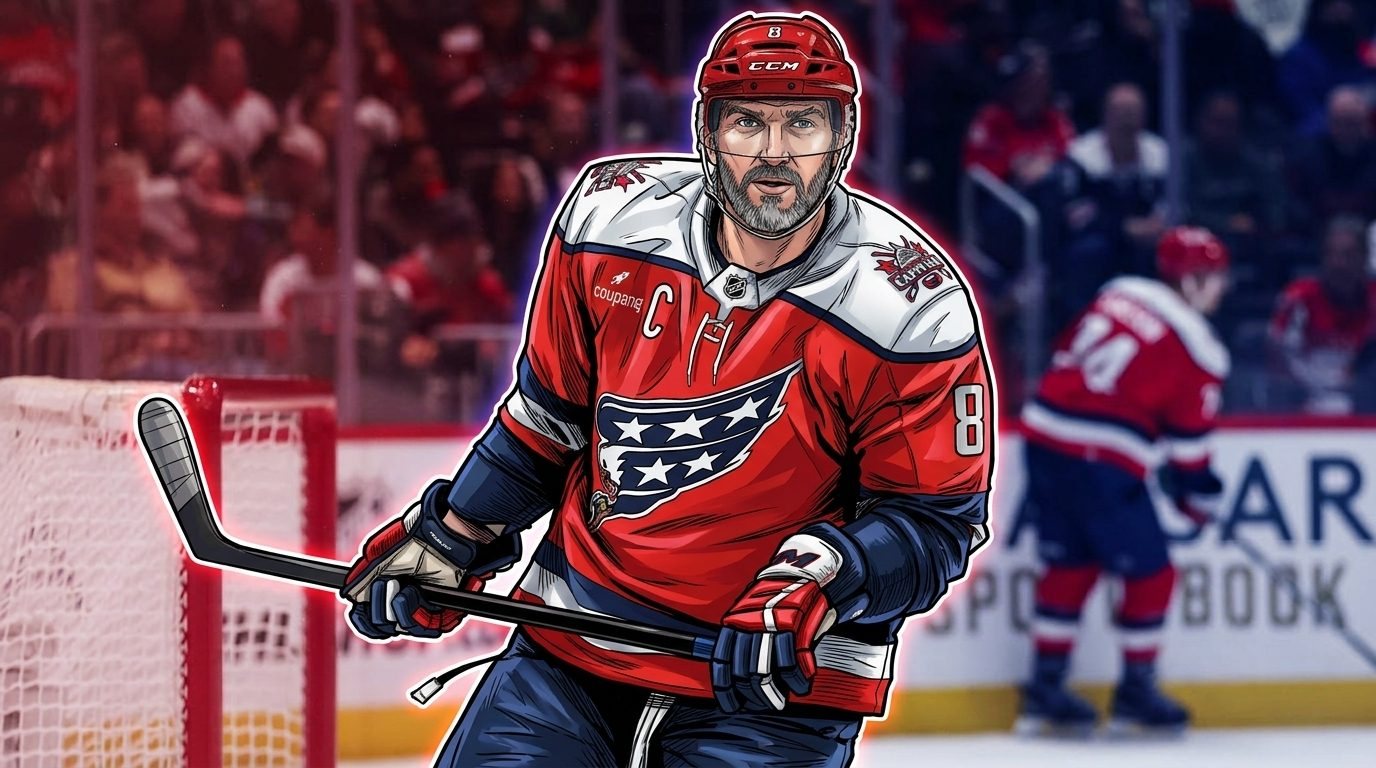
Alexander Ovechkin is the Washington Capitals left wing who, across a career spent entirely in Washington, rewrote the NHL’s most storied individual record. Taken first overall in 2004, he became the league’s all-time leading goal scorer on April 6, 2025, passing Wayne Gretzky’s 894, and later the first player to reach 900. A Stanley Cup champion, a three-time Most Valuable Player and a record nine-time goal-scoring champion, he assembled the résumé of the most prolific pure scorer the sport has produced — and on October 5, 2026 he announced that the 2026-27 season would be his last.
| Vitals | |
|---|---|
| Born | September 17, 1985, Moscow, USSR |
| Position | Left wing (shoots right) |
| Teams | Washington Capitals (since 2005) |
| Draft | 1st overall, 2004 NHL Draft |
| Status | Under contract for 2026-27; set to retire after the season (announced Oct. 5, 2026) |
| Number | 8 |
Early career
The No. 1 pick. Ovechkin was the consensus top prospect of a loaded 2004 class and went first overall to Washington, though the 2004-05 lockout pushed his debut back a year. He arrived in the NHL at 20 and announced himself immediately, scoring twice in his first game on October 5, 2005 against the Columbus Blue Jackets.
The rookie standard. His first season set a tone that never softened. Ovechkin posted 52 goals, 54 assists and 106 points in 2005-06, won the Calder Trophy as rookie of the year, and became the first rookie in 15 years named to the NHL First All-Star Team. He and Pittsburgh’s Sidney Crosby, drafted a year apart, would frame the league’s next two decades as its defining rivalry of star power.
The goals record
The chase. Gretzky’s 894 goals had stood since 1999 and was long treated as untouchable. Ovechkin entered the 2024-25 season with 853 and closed the gap over the winter. He tied the record with his 894th goal on April 4, 2025, scoring twice against the Chicago Blackhawks, then passed it two days later.
No. 895. On April 6, 2025, against the New York Islanders, Ovechkin scored the 895th goal of his career to move past Gretzky and become the NHL’s all-time leading goal scorer. He kept climbing: on November 5, 2025 he beat Jordan Binnington of the St. Louis Blues for his 900th goal, the first player in league history to reach the mark. As of October 29, 2026 he stood at 930 career goals, with Gretzky second and Gordie Howe (801) third.
The 2018 Cup
The breakthrough. For more than a decade the knock on Ovechkin was that his teams could not finish, undone repeatedly in the playoffs — most painfully by Crosby’s Penguins. Washington had reached the Stanley Cup Final only once before, a four-game sweep at the hands of the Detroit Red Wings in 1998, well before Ovechkin’s time, and the franchise had never won it. That reputation ended in 2018. The Capitals returned to the Final and beat the expansion Vegas Golden Knights four games to one, clinching with a 4-3 win in Game 5 on June 7, 2018. It was the franchise’s first championship, 44 years in the making.
The Conn Smythe. Ovechkin was named playoff MVP, leading the Capitals’ run with the kind of two-way, net-front force his critics had insisted he lacked. The title, more than any individual trophy, reshaped how his career would be read.
Trophies
The hardware. Beyond the goals mark, Ovechkin’s trophy case is among the deepest of his era. He won the Hart Memorial Trophy as MVP three times (2008, 2009, 2013) and the Art Ross Trophy as scoring leader in 2008. His signature award is the Rocket Richard Trophy, given to the league’s top goal scorer: he has won it a record nine times, including a stretch that spanned three different NHL eras. He added three Ted Lindsay Awards (2008, 2009, 2010) as the players’ choice for most outstanding, and has been selected to 13 NHL All-Star Games.
The final season
The last lap. On October 5, 2026 — 21 years to the day after his debut — Ovechkin announced that 2026-27 would be his final NHL season, closing a 22-year career spent entirely with Washington. He entered the season with 929 goals and reached 930 inside the first month, extending a record that, like the one he broke, may now stand for a generation.
By the numbers
Regular-season totals, per Hockey-Reference:
| Season | GP | G | A | PTS | SOG | +/- |
|---|---|---|---|---|---|---|
| 2005-06 | 81 | 52 | 54 | 106 | 425 | +2 |
| 2006-07 | 82 | 46 | 46 | 92 | 392 | −19 |
| 2007-08 | 82 | 65 | 47 | 112 | 446 | +28 |
| 2008-09 | 79 | 56 | 54 | 110 | 528 | +8 |
| 2009-10 | 72 | 50 | 59 | 109 | 368 | +45 |
| 2010-11 | 79 | 32 | 53 | 85 | 367 | +24 |
| 2011-12 | 78 | 38 | 27 | 65 | 303 | −8 |
| 2012-13 | 48 | 32 | 24 | 56 | 220 | +2 |
| 2013-14 | 78 | 51 | 28 | 79 | 386 | −35 |
| 2014-15 | 81 | 53 | 28 | 81 | 395 | +10 |
| 2015-16 | 79 | 50 | 21 | 71 | 398 | +21 |
| 2016-17 | 82 | 33 | 36 | 69 | 313 | +6 |
| 2017-18 | 82 | 49 | 38 | 87 | 355 | +3 |
| 2018-19 | 81 | 51 | 38 | 89 | 338 | +7 |
| 2019-20 | 68 | 48 | 19 | 67 | 311 | −12 |
| 2020-21 | 45 | 24 | 18 | 42 | 182 | −7 |
| 2021-22 | 77 | 50 | 40 | 90 | 334 | +8 |
| 2022-23 | 73 | 42 | 33 | 75 | 294 | −16 |
| 2023-24 | 79 | 31 | 34 | 65 | 272 | −22 |
| 2024-25 | 65 | 44 | 29 | 73 | 237 | +15 |
| 2025-26 | 82 | 32 | 32 | 64 | 244 | −5 |
Career totals
Ranks
- 1st Goals, NHL history (930)
- 1st Power-play goals, NHL history (331)
- 1st Game-winning goals, NHL history (141)
- 1st Shots on goal, NHL history (7,124)
Honors
- NHL all-time goals leader
- 2018 Stanley Cup champion
- 2018 Conn Smythe Trophy
- 3× Hart Trophy (2008, 2009, 2013)
- 9× Rocket Richard Trophy
- 2006 Calder Trophy
- 2008 Art Ross Trophy
- 3× Ted Lindsay Award (2008, 2009, 2010)
- 13× NHL All-Star
Per Hockey-Reference, through October 29, 2026. Leaderboard ranks: goals, power-play goals, game-winning goals, shots.
The arguments
Goals king, or the greatest ever? Passing Gretzky reopened the oldest debate in hockey. Ovechkin’s supporters argue that the single hardest record to set — most goals, the game’s scarcest and most decisive act — now belongs to him, and that no one scored more across more eras. Skeptics counter that goal-scoring is one category, not the whole game: Gretzky remains the all-time points leader at 2,857, nearly 1,200 clear of Ovechkin’s 1,691 (10th all-time), a gap built almost entirely on playmaking. The record settles who scored the most; it does not settle who was best.
Volume and the power play. A second argument concerns how the goals were scored. Critics note that Ovechkin’s totals lean on longevity and on a record 331 power-play goals, and that his 7,124 shots — also an NHL record — reflect a shoot-first role few players are given. Defenders answer that leading the league in goals nine times is not a byproduct of volume, and that scoring 50 in his age-36 season (2021-22) is evidence of a scorer who aged on his own terms.
The playoff question, answered late. For much of his prime, the case against Ovechkin was that his Capitals could not win when it mattered, bowing out of the postseason year after year. The 2018 Cup and Conn Smythe quieted that line permanently, though it remains part of how his peak years are remembered — a decade of regular-season dominance before the championship arrived.
Why it matters
Ovechkin turned a record that was supposed to be permanent into one that was merely difficult, and then cleared it by a margin that reframed what a goal scorer could do. Whether or not the points king still outranks him in the greatest-ever argument, the goals mark is the one number every hockey conversation now has to account for — and the player who holds it did it in one uniform, over 22 seasons, chasing a ghost until he became one.