Sidney Crosby
Sidney Crosby is the Pittsburgh Penguins captain and three-time Stanley Cup champion whose 1,761 points rank among the NHL's all-time scoring leaders.
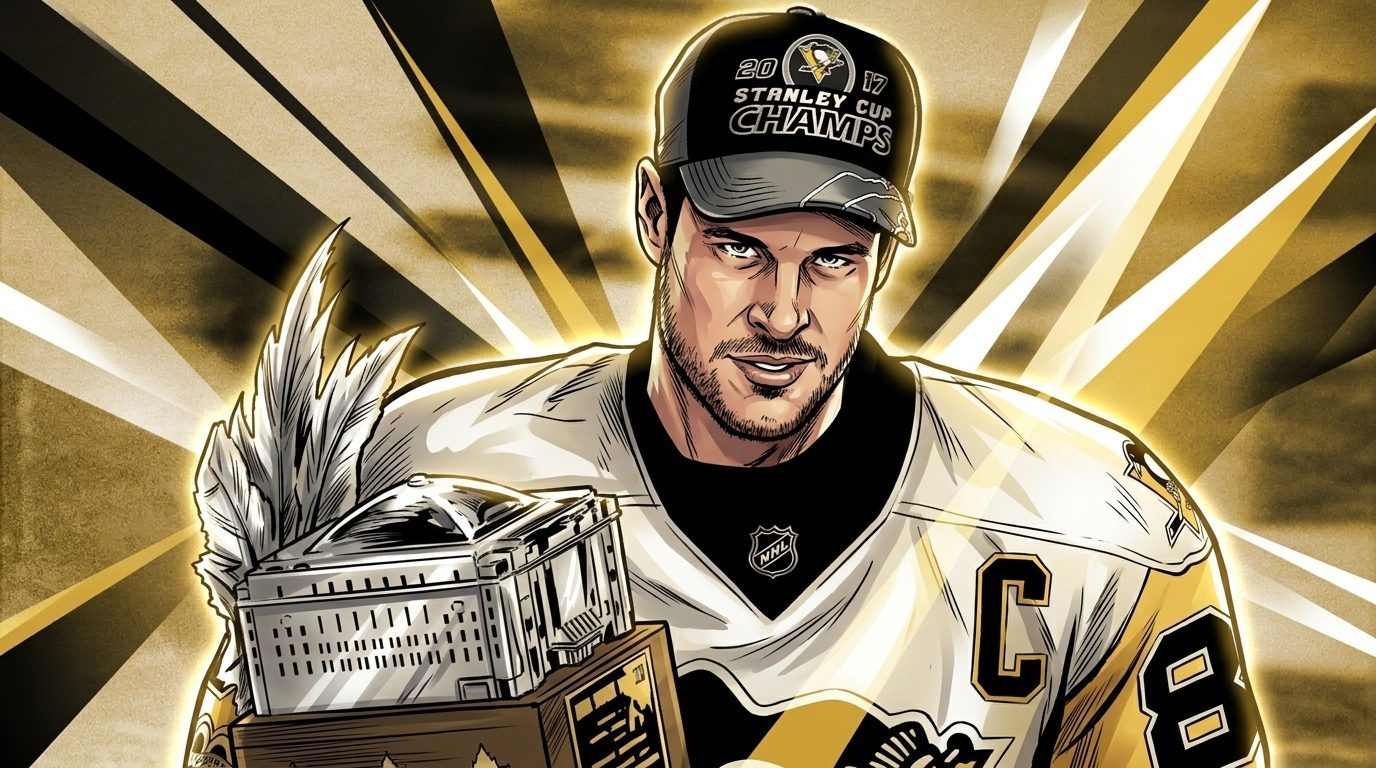
Sidney Crosby is the center and captain of the Pittsburgh Penguins, the first overall pick of the 2005 NHL Entry Draft and the defining player of his generation. Across a career spent entirely in Pittsburgh, he has won three Stanley Cups, captured two Hart Trophies as league MVP, and climbed to seventh on the NHL’s all-time scoring list. He is also the only player to captain Canada to Olympic, World Championship and World Cup gold, the distinction that made him the face of the sport internationally as well as in Pittsburgh.
| Vitals | |
|---|---|
| Born | August 7, 1987, Cole Harbour, Nova Scotia, Canada |
| Position | Center (shoots left) |
| Teams | Pittsburgh Penguins (2005–present) |
| Draft | 1st overall, 2005 NHL Entry Draft, Pittsburgh |
| Contract | Signed through 2026-27, $8.7M AAV (as of October 9, 2026) |
| Number | 87 |
Before the NHL
The phenom. Crosby arrived in the league already labeled “The Next One,” a nickname that trailed him out of minor hockey in Nova Scotia and through two seasons with Rimouski Océanic of the Quebec Major Junior Hockey League. He led Canada to gold at the 2005 World Junior Championship and was the consensus top prospect heading into the draft.
The lottery. The 2005 NHL Entry Draft followed the lost 2004-05 lockout season and was conducted by weighted lottery rather than reverse standings. The Penguins won the right to select first and took Crosby, pairing him with Mario Lemieux, in whose home Crosby lived during his rookie year. The hype was unusual; the follow-through was more unusual still.
Pittsburgh Penguins: the rise
The arrival. Crosby posted 102 points as an 18-year-old rookie in 2005-06, finishing as Calder Trophy runner-up. One year later he won the Art Ross Trophy with 120 points and the Hart Trophy as league MVP, becoming the youngest scoring champion in league history. On May 31, 2007, Pittsburgh named him captain at 19, then the youngest captain in NHL history to wear the “C” full-time — a distinction later passed to Gabriel Landeskog in 2012 and then Connor McDavid in 2016.
The first Cup. The young Penguins reached the Stanley Cup Final in 2008, lost to Detroit, then returned in 2009 and beat the Red Wings in seven games. Crosby, at 21, became the youngest captain to win the Stanley Cup. Months later he scored the overtime “Golden Goal” that won Canada gold at the 2010 Vancouver Olympics.
The prime and the injuries
The ceiling. In 2009-10 Crosby scored a career-high 51 goals, sharing the Maurice Richard Trophy. His peak form, though, collided with his health: a pair of hits in January 2011 produced a concussion that cost him most of two seasons, limiting him to 41 games in 2010-11 and 22 in 2011-12. The absence reframed every conversation about him around durability.
The return to the summit. Crosby answered with a second Hart and a second Art Ross in 2013-14, then anchored the Penguins’ back-to-back championships in 2016 and 2017. He won the Conn Smythe Trophy as playoff MVP in both runs, the third player ever to take it in consecutive years, and added the Richard Trophy in 2016-17. In between he captained Canada to gold at the 2014 Sochi Olympics and the 2016 World Cup of Hockey, where he was named most valuable player.
Longevity and the climb
The grind. From 2017-18 onward Crosby became a study in sustained excellence rather than peak dominance, clearing 90 points in most full seasons into his late thirties. He reached 100 points again in 2018-19 and posted 94 in 2023-24 at age 36, keeping his scoring pace remarkably flat as the roster around him turned over.
The milestones. The longevity carried him up the all-time leaderboards. He passed Mario Lemieux to become the Pittsburgh franchise leader in points and assists, and by the start of the 2026-27 season he had moved into seventh place on the NHL’s all-time scoring list. He signed a two-year, $17.4 million extension on September 16, 2024 carrying an $8.7 million cap hit — a figure echoing his birthdate and jersey number — and keeping him in Pittsburgh through 2026-27. He captained Canada again at the 2026 Milan-Cortina Olympics, where the team took silver after a 2-1 overtime loss to the United States; Crosby did not dress for the final after a lower-body injury in the quarterfinal.
By the numbers
| Season | GP | G | A | PTS | +/- |
|---|---|---|---|---|---|
| 2005-06 | 81 | 39 | 63 | 102 | -1 |
| 2006-07 | 79 | 36 | 84 | 120 | +10 |
| 2007-08 | 53 | 24 | 48 | 72 | +18 |
| 2008-09 | 77 | 33 | 70 | 103 | +3 |
| 2009-10 | 81 | 51 | 58 | 109 | +15 |
| 2010-11 | 41 | 32 | 34 | 66 | +20 |
| 2011-12 | 22 | 8 | 29 | 37 | +15 |
| 2012-13 | 36 | 15 | 41 | 56 | +26 |
| 2013-14 | 80 | 36 | 68 | 104 | +18 |
| 2014-15 | 77 | 28 | 56 | 84 | +5 |
| 2015-16 | 80 | 36 | 49 | 85 | +19 |
| 2016-17 | 75 | 44 | 45 | 89 | +17 |
| 2017-18 | 82 | 29 | 60 | 89 | 0 |
| 2018-19 | 79 | 35 | 65 | 100 | +18 |
| 2019-20 | 41 | 16 | 31 | 47 | -8 |
| 2020-21 | 55 | 24 | 38 | 62 | +8 |
| 2021-22 | 69 | 31 | 53 | 84 | +19 |
| 2022-23 | 82 | 33 | 60 | 93 | +8 |
| 2023-24 | 82 | 42 | 52 | 94 | +7 |
| 2024-25 | 80 | 33 | 58 | 91 | -20 |
| 2025-26 | 68 | 29 | 45 | 74 | 0 |
Career totals
Ranks
- 7th Points, NHL all-time history (1,761)
- 1st Points, Penguins franchise history (1,761)
- 1st Assists, Penguins franchise history (1,107)
- 1st Games played, Penguins franchise history (1,420)
- 2nd Goals, Penguins franchise history (654)
Honors
- 3× Stanley Cup champion (2009, 2016, 2017)
- 2× Hart Trophy (2007, 2014)
- 2× Conn Smythe Trophy (2016, 2017)
- 2× Art Ross Trophy (2007, 2014)
- 2× Maurice Richard Trophy (2010, 2017)
- 3× Ted Lindsay Award (2007, 2013, 2014)
- 2× Olympic gold medalist (2010, 2014)
- Triple Gold Club member
Per Hockey-Reference, career points leaders and Penguins franchise leaders, through October 9, 2026.
The arguments
Greatest of his generation? For most of his career the debate was framed as Crosby versus Alexander Ovechkin, the two first-overall picks taken a year apart who came to represent opposite templates — Crosby the two-way playmaker and champion, Ovechkin the record-chasing goal scorer. Crosby’s supporters point to the three Cups and two Conn Smythes; Ovechkin’s point to the goal record Crosby never approached. The reference totals frame rather than settle it: Crosby finished with more career points, Ovechkin with far more goals.
What the injuries cost. A second strand of debate concerns the 2011-12 concussion years. One view holds that the lost games, documented in his game logs, kept Crosby from a scoring total that might have challenged the all-time leaders rather than settling in the top ten. The counterview notes that he returned to win two more MVP-level seasons and two more Cups, and that the concussion era reshaped the NHL’s approach to head injuries in part because of how public his was.
The captaincy case. A third argument, harder to quantify, concerns leadership. Advocates cite his status as the only Triple Gold Club captain and the Penguins’ sustained contention; skeptics note that peak Pittsburgh was also built around Evgeni Malkin and Kris Letang, and that team success is never one player’s to claim.
Why it matters
Sidney Crosby’s case rests on the rare combination of immediate stardom and extended durability: he met impossible expectations as a teenager, lost prime years to concussions, and still assembled a résumé of three championships, two MVPs and a top-seven scoring total built over two decades with a single franchise. Whether or not the generational debates ever resolve, the record he compiled in Pittsburgh — franchise-leading, Cup-winning and internationally decorated — is the kind that settles arguments rather than starting them.