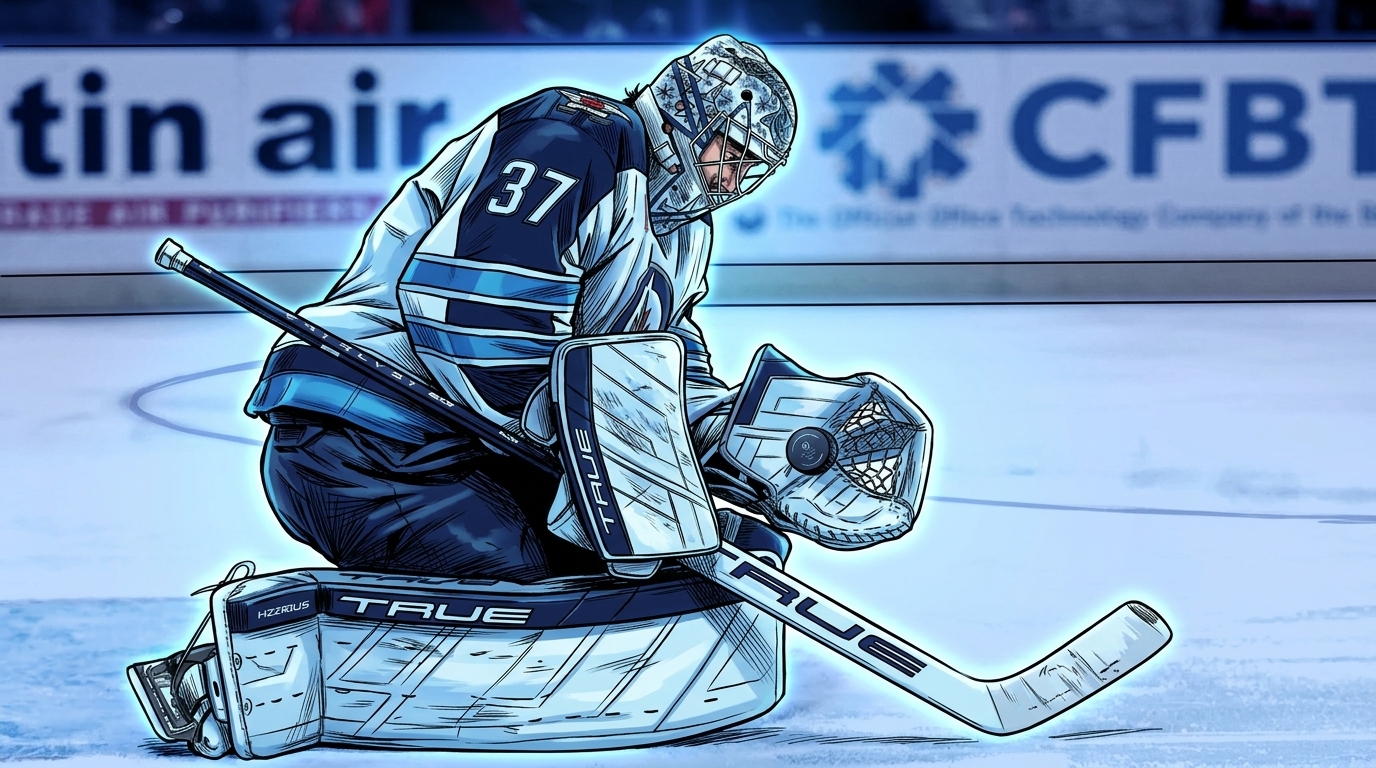

We’re closing in on two weeks since Connor Hellebuyck’s trade request went from open secret to official statement, and in that stretch, exactly two teams have shown their actual hand. Florida spent its trade capital on Brady Tkachuk instead. Buffalo said no to a Winnipeg framework in June, then said no to a different one in July. Nobody else linked to this deal has done anything but get named in a rumor roundup.
Hellebuyck confirmed the request publicly on August 27, through a statement from his agent, Ray Petkau, after asking privately for months. His own words made clear this isn’t a shot at the organization: “Winnipeg has been my home for my entire NHL career, and I will always be grateful.” Then the part that actually matters to Cheveldayoff’s summer: “My position has not changed, and I believe moving on is the best path forward for me and my family.”
He holds a full no-movement clause through this season, meaning he could technically sit in Winnipeg’s crease against his own wishes and there would be nothing anyone could do about it. He’s not doing that. Per Chris Johnston’s reporting, Hellebuyck is willing to waive the clause for a variety of teams: the holdup was never permission, it’s price. (Kevin Cheveldayoff has fielded actual offers from Buffalo and Carolina, among others, and simply hasn’t felt strongly enough about any of them to say yes.) Winnipeg spent the summer asking for a return nobody’s matched yet.
Who’s Actually in on Connor Hellebuyck?
Six teams are publicly linked to Hellebuyck: Buffalo, Carolina, Florida, New Jersey, San Jose, and Vegas. But Florida already spent its trade capital on Brady Tkachuk, and Buffalo has rejected two separate Winnipeg frameworks. That leaves four teams whose actual interest has never been tested with a real offer.
The six-team list comes from a Yahoo Sports Canada rumor roundup, and it reads better than it holds up. Florida is the easiest to cross off. The Tkachuk trade itself cost Ottawa’s captain two 2026 first-round picks, a 2027 first, and a 2030 second, which is roughly the entire budget a team gets to spend on one blockbuster in a summer. We covered Florida’s exit from the market in more detail after that trade closed, and nothing about the Panthers’ cap sheet has loosened since. New Jersey, San Jose, and Vegas remain names on a list, not parties to a negotiation anyone has described in any real specifics.
Buffalo is the team that’s actually put something on the table, twice, and gotten told no both times. That’s the strongest evidence available for what Winnipeg is asking, and for what still isn’t enough.
Why Has Winnipeg’s Asking Price Already Failed Twice?
Before this year’s draft, Winnipeg asked Buffalo for the fourth overall pick while keeping its own first-rounder; Buffalo said no. In July, Winnipeg asked for winger Zach Benson instead; Buffalo said no again. Both frameworks tested the market at Winnipeg’s own number, and both died there.
Those are two different asks, not one rejection retold twice. Before the draft, per reporting citing Elliotte Friedman, Winnipeg wanted Buffalo’s fourth overall pick while holding onto its own first-rounder, and Buffalo passed. In July, the ask shifted to winger Zach Benson, and Buffalo said no to that too; we covered that rejection when Sportsnet’s Nick Kypreos reported it on Real Kyper & Bourne. (Two different players, two different frameworks, same answer both times.) Then July 1 made the math worse: teams reset their no-trade lists league-wide, and Buffalo goalie Ukko-Pekka Luukkonen’s five-team no-trade clause now blocks him from being part of any package to Winnipeg, narrowing exactly what Buffalo has left to offer.
Darren Dreger’s read on the market this week matches the pattern: activity, but nothing close. He posted on X:
https://twitter.com/DarrenDreger/status/2072297693787914261
Carolina staying in that conversation, rather than dropping out like Buffalo’s two dead frameworks, is the one piece of actual forward motion here. Elliotte Friedman put the broader stall more bluntly on NHL Network, saying he still expects a deal eventually, adding it “could be one of those things that picks up closer to training camp.” Quiet isn’t the same as dead. It’s also not the same as close.
There’s a bitter joke buried in the timeline here. Hellebuyck’s last full season was the best of his career: a 47-12-3 record, a 2.00 GAA, a .925 save percentage, eight shutouts in 63 games, a second straight Vezina Trophy, and the Hart Trophy too, the first goalie to win both in the same season since Carey Price did it in 2014-15. (Try explaining to a Winnipeg fan why the reigning MVP wants out after one bad season.) Then came the crash: a career-worst .895 save percentage, missed time to injury, and a Jets team that didn’t make the playoffs at all. Hellebuyck still won Olympic gold with Team USA in February. None of that irony changes the mechanics of the trade market, but it explains why Winnipeg feels no urgency to sell at a discount.
If Winnipeg actually moves him, the in-net alternative isn’t pretty. The names on the table are free agents Connor Ingram and Cam Talbot, or a trade for San Jose’s Yaroslav Askarov. None of those is a lateral move from a three-time Vezina winner, even a struggling one. That gap is Winnipeg’s leverage problem as much as it is Buffalo’s or Carolina’s: whoever gets Hellebuyck upgrades immediately, and whoever loses him needs a real answer in net by camp, not a placeholder.
Here’s the actual signal underneath all the names: the delay itself is the information. Two of six reported suitors have already shown their hand, and neither is coming back. Florida chose Tkachuk. Buffalo tested Winnipeg’s price twice, with two different players, and walked away both times. A goaltender with a full no-movement clause, sitting on a public trade request for coming up on two weeks with camp about to open, is negotiating from a position that’s already been tested in the market and found too expensive. Nothing reported since August 27 shows Winnipeg’s number has moved.
I think this drags past the start of camp. Cheveldayoff has shown all summer that he’d rather sit on an unhappy franchise goaltender than sell him at what the market’s actually offering, and nothing about two rejected frameworks changes that calculus. Carolina remains the most live conversation, per Dreger, and Friedman’s framing of the market picking up “closer to training camp” suggests both sides know the real pressure point is still ahead, not behind. But knowing where the pressure point is and being willing to cave to it are different things, and Winnipeg’s behavior since June suggests it’s willing to let this sit uncomfortably into the season if nobody meets its price.
Watch what Winnipeg actually does in net once camp opens, not what it says. If Stuart Skinner or a camp fill-in gets real starts in the opening week, that’s a team preparing to play the long game with an unhappy Vezina winner still on the roster. If the phone starts ringing with a number Buffalo or Carolina hasn’t already offered and had rejected, that’s the actual trade. Everything else, including the other four names on that suitor list, is still just a list.