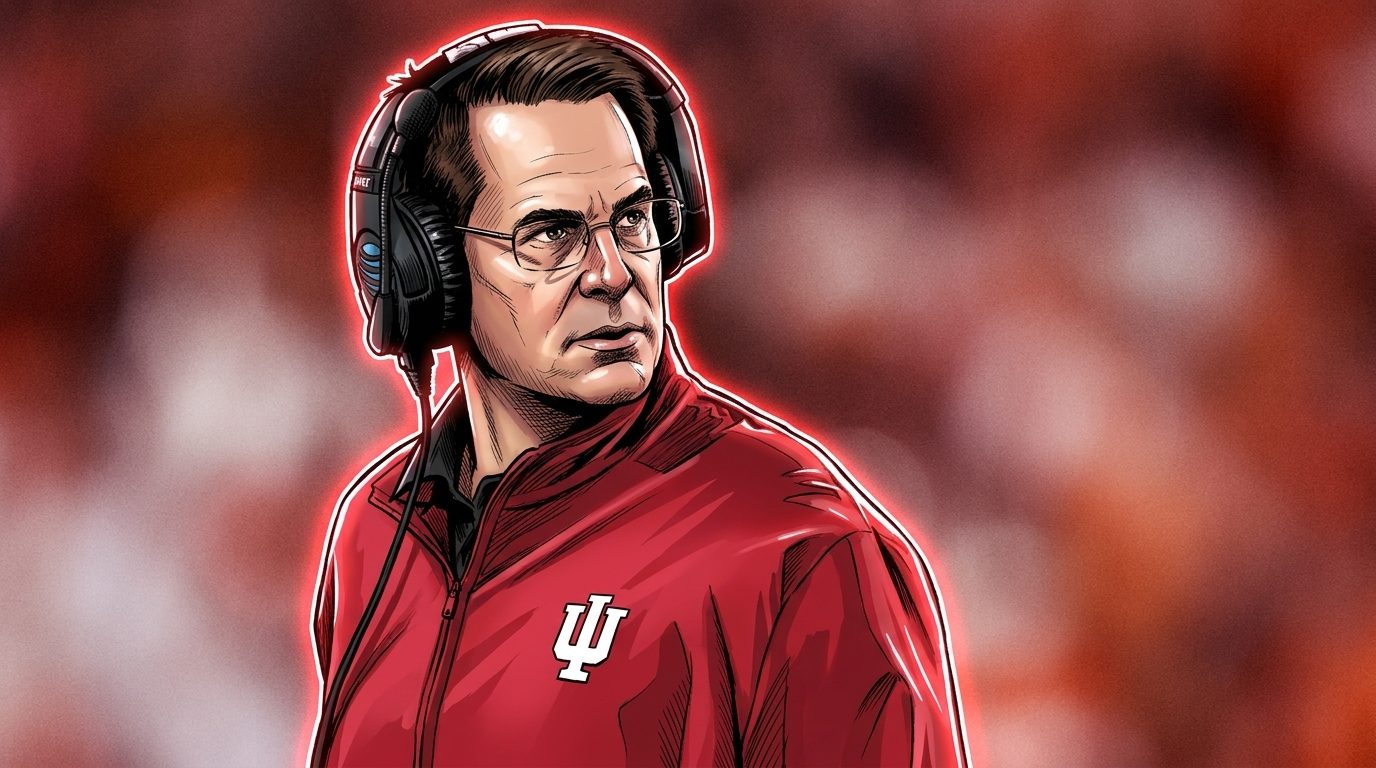

A coach who changes his kicker and his quarterback inside one game is publishing a depth chart in real time. Curt Cignetti did both at Husky Stadium on Saturday, and Washington still won 27-24 in overtime, dropping the sixth-ranked Hoosiers to 9-2 overall and 6-2 in the Big Ten. Two position changes, one result, and the kicking change is the one with a history.
Why did Indiana lose to Washington?
Indiana lost because Washington made the last kick and Indiana did not. Tyler Robles hit a 46-yard field goal in overtime after Paddy McAteer’s 37-yarder was tipped wide earlier in the extra period. Washington also outgained the Hoosiers 443-392, so the overtime result was no fluke of the scoreboard.
The yardage gap points to where the game leaked. Demond Williams Jr. went 24-of-41 for 227 yards and a touchdown and added 88 rushing yards and a score. A defense that spends the afternoon chasing a quarterback who both throws and runs hands its offense and special teams a smaller margin for error. Indiana needed clean kicking, and it did not get it.
What did the kicker switch tell us?
It suggests Cignetti no longer trusted Nico Radicic with a close game. Radicic’s field goal attempt was blocked in the third quarter by Washington lineman Drew Azzopardi, and Cignetti went to McAteer from there. Afterward he acknowledged that Indiana has missed too many field goals this year.
That admission is the closest thing to a diagnosis in the postgame record, and it is not a new one. On Oct. 31 against Minnesota, Radicic had already missed a pair of kicks when Cignetti went to McAteer for the 60-yarder that forced overtime. McAteer is a kickoff specialist, which says how thin the options were.
https://twitter.com/CBSSportsCFB/status/2116669557020766655
Line the two games up and the Washington move stops looking like an in-game adjustment. It was the second time in three weeks that Cignetti pulled his kicker in a spot where points were needed. The first time, the replacement made a 60-yarder. The second time, the replacement’s 37-yarder was tipped wide in overtime. One call worked and one did not, but the pattern matters more than either outcome: Radicic’s kicks failed in both games, and Cignetti has said Indiana has missed too many field goals.
A blocked kick is a different kind of miss than a wide one. It can come from protection, snap and hold timing, or the trajectory of the kick itself, and the coverage does not say which one went wrong. What it does say is that a Washington lineman got a hand on the ball at a moment Indiana needed three points.
What does the quarterback swap say?
It says Cignetti was willing to change quarterbacks even after a start that opened perfectly. Grant Wilson threw a 74-yard touchdown to Charlie Becker on the first play, then finished 8-of-16 for 119 yards. Josh Hoover replaced him in the third quarter and went 7-of-13 for 121 yards with a 35-yard touchdown to Nick Marsh.
No reason for the change appears in the coverage. The numbers allow a narrower read. Hoover threw three fewer passes, completed a slightly higher share of them and gained two more yards than Wilson did. The 74-yarder to Becker was the single biggest play either quarterback produced, and the remaining 15 Wilson attempts produced 45 yards.
That last figure is just arithmetic on the box score: 119 yards minus 74 leaves 45 across the other attempts. It does not prove Wilson was the problem, and it does not prove Hoover was the answer. It shows an offense that found one huge play early and then needed a steadier supply of smaller ones.
Cignetti said Washington “made one more play” and called it a “great win for them.” That reads like a coach who sees a margin, not a collapse, and in a game that went to overtime and turned on a tipped kick, the margin was exactly that thin.
What the two moves have in common
Both changes came from the same instinct: when a unit stalls, replace the person and keep the plan. That works when the replacement is better. It works less well when, as with the kicker, the replacement is a kickoff specialist asked to cover a different job, and when, as with the quarterback, the replacement posts a solid but unspectacular line.
Special teams decides close games with no schedule to hide behind. A defense can cover a quarterback’s bad half, and an offense can cover a defense’s, but a field goal is a one-person job with a protection unit around it. When that job is in doubt, every other unit has to be a little better to compensate.
What it costs Indiana
The loss clouds the path to a Big Ten title game. Indiana has to beat Purdue and get help, and in a conference that has dominated recently a team has little slack to lose a game like this.
The quarterback question can wait for film study. The kicker question cannot, because Cignetti has now changed kickers in two games and watched one replacement tip a 37-yarder wide at the worst possible time. Whoever lines up against Purdue will be asked to do the one thing Indiana has not done reliably this season.