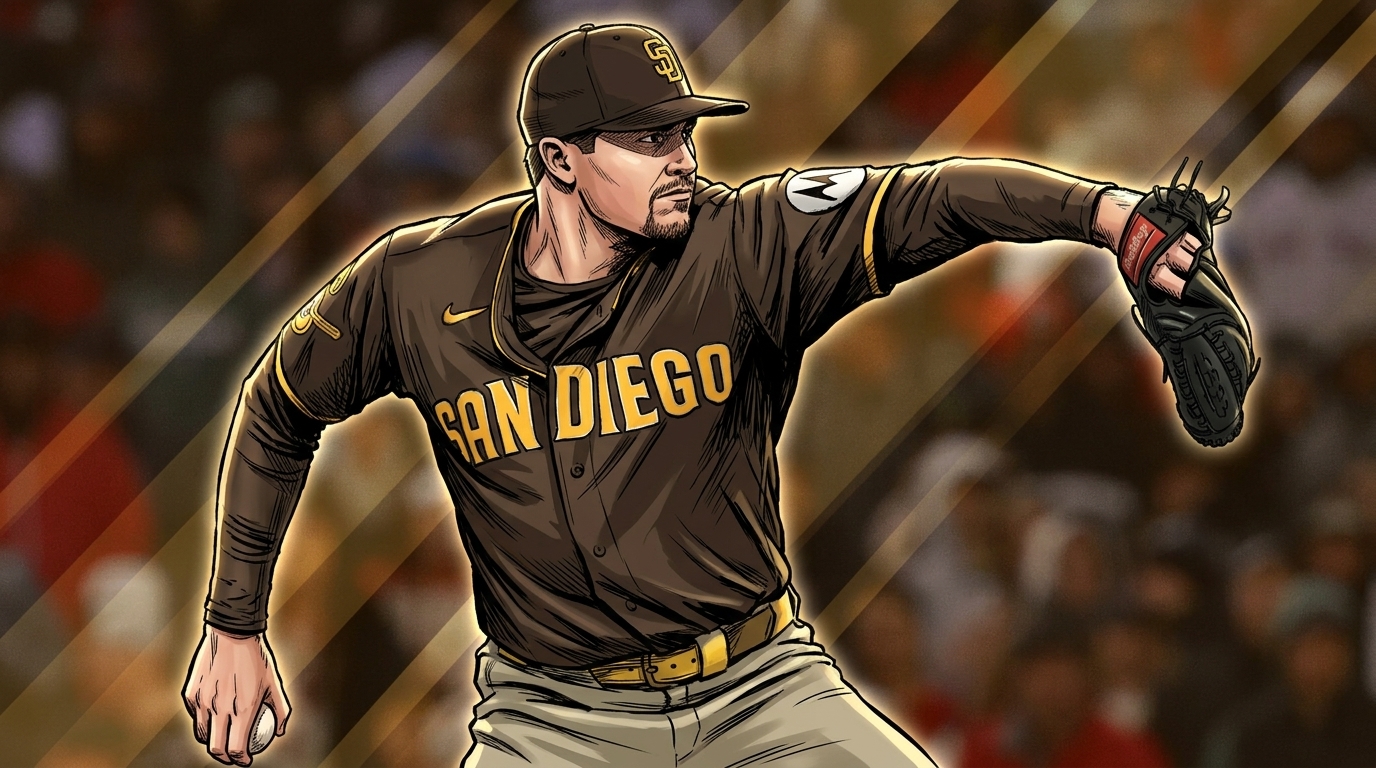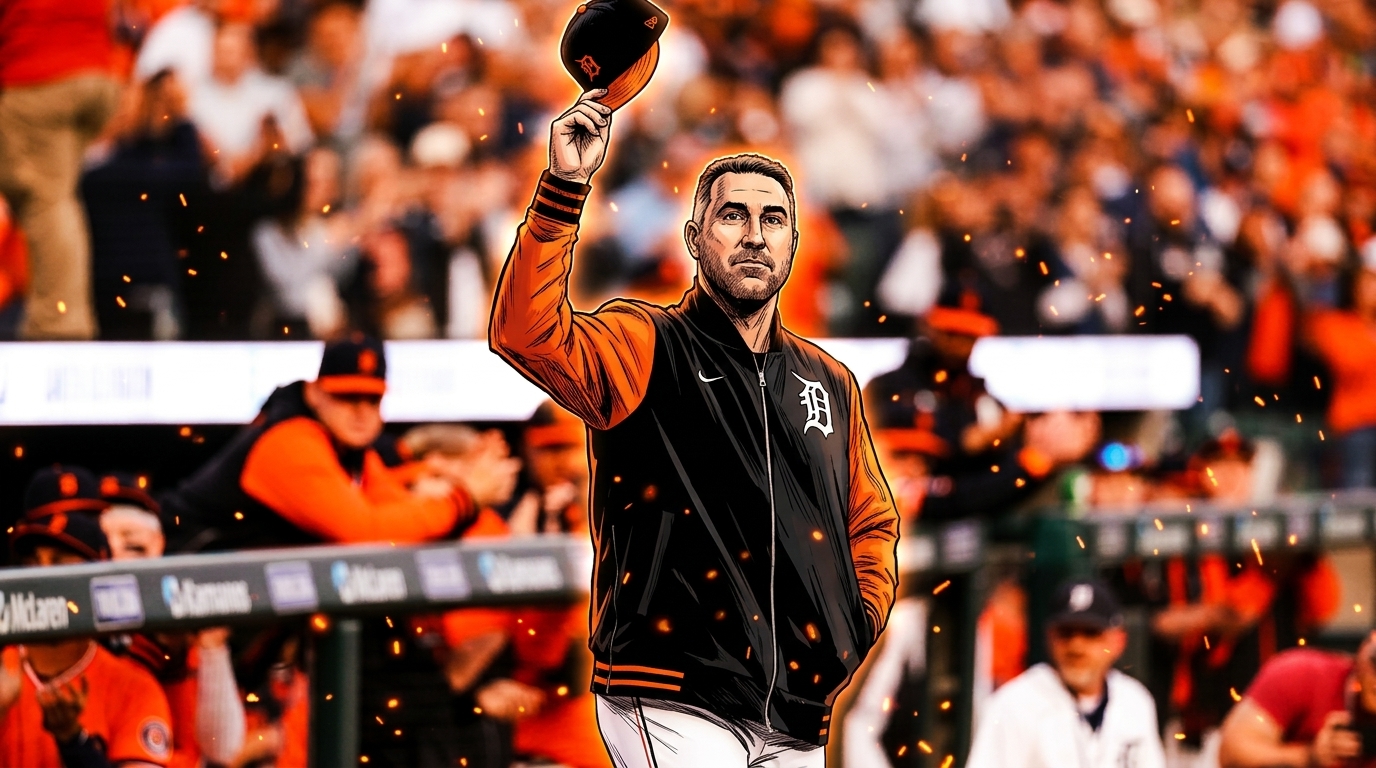

We’ve known since July that this day was coming, and it still didn’t feel real until it actually happened: Justin Verlander made the final start of his career this afternoon against the Pittsburgh Pirates, at a sold-out Comerica Park, closing out a run that started when Detroit made him the second overall pick in 2004.
First pitch was 1:10 p.m. on a Saturday, which under normal circumstances is a quiet, mid-afternoon time slot on the schedule. Comerica Park sold out anyway. That alone tells you something about how this city decided to treat the next few hours.
The full accounting reads absurd in one sitting: three Cy Youngs, the 2011 AL MVP award, two World Series rings with Houston, and three no-hitters, compiled across two decades without much of a real dip in relevance. He entered his final start ranked ninth all-time in strikeouts, at 3,554, just ahead of former Tigers rotation mate Max Scherzer.
None of this was supposed to happen on this exact timeline. Verlander missed almost the entire 2026 season with hip and hamstring injuries, and Detroit activated him off the 60-day injured list specifically for this start, after a bullpen session and a simulated game. He’d announced the shape of this ending back in July, saying he wanted “the game to tell me when it was time,” and that over the following months, “I realized that the time has come.” Baseball obliged.
(I grew up watching him carve up the rest of the AL Central for a decade from the wrong side of it — my dad still won’t discuss the 2011 ALCS in detail. There’s a version of this piece where I pretend to be neutral about that. This isn’t that piece.)
Friday night, Comerica Park held the ceremony first. Verlander’s family was there, along with longtime catcher Alex Avila, his current Tigers teammates, and manager A.J. Hinch, and the gifts came from former pitching coach Jeff Jones and ex-teammate Brandon Inge. Detroit built the whole night around gratitude, and Verlander thanked the Ilitch family, invoked Al Kaline’s memory, and singled out Avila, Don Kelly, and Jim Leyland by name.
On the Tigers part specifically, he didn’t hedge: “Your love and support has meant the world to me. That love and support has solidified for me that I am, and always will be, a Detroit Tiger.” Two decades with one franchise and an MVP trophy earned in the middle of it, and he still felt the need to say the quiet part out loud.
He was honest about the nerves, too: “I’m pretty anxious about tomorrow. It’s weird, because it’s almost like playoff anxiousness. There’s no script. I want to go as long as I can.” That’s a 43-year-old who has pitched in a World Series describing a Saturday afternoon start like it still carried October stakes.
But that’s not even the most interesting part of Saturday. The Pirates’ manager standing in the opposing dugout is Don Kelly, and the two of them go back further than anyone else in either clubhouse.
Kelly and Verlander were teammates at Double-A Erie in 2005 (Verlander’s actual professional debut), and Kelly has talked about the stadium radar gun failing to register his readings that year. They won four straight AL Central titles together in Detroit from 2011 to 2014, then reunited in Houston in 2019 with Kelly coaching first base. The two paths kept crossing for two decades, and Saturday they crossed one more time, on opposite sides of the same field.
Verlander addressed him directly at Friday’s ceremony: “Loved playing with you, man, and looking forward to competing against you tomorrow one last time.” Kelly’s answer, when asked about facing his old teammate, wasn’t complicated: “It’s unbelievable the career that he’s had, no doubt, first-ballot Hall of Famer.”
Detroit didn’t stop at nostalgia when it filled out Saturday’s lineup card. The Tigers batted Max Clark, Hao-Yu Lee, and Kevin McGonigle first, second, and third — the organization’s three best prospects, the ones beat coverage keeps calling the next great era of Tigers baseball, all hitting in front of Verlander in his final start.
(No front office plans a depth chart that precisely. Clark, Lee, and McGonigle were the best players available today, not props hired for symbolism. The symbolism just happened to be sitting right there.)
There was a smaller moment tucked into Friday night that says as much about the whole weekend as any of the career numbers. Verlander’s daughter was set to throw out Saturday’s ceremonial first pitch, and he talked about practicing with her like it was the biggest assignment of the week: “We’ve been practicing. She’s all pumped up about it… she’s got to get better at catching. Right now, she’s getting good at throwing.”
MLB’s account caught him walking in Saturday for the start itself:
https://twitter.com/MLB/status/2103881224376991992
Watch that back with the sound on, and the sellout crowd makes more sense than any injury report or stat line could explain on its own.
I think the instinct is to call this a storybook ending Detroit somehow engineered, and I think that read gives the front office too much credit and the sport too little. Nobody schedules a bench coach turned rival manager into a farewell tour twenty-one years in advance. What actually happened is simpler and, I’d argue, more meaningful: Verlander spent two decades inside one organization’s bloodstream, long enough that when it came time to say goodbye, the people standing closest to him were the same people who’d been there since Erie.
Call it a full-circle ending if you want the shorthand version. I’d call it something closer to proof of how rarely players and organizations stay tangled up this long anymore. Rosters turn over, front offices turn over, whole coaching staffs turn over inside a five-year window most places. Verlander and Kelly went from a Double-A infield to a big-league dugout and back to opposite ends of the same rivalry without either of them leaving the sport long enough to lose the thread.
(Full disclosure: I’ve read enough of these career-arc profiles to recognize manufactured framing when I see it. This wasn’t that. The dates just happen to line up, which is rarer than it sounds.)
What happens next in Detroit is its own story. The rotation Verlander leaves behind still runs through Tarik Skubal, and the Tarik Skubal trade speculation that’s already swirling around Detroit’s rotation isn’t going away just because the farewell tour ended. If anything, how loudly other teams have already called about Detroit’s ace is the next reminder that this organization is always mid-transition, handing something to whoever’s next in line.
Clark, Lee, and McGonigle were in the building for that lesson today, whether they clocked it or not. Twenty-one years from now, one of them might be the guy some manager down the hall remembers from Double-A.