
There’s a particular kind of whiplash that comes from pulling up a sports clip after you already know how the game ended. I watched the Natalie Nakase video Friday night with the final score already lodged in my head, which meant I watched a woman’s legs give out on a basketball court already primed to read it as proof of something instead of a scare. Live sports doesn’t work like that. Clips do, and it’s worth sitting with how much of this particular reaction depended on the ending arriving before the footage did.
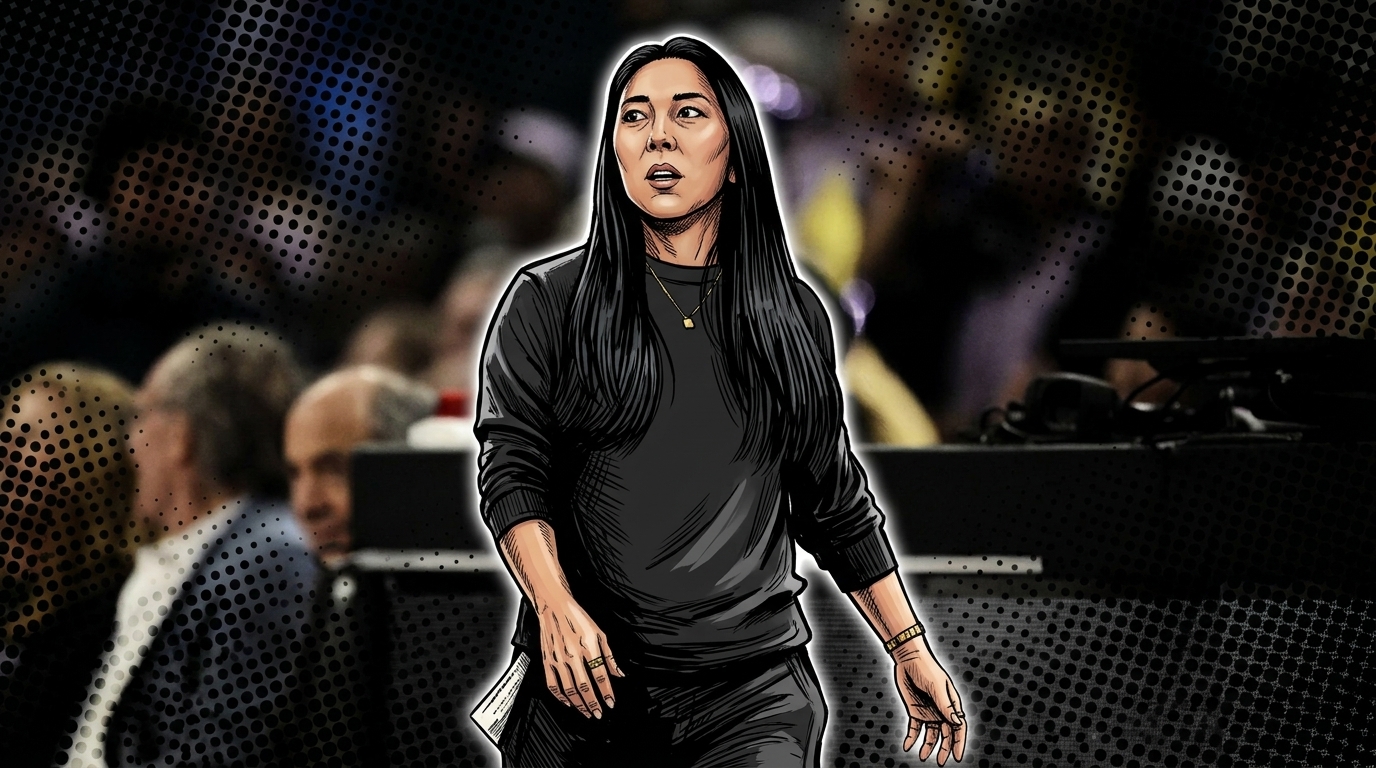
Natalie Nakase collapsed on the sideline with 1:40 left in the fourth quarter of Game 3 against the Dallas Wings, mid-argument with a referee over a no-call on a Gabby Williams layup. Her knees went out from under her. Guard Kaitlyn Chen and assistant coaches Kasib Powell and Sugar Rodgers sprinted over to get her upright. Golden State had just trimmed a 16-point deficit to one point when it happened, and Nakase stayed on the sideline through the final buzzer as the team everyone agreed was better than its record showed finished the job, 77-73, the first playoff series win in franchise history.
What the reaction to Nakase’s collapse reveals isn’t really about Nakase. It’s about how much of our capacity to worry runs through a scoreboard she wasn’t even looking at when she went down.
Had Golden State blown that lead instead of finishing the comeback, a head coach going down hard enough for her own players to run and catch her reads as an injury story, the kind that gets a follow-up quote from the team the next morning about her status for Sunday. Because the Valkyries won anyway, the same ninety seconds got folded into the Valkyries’ comeback win over the Wings as a detail in the highlight reel, a credit to how tough Nakase is rather than a reason to ask more questions. The outcome decided which story we got. The collapse itself didn’t change.
The clearest version of that reflex ran under Tim Kawakami’s byline at The Standard, in a column that frames a coach’s body giving out as pure resolve. Her legs failed, he writes, but “it was just her soul” pulling her back up, and there was “no air of emergency” on a sideline where three people had just sprinted over to catch her. Nobody put that description to Nakase directly, because Nakase wasn’t there to answer it. She skipped the postgame podium entirely.
Assistant coach Kasib Powell took the podium in her place and, as Yahoo Sports reported, delivered the only information anyone actually got: “Natalie’s fine. It’s a quick turnaround. We play here on Sunday and she wasn’t missing it for anything.” He said she’d already drawn up the next play and was back in the huddle getting on the team about a stop, almost immediately. Williams, the player at the center of the no-call that started the whole argument, told Kawakami almost the same thing, in fewer words: “She’s OK; she’s fine… We just tried to step up ourselves… We’re just happy she’s OK.”
The fans watching live split about the way you’d expect. Some went straight to alarm — “I HOPE SHE OK” still sits in those replies next to real questions about coaching stress. Others went straight to the version that was always going to win, clipping the moment down and looping it, no context, cut exactly where the footage flatters the story everyone already wanted to tell:
https://twitter.com/LakeShowYo/status/2106221841413206320
That’s the format doing its job. The alarmed replies don’t get the retweets. “Coach is a sicko” does.
Golden State moves on to face the defending champion Las Vegas Aces this weekend, with Game 1 Sunday at Chase Center. Maybe none of this should surprise me. Players finish games on injuries they’ll need surgery for later. Coaches push through family funerals. There’s a real tradition in sports of treating your own body like something you negotiate with mid-task, and Powell’s account of Nakase drawing up a play seconds after going down isn’t necessarily spin. It might just be true to how that job works.
What bothers me isn’t that she kept coaching. It’s how fast everyone else decided that was the whole story. Nobody outside that locker room knows what actually happened to Natalie Nakase’s body on Friday, and nobody should guess, least of all someone whose only sourcing is a search engine and an X timeline. I just keep running the same ninety seconds with a different final score. The Wings hang on instead of blowing the lead, and I think we’re still asking about her health on Sunday morning instead of scrolling past a clip captioned with something about warrior culture. I don’t know what that says about how the Valkyries will talk about this once the adrenaline wears off. I know it says something about the rest of us, and I’m not sure it’s flattering.