
Ohio State was the best team in college football for three quarters on Saturday night, and the preseason poll that crowned it never checked whether that would hold up once things got hard. The Buckeyes led Texas 23-3 walking into the fourth quarter in Austin; they lost 24-23, on a Hollywood Smothers plunge with 25 seconds left, and the real embarrassment belongs to anyone who treated an August ranking as anything sturdier than a talent audit. Vegas had already priced Ohio State as the safer team, which means the market and the poll voters were reading from the same spreadsheet — one with no column for what a program does once it blows a 20-point fourth-quarter lead.
That’s the whole scam of preseason college football: a grading system built entirely from inputs that stop mattering once a game turns uncomfortable. The preseason polls that put Ohio State at No. 1 were correct about what they measured — returning production, a five-star receiver in Jeremiah Smith, a quarterback change in Julian Sayin that looked seamless in August. None of that was wrong; it just wasn’t sufficient, the college football equivalent of an accountant signing off on a company’s books with no way to flag that nobody inside knows what to do when the fire alarm actually goes off.
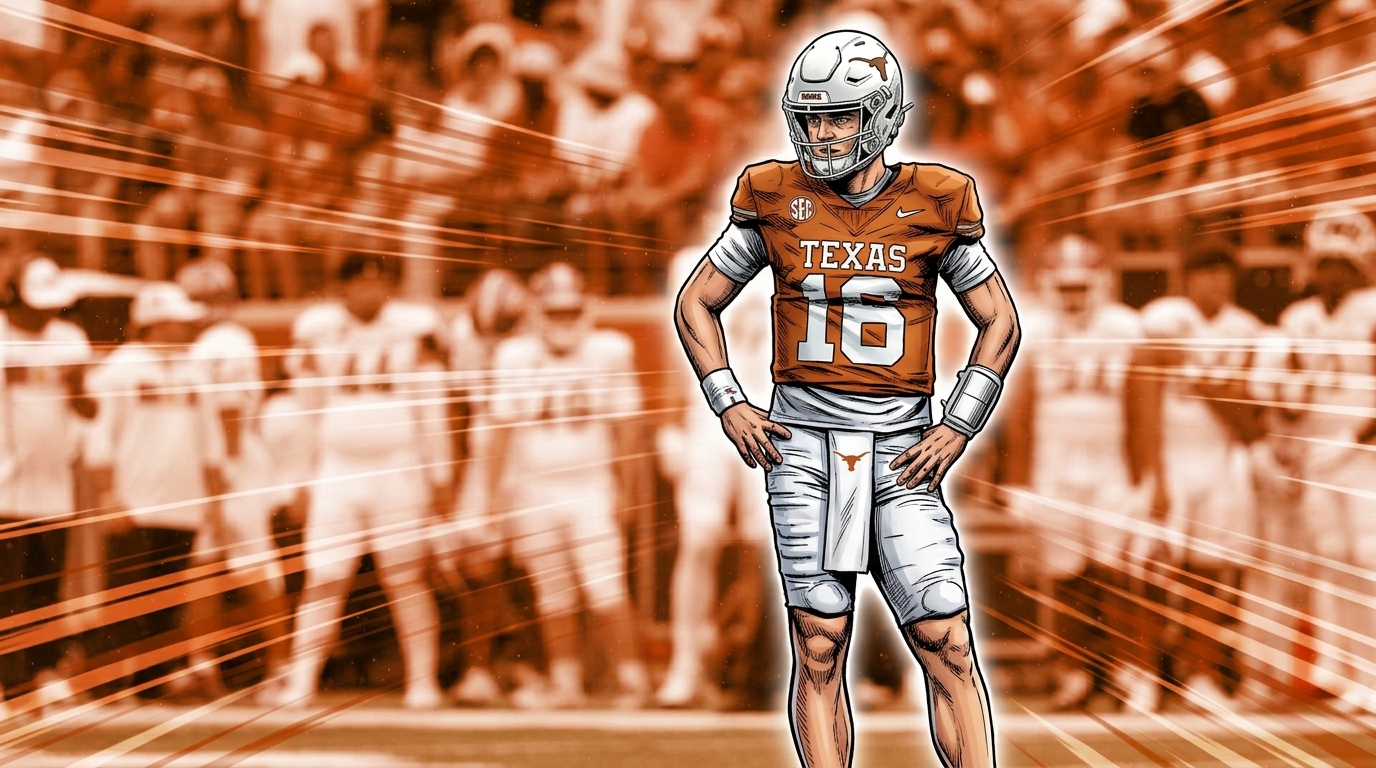
The fire alarm went off early in the fourth quarter: Arch Manning found Ryan Wingo for one touchdown, then Smothers punched in a second score from a yard out with 7:14 left. Ohio State still had a chance to make the rest of this irrelevant: Connor Hawkins lined up for a 45-yard field goal, and missed it. Manning drove Texas back down the field, Smothers scored again with 25 seconds on the clock, and the No. 1 team in the country lost a game it had led by three scores less than a quarter earlier.
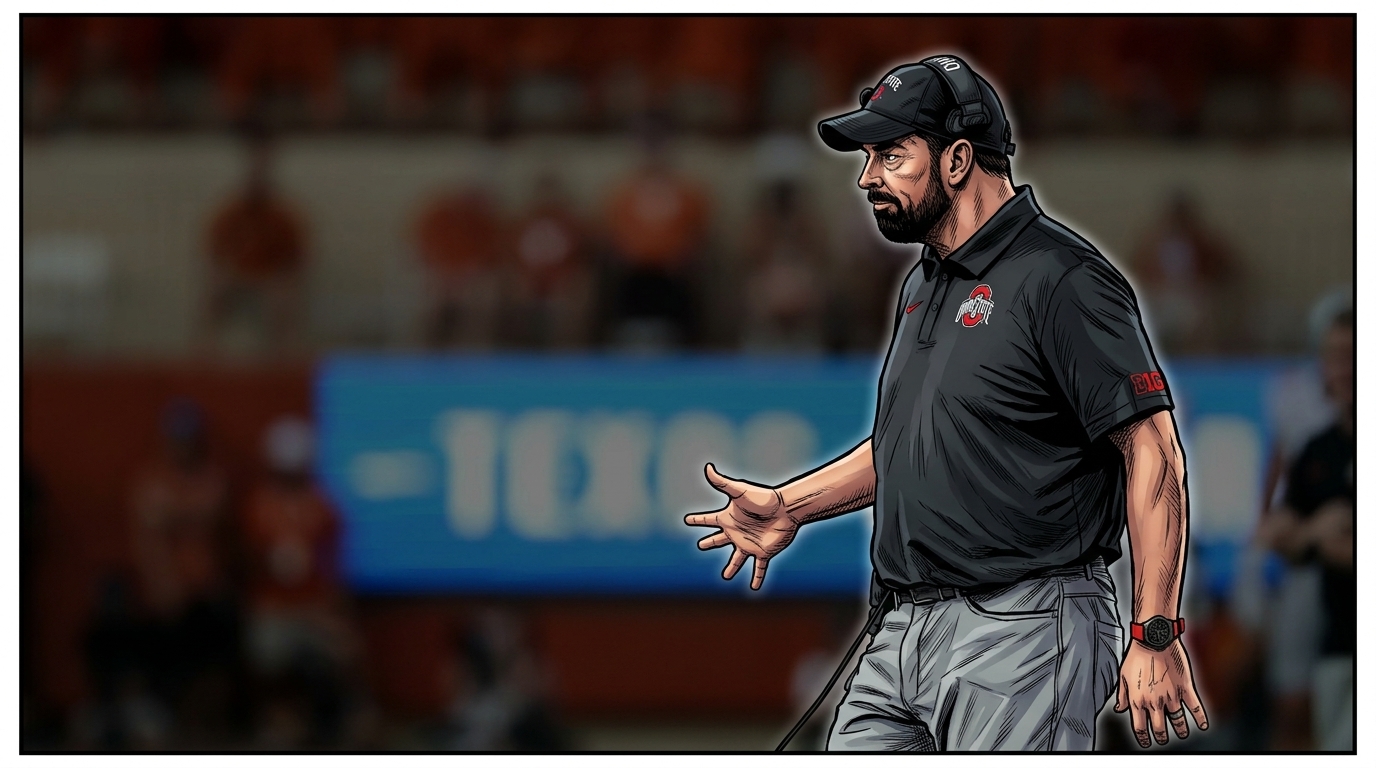
Ryan Day’s postgame explanation is worth reading slowly, because it says almost nothing while sounding like it says a great deal: “We really played well for three quarters and then didn’t play well enough in the fourth quarter; that’s the bottom line.” He reached for that same closing line again on the pass rush: “…we weren’t able to do that at a high enough rate, and especially when the game was on the line. That’s the bottom line.” Repeating a conclusion twice isn’t the same as reaching one. Pressed further, Ryan Day couldn’t explain what happened, and said so: “I can’t really sit here and tell you exactly, I know why that happened. But we all gotta take accountability and get this thing corrected and fixed moving forward.” I’ve reread that part a few times now, and it still resolves into nothing more specific than a coach admitting, on the record, that he doesn’t know.
Give him this much: he counted the failure correctly. “When you look at not being able to get off the field on defense, when you’re really not able to sustain any drives on offense, and then we missed the field goal — all three phases didn’t get it done in the fourth quarter.” That’s an audit of its own, and it’s more honest than the one the poll voters ran in August, because it admits the categories that actually decide games can’t be measured until a game demands them.
Julian Sayin’s first year as the guy produced 278 passing yards on 17-of-32 throwing, plus 94 rushing yards as a team, against a Texas offense that answered with 195 through the air and 141 on the ground behind Manning. Ohio State turned it over once to Texas’s two and still finished with a slim time-of-possession disadvantage, 28:32 to 31:28, the kind of split that looks fine on a stat sheet and means nothing once the fourth quarter starts asking different questions. Smith caught eight passes for 164 yards and a touchdown, a terrific individual night spent in front of a defense that couldn’t find one more stop when it mattered.
Steve Sarkisian, gracious in victory, called Ohio State “a really good program” with “a really talented roster” and “really good coaches” who “play the game the right way.” Every word of that is a restatement of the preseason ranking. It reads less like a scouting report now and more like an epitaph for one specific Saturday night in Austin.
None of this required Texas to be more talented than Ohio State; it required Texas to be steadier once the game got difficult. That’s the gap between talent and composure, and Saturday night was the first time this particular Buckeyes team had to answer for it in front of anyone who mattered.
Smothers himself didn’t take a victory lap afterward. Asked about the finish, he offered nothing louder than this:
https://x.com/ESPNCFB/status/2098982267343307146
That’s what composure actually sounds like when a team has it: not a mic-drop, just an accurate accounting of a game that got sloppy and stayed close enough to steal. Twenty-one unanswered points doesn’t happen because a roster stops being talented for a quarter; it happens because nobody on the other sideline had an answer, and Ohio State’s own head coach couldn’t say why in real time either. Ohio State will presumably still be good. It just turns out “good” was never the question the fourth quarter was asking.