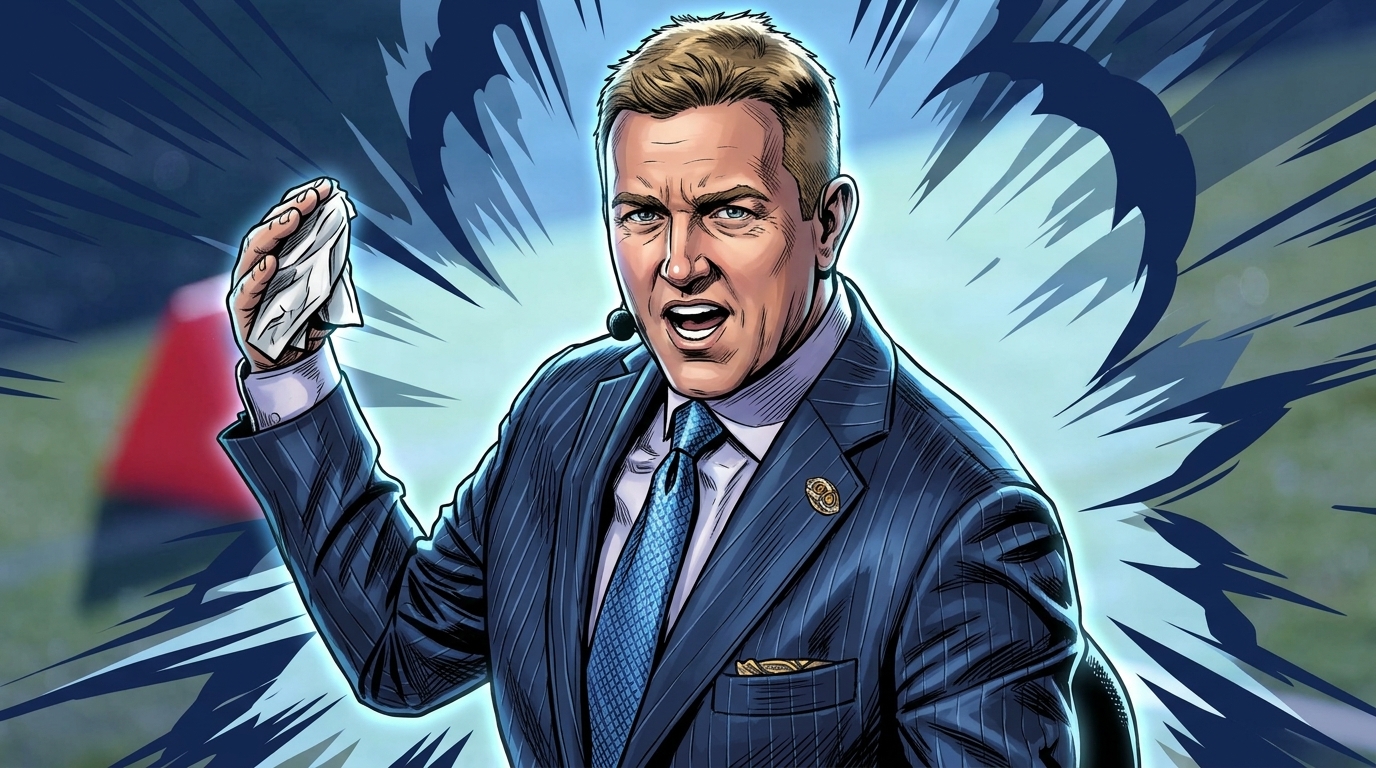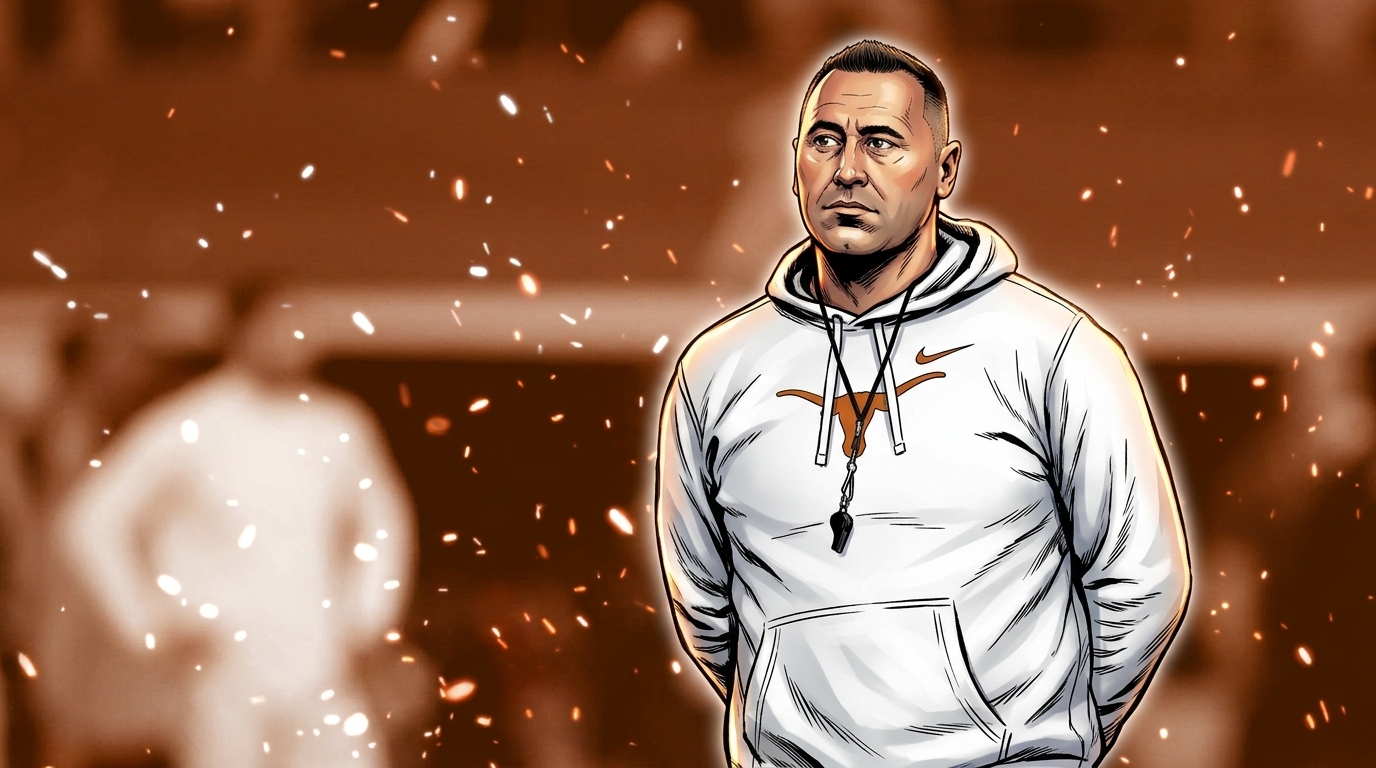

We spent about eighteen hours convinced Steve Sarkisian had blown off an ESPN sideline reporter in the middle of the biggest college football game of the season, and it turns out the reporter herself said on the air that he’d done the opposite. Laura Rutledge told viewers Sarkisian waited through her own network’s technical issues before he had to jog back to his team. He apologized for it anyway.
Some background, because the game itself is half of why this got so much oxygen. Texas trailed Ohio State 20-3 at halftime on September 12 and won 24-23, which made the historic fourth-quarter comeback the largest ever against an AP No. 1 team. Sarkisian was standing on that sideline down seventeen points to the top team in the country when a scheduled halftime hit with Rutledge was supposed to happen. It didn’t. He left for the locker room instead, and by the time anyone had context for why, the clip of him walking away had already lapped the explanation.
(Apology press conferences have become their own genre in college football, and Sarkisian just filed the latest entry: a coach explaining himself for something a camera crew caused.)
What Actually Happened at Halftime?
No. A new video and Rutledge’s own comments on the broadcast both show Sarkisian waiting through ESPN’s technical difficulties before he had to leave for the locker room. He apologized for the moment anyway, which reads less like a confession than a coach absorbing blame to make a manufactured story go away faster.
Here’s the fuller picture. ESPN’s own truck had equipment issues trying to record and relay the scheduled interview. Sarkisian stood there and waited it out. Rutledge told viewers as much in real time: “We actually just lost Sark because he had to go,” she said, before crediting him directly, adding that he’d “waited for a long time, been very patient with some technical issues that we had.” That’s the reporter who was supposedly stood up describing the guy who allegedly stood her up as patient. It’s an odd shape for a snub story to take.
A few days later, video from Texas team photojournalist Aidan Boyd made the same point without anyone having to say it out loud. Noah Gross posted the footage of Sarkisian standing on the sideline through the delay:
https://twitter.com/noah_gross27/status/2100670840278749363
Watch it and the story more or less writes itself in reverse. He’s not checking his watch or storming off camera. He’s just standing there, waiting on a broadcast that was never going to be ready in time.
Why Apologize If Rutledge Defended Him On Air?
This is the part that actually complicates things, and it’s worth sitting with instead of resolving too quickly. At his next weekly press conference, Sarkisian brought the moment up unprompted and said he “could have definitely handled that situation better with a little bit more patience in the moment.” Set that next to Rutledge’s live comments and it doesn’t square. The reporter said he was patient. He said he wasn’t patient enough. One of them is being generous.
(ESPN’s own broadcast truck, not exactly a JV operation covering a random Tuesday of MACtion, was the one having equipment problems, on the same broadcast that turned into ESPN’s own best regular-season audience in a decade. The stakes here were about production, not disrespect.)
Live production breaks constantly, and most of the time nobody notices because nothing goes wrong on camera. This time something did, and the guy standing on the sideline caught the blame instead of the equipment.
I think the apology makes more sense as public relations than personal accountability. Fifteen minutes of ESPN-bashing beats fifteen hours of it, and a head coach two weeks into a signature win can afford a five-second mea culpa if it ends the conversation faster. Sarkisian didn’t apologize because he did something wrong. He apologized because apologizing was the quickest way out of a story that had already outrun the facts.
Keep this separate from a separate deepfake controversy involving a different reporter from that same week: Holly Rowe, a postgame interview, and an AI video that quarterback Arch Manning laughed at before apologizing himself. Different reporter, different interview, different apology. The two stories get folded together online because they involve the same coach and the same week, but Rutledge’s halftime moment and Rowe’s postgame one are not the same incident. Treating them as one blurs a story that ESPN’s equipment caused into one that involves an actual person making an actual joke.
What This Says About How These Stories Travel
The part of this actually worth remembering has nothing to do with Sarkisian’s patience level and everything to do with how fast a clip outruns its own context. Three separate threads point the same direction: the original footage of him walking off, Rutledge’s live comments crediting his patience, and Boyd’s video confirming the wait was on ESPN’s end. That’s three independent confirmations for a story that hardened into “the coach snubbed the reporter” within about a day. The clarifying footage never had a chance to travel as far as the initial framing did.
Fan reaction split about how you’d expect. Some pointed out Sarkisian had a seventeen-point deficit to erase and a locker room to reach, and treated the whole episode as a non-story. Others took it as further proof the network is “rotten to the core,” or, in the gentler version, that it “wasn’t that hard to record an interview.” Both readings can be true at once. The rarer reaction, from what I saw, was anyone actually quoting Rutledge’s own words back at the people angriest on her behalf.
My read: this was never a snub, and I don’t think it was ever really about Sarkisian’s manners. It’s about a fanbase, a network, and a news cycle all needing a version of the story more dramatic than “the truck broke.” Sarkisian’s apology gave everyone permission to keep believing the more dramatic version even after the evidence said otherwise, which is its own small case study in how these stories move now: the apology gets clipped and shared, not the corroborating video that made the apology unnecessary in the first place.
What I’ll actually be watching for the next time Texas plays a ranked opponent on national television is whether ESPN fixes its own equipment before it needs a head coach’s mea culpa to smooth things over. Sarkisian handled his end fine the first time. He shouldn’t have to apologize for it twice.