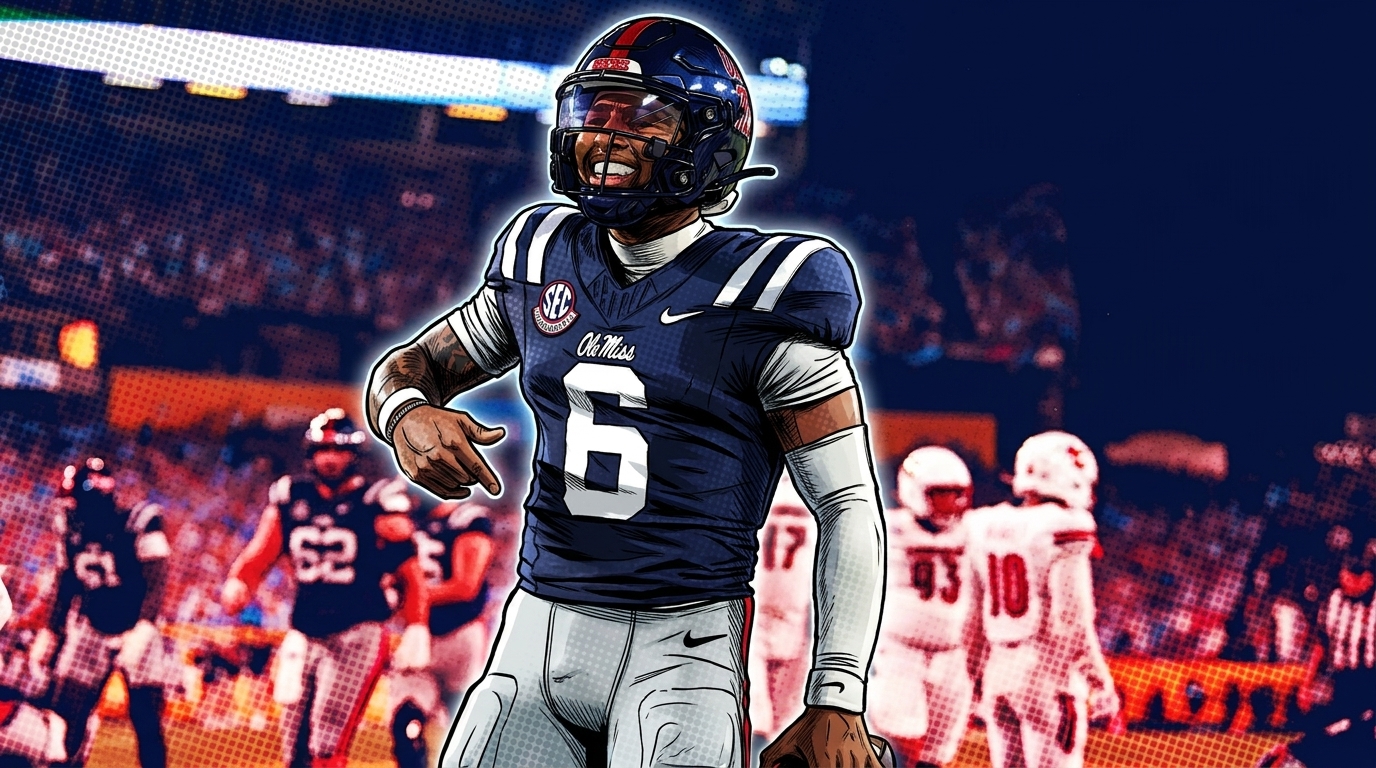

The NCAA spent the better part of a year trying to convince Mississippi courts that Trinidad Chambliss didn’t deserve one more season of college football, and I refuse to let that fight get buried under the 363 passing yards he just hung on Lane Kiffin. Chambliss sued the NCAA and won — twice — before he ever lined up against LSU, and I’m angrier about how quietly that win is getting treated than I am impressed by the box score.
I spent eighteen months out of college at a housing policy nonprofit learning that powerful institutions rarely lose fights on the merits. They win by betting the other side can’t afford to keep fighting. That’s the NCAA’s entire eligibility-waiver operation. It isn’t a medical review. It’s a math problem about how much resistance a 22-year-old quarterback can mount before he runs out of money, time, or nerve, and the NCAA bet wrong on Chambliss.
Start with who they tried to bury. Chambliss was an unrated high school recruit who became a two-time Division II national champion backup at Ferris State, then missed the entire 2022 season to what’s been described as a respiratory illness, tonsillitis layered on chronic fatigue. When he transferred to Ole Miss and asked for a sixth year of eligibility to make up for that lost season, the NCAA decided it knew his own case better than his own doctors did.
Their stated reasoning, in writing: evidence suggested Ferris State benched him for “development needs and our team’s competitive circumstances.” Translate that out of institutional-speak and it reads: we think you just weren’t good enough, so we’re not handing back the year we think you wasted. That’s not a medical determination. That’s a Division I bureaucracy overruling a documented illness because overruling it cost the NCAA nothing.
So Chambliss sued. Lafayette County Chancery Court Judge Robert Whitwell granted him a preliminary injunction on Feb. 12, clearing him to play while the case worked itself out. The NCAA appealed, presumably expecting a friendlier room. It didn’t get one. The Mississippi Supreme Court denied the NCAA’s appeal about six weeks later, and Chambliss walked into fall camp exactly where a chancery court judge in Oxford had already said he belonged.
Two separate Mississippi courts, a trial-level chancery court and the state’s highest appellate bench, looked at the NCAA’s case and told it no. It’s not the first time a body that insists it’s the sole legitimate arbiter of eligibility has found out a judge disagrees — the same pattern that got Trey Kaufman-Renn a sixth season shows an organization that keeps confusing its own bylaws with the law. Chambliss’s attorney, Tom Mars, saw exactly what was coming the moment the NCAA filed its appeal.
“Everyone remembers when the NCAA famously appealed to the Supreme Court in the (Shawne) Alston case and got their teeth knocked out by Justice Kavanaugh,” Mars said. “I expect the NCAA to be spitting chiclets in this appeal as well.” He wasn’t being cute. Alston was the NCAA marching into the actual U.S. Supreme Court to defend limiting what athletes could earn, and getting handed a concurrence from Kavanaugh that read less like case law and more like a public flogging. Mars bet the NCAA would walk into a Mississippi courtroom with the same arrogance and get the same result.
He was right, and none of it was abstract to Chambliss. He’s the specific person who had to hire a lawyer and sit through chancery court proceedings instead of just playing football, because the NCAA decided a documented illness wasn’t worth a sixth year of eligibility without a fight. That’s real money, real time, real stress, absorbed by a 20-something quarterback against an organization that answers to almost nobody. It’s exactly why the NCAA’s own eligibility rule blowing up on it in federal court isn’t a one-off. The waiver process was never built to evaluate fairness. It was built to see how much bullshit a kid would eat before he gave up, and Chambliss ate less of it than they planned for.
Then he went out Saturday and made the receipts embarrassing.
https://twitter.com/performancesCFB/status/2101515247026635177
Chambliss threw for 363 yards and added the go-ahead score himself on a fourth-quarter scramble that put Ole Miss ahead for good against the coach who left Oxford for Baton Rouge. LSU tied it late. Ole Miss answered with a two-point conversion to make it an eight-point game, and Kiffin’s final possession died on a deflected fourth-down pass that got picked off. Final: 32-24, in the building the NCAA spent a year trying to keep him out of.
I don’t care how good the stat line reads. The stat line isn’t the story. The story is a multibillion-dollar governing body looked at a kid with a documented illness, decided he wasn’t worth an exception, lost in front of a chancery judge, lost again in front of the state’s highest court, and then got outcoached and outplayed by the same kid it tried to bench through paperwork. Force someone to beat you twice before you’ll let them play, and don’t be surprised when he does exactly that on national television, in the same damn stadium the NCAA didn’t think he’d earned the right to stand in.