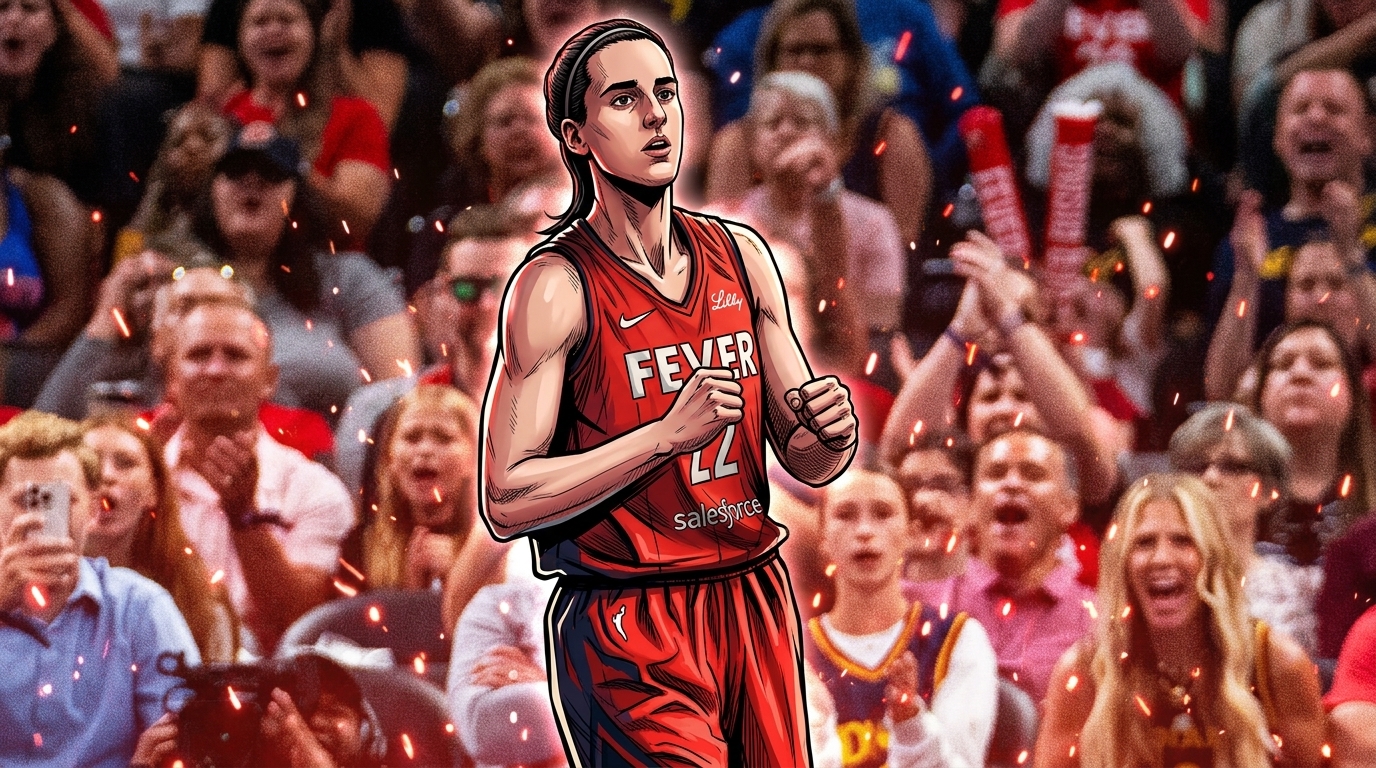

There’s a number in Caitlin Clark’s game log this week that makes the loudest debate in the WNBA feel almost redundant, and it isn’t 37 or 34. It’s six, and what six does to four.
Clark just became the first player in league history to post back-to-back 30-point, 10-assist games, one Fever win apart. The stat spreading faster than either box score is the one sitting underneath it: Clark now has six career games with at least 30 points and 10 assists. Every other player who has ever suited up in the WNBA has combined for four.
How Many 30-Point, 10-Assist Games Does Caitlin Clark Have?
Caitlin Clark has six career games with at least 30 points and 10 assists, including the first back-to-back pair in WNBA history, on August 23 and August 29, 2026. The rest of the league, every player across every season, has four such games combined.
Six ahead of four is lopsided on its own. What sharpens it is how little of a career Clark needed to get there. This isn’t a gap that closes with one bad shooting night from the field. It’s a gap that requires the entire rest of the league, every guard and forward who has ever recorded a 30/10 game, to catch up to one player, and the arithmetic is now public enough that it’s harder to wave off as a small-sample fluke.
A 30-point, 10-assist game asks a guard to do two jobs that usually trade off against each other. Score enough to bend the defense, then still find nine or ten teammates for makeable shots once that defense bends. Most nights a player who chases the scoring number stops passing, and a player who chases the assist number stops shooting. Clark has now done both, at the same time, six separate times.
The Back-to-Back Nobody Else Has Ever Pulled Off
Start with August 23 against the Chicago Sky: 37 points, 10 assists, and a career-high 8-of-12 from three, in a 113-90 Fever win that was never really in doubt after the first quarter. Eight makes on 12 three-point attempts is two-thirds accuracy from distance, the kind of shooting night most guards get once a season, not once a week. Six days later, against the Connecticut Sun, Clark backed it up: 34 points, 12 assists, 5 rebounds, 3 steals, 12-of-19 from the field and 6-of-12 from three, all of it in 34 minutes. That’s better than six makes out of every ten shots from the floor and exactly half her threes, in three fewer minutes than a full game. Yardbarker tracked the pair together and called it what it is: nobody in WNBA history had ever strung two 30/10 games together before this month.
Put plainly, that means Clark scored at a near-40-point pace while also running the offense at a near-triple-double assist rate, twice in a week, against two different defenses built to slow different things down. Chicago wanted to make her a scorer. Connecticut wanted to make her a passer. She answered both questions in the same six days, and the second answer came with three steals attached, which is the part of the box score that never makes the highlight package but tells you she wasn’t coasting on offense alone.
The league’s own account posted the two performances side by side once the second game closed the streak:
https://x.com/WNBA/status/2093519144301875698
No caption necessary. The box score already did the bragging for her.
Why the MVP Odds Still Don’t Believe It
This is where the arithmetic runs into the market. FanDuel still has A’ja Wilson at -360 to win MVP, which translates to something close to a 78 percent implied favorite before another game is even played. Clark sits fourth in the same odds, at +1300, an implied shot in the neighborhood of 7 percent, behind Wilson, the case for Paige Bueckers at +850, and Olivia Miles’ rookie season in Minnesota at +1000.
Miles is the one worth sitting with for a second. A rookie averaging 19.7 points, 4.7 rebounds and 5.8 assists on 50.2% shooting isn’t just efficient. On a 25-6 team, that’s an MVP case with a won-loss record attached to it, which is exactly the thing Clark’s case is missing right now. Bueckers has built her own version of the same argument, on a team that’s kept winning around her all year.
None of that erases six 30/10 games against four. It just explains why the betting markets, which still have Clark trailing all three of Wilson, Bueckers and Miles, are pricing something other than box-score volume. They’re pricing team success. On that measure, Clark still has work to do.
What a Second-Half Push Would Actually Take
The clearest gap in Clark’s case isn’t a scoring number. It’s win shares, the metric that tries to fold scoring, playmaking, defense and efficiency into one number representing what a player’s production is actually worth in the standings. Clark’s win-share total lags the frontrunners, even in a season where her per-game numbers (21.5 points, 3.8 rebounds, 7.9 assists, 44.3% shooting) already rank among the best in the league. I ran the comparison a few different ways: scoring rate, assist rate, shooting efficiency. The answer never moves. Clark’s box score is out ahead of the field on every one of those counts. Win shares are the one column where the incumbents still lead, because that number rewards winning as much as it rewards volume, and volume is the one thing Clark has never lacked.
Since the All-Star break, Clark is averaging 24.3 points on 47.5% shooting and 9.0 assists a game, a stretch Bleacher Report has flagged as one of the best of her career. Translate that: a nearly 50 percent shooting clip while also averaging almost a nine-assist double-double, sustained across weeks rather than a single hot night. The problem is that the stretch hasn’t yet translated into the standings the way it needs to. Indiana sits 1.5 games back of second-place Golden State, close enough that every game left on the schedule functions as a seeding game.
It helps that Clark isn’t the only Fever guard heating up. Kelsey Mitchell’s own scoring streak, 20-plus points in 23 straight games, has kept Indiana from leaning on Clark alone to close the Golden State gap. A team push, not just an individual one, is what the win-share column has been asking for all along.
If the Fever climb past Golden State behind this version of Clark, the MVP race stops being a box-score argument and becomes a standings argument too. That’s the version of this race Clark actually wins. Six 30/10 games are already more than the rest of the league has ever produced combined. Give her the seeding push to go with it, and this stops being a debate and starts being a formality.