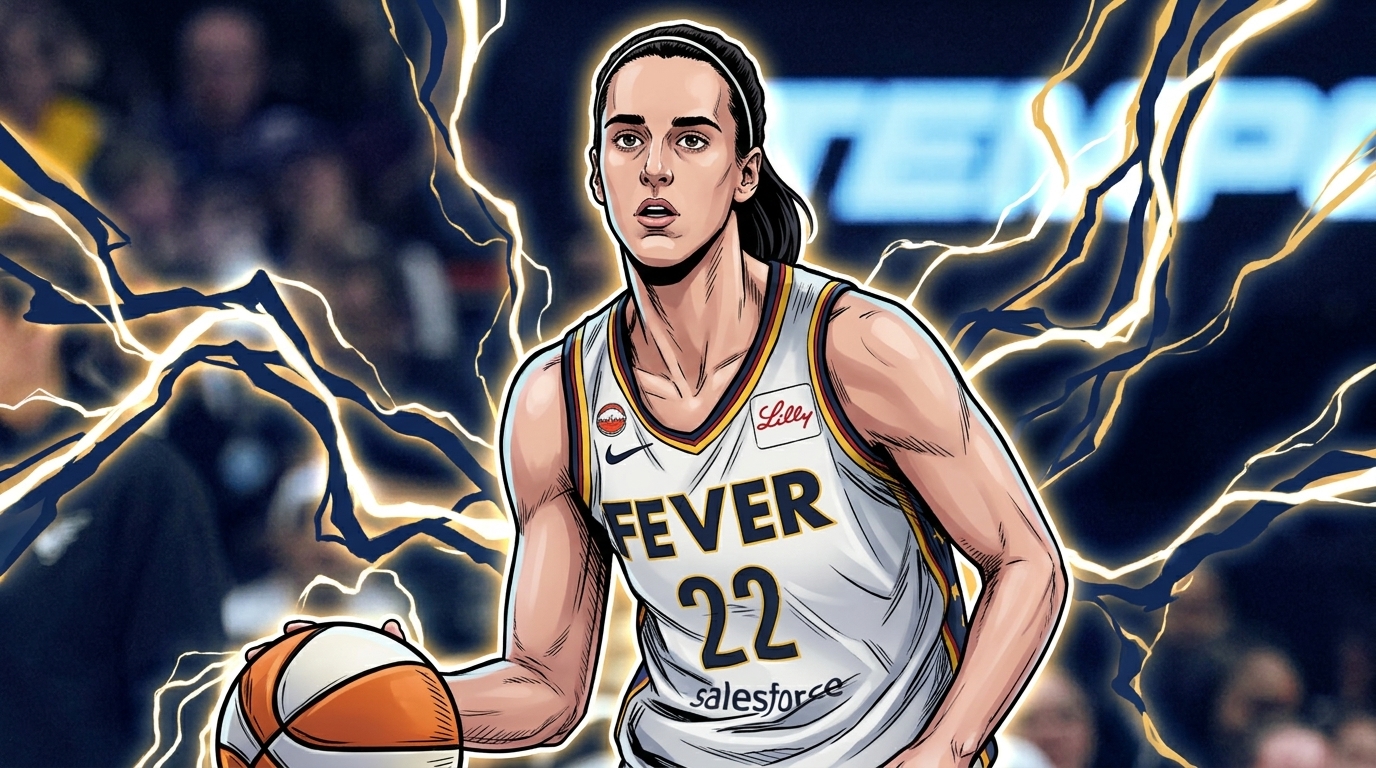

There’s a stat line that used to take an entire career to accumulate, and Caitlin Clark just hit it for the tenth time in a single season. Her 10th game this year with at least 25 points and 10 assists came in the Indiana Fever’s 103-85 win over Toronto Tempo on Friday, and per Yahoo Sports, that mark is now more than any player has recorded across a full WNBA career. Not a season. A career.
Ten times. In one year. That’s the number the MVP case has quietly been built on all season, and it’s about to stop being a case and start being an obvious conclusion.
https://twitter.com/IndianaFever/status/2101132910656995443
How Rare Is a 25-Point, 10-Assist Night?
A 25-point, 10-assist game requires a player to be her team’s primary scorer and primary playmaker in the same 40 minutes, not one or the other. It’s the rough basketball equivalent of a quarterback throwing for 300 yards and running for 100 in the same afternoon.
Most All-Stars never do it once. Clark has now done it ten times before the season is even finished, and the reason this threshold gets treated as a career milestone instead of a seasonal one is structural. Scoring volume and playmaking volume usually trade off against each other, because the possessions a player spends shooting are possessions she isn’t spending setting someone else up. Defenses build entire game plans around forcing that trade-off: take away the pull-up jumper and dare her to pass, or take away the driving lanes and dare her to shoot over a set defense. Clark’s game breaks that trade-off on a semi-regular basis, which is a different, harder thing than just being good at two skills separately. It means opponents haven’t found the side of the equation they’re allowed to give up.
What Clark’s Line Against Toronto Actually Looked Like
Clark’s box score from Friday: 28 points, 14 assists, six rebounds, 7-of-15 shooting from the field, 2-of-8 from three, and a perfect 12-of-12 from the free-throw line in 34 minutes. That 25 percent clip from three is well below her season average of 37 percent, per her ESPN gamelog, which means the outside shot simply wasn’t falling. It didn’t matter. She got to the rim and the free-throw line enough to finish with 28 points anyway, and the 14 assists were the actual driver of the night.
That’s the version of Clark that should worry opponents more than the shooting version does. A cold three-point shooting night usually caps a scorer’s ceiling. Instead, Toronto had to deal with a point guard who kept finding the extra pass regardless of whether her own shot was working, on her way to a 103-85 final that was never particularly close. Thirty-four minutes is also a normal workload for her, not an extended one, which matters for anyone trying to argue this line came from an unusual amount of playing time rather than an unusual level of production.
Why the Volume Argument Doesn’t Hold Up
The standard counterargument to any high-usage MVP case is volume: she just does more because the ball is in her hands more, so of course the counting stats pile up. It’s a fair question to ask about most high-usage guards. It doesn’t survive contact with Clark’s actual season averages, which sit at 22.6 points and 8.5 assists per game on 45.6 percent shooting from the field, per her gamelog. Those are efficient numbers for a guard who’s also averaging nearly three made threes a night. Volume without efficiency is a compiler stat. Volume with this shooting profile is a different category of production.
I’ll admit the number that actually stopped me was the free-throw line. A perfect 12-of-12 from the stripe on a night when the jumper wasn’t falling is the kind of detail box scores bury, and it’s the part of Friday’s line that tells you the most about how Clark adjusted in real time rather than just riding a hot shooting hand.
MVP voters tend to reward exactly this pattern once they notice it: not the best individual highlight of the year, but the player who keeps producing at an elite level through the nights when one part of her game isn’t cooperating. A guard who needs a hot shooting hand to hit 25 and 10 is a good player having a good year. A guard who hits it anyway on a 25 percent three-point night is making a different kind of case, and voters have historically leaned toward the second version of that argument.
Kelsey Mitchell Is Doing This Too, and That’s the Point
Clark wasn’t even the top scorer in her own building on Friday. Kelsey Mitchell dropped 33 points on 12-of-17 shooting, including 7-of-11 from three, and in doing so broke the WNBA’s single-season scoring record, passing A’Ja Wilson’s mark of 1,021 points from 2024 with 1,034 of her own. Mitchell also set the franchise’s single-season three-point record in the same game, at 128 makes. Mitchell’s own record-breaking season is a legitimate standalone story, and it happened in the same box score as Clark’s milestone.
That’s not a coincidence, and it’s the actual argument here. A point guard who’s setting up a teammate for a franchise scoring record on the same night she’s compiling her own historic line is doing something more valuable than either total by itself. Mitchell’s record doesn’t compete with Clark’s MVP case. It’s supporting evidence for it.
So Is the MVP Case Actually Closed?
Ten 25-point, 10-assist games in a season, from a guard averaging 22.6 and 8.5 for the year while her backcourt partner breaks the league scoring record around her, is about as clean a data set as this argument gets. It reads a little like watching Steph Curry’s first unanimous MVP season play out again from a different angle: a skill set arrives that the existing statistical categories weren’t built to describe, and the league spends a year trying to catch up to the box score instead of the other way around.
The MVP case Clark was already building got its final piece of evidence on Friday, and it didn’t need a signature moment to get there. It needed a tenth data point in a pattern that was already unambiguous. Give me Clark. The rest of the field is playing for second, and the numbers stopped pretending otherwise a while ago.