Caitlin Clark
Caitlin Clark is the Indiana Fever guard and NCAA all-time scoring leader whose arrival reshaped WNBA attendance, TV ratings and player salaries.
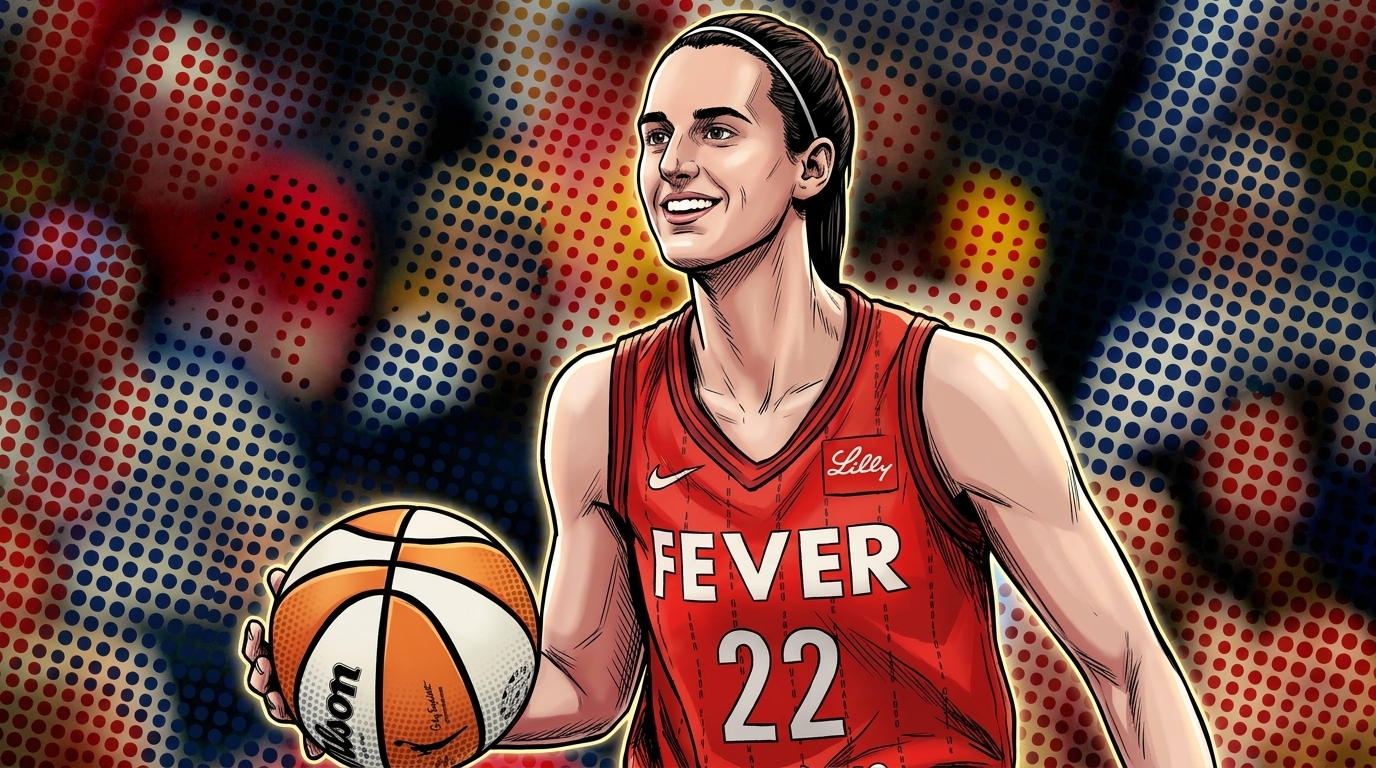
Caitlin Clark is an American professional basketball guard for the Indiana Fever and the most consequential draw women’s basketball has produced in the modern television era. At the University of Iowa she became the NCAA Division I all-time leading scorer, and as the No. 1 pick in the 2024 WNBA draft she carried that audience into the professional league, where her rookie season rewrote attendance, viewership and revenue baselines. What distinguishes Clark is not only what she scores but what moves when she plays: gate receipts, broadcast windows, ticket resale markets, and the terms of the collective bargaining agreement that will govern the WNBA through 2032.
| Vitals | |
|---|---|
| Born | January 22, 2002, Des Moines, Iowa (Wikipedia) |
| Position | Guard (WNBA) |
| Number | 22 (Basketball-Reference) |
| Teams | Indiana Fever (2024–present) |
| Draft | 2024, Round 1, No. 1 overall, Indiana Fever (WNBA) |
| Contract (Sep. 15, 2026) | Third year of her rookie-scale deal, $528,846 in 2026 |
College
The résumé. Clark spent four seasons at Iowa (2020–2024) and left as the all-time leading scorer in NCAA Division I history, men’s or women’s, with 3,951 career points and a career average of 28.4 points per game. She also finished with the NCAA Division I women’s career record for three-pointers, 548 — the overall Division I career three-point record belongs to Detroit Mercy’s Antoine Davis at 588 — along with 1,144 assists (Wikipedia).
The record chase. On February 15, 2024, she passed Kelsey Plum’s women’s Division I career scoring mark of 3,527 points, hitting a long three against Michigan and finishing with a career-high 49 points (CBS Sports). On March 3, 2024, she surpassed Pete Maravich’s all-division record of 3,667 points to become the leading scorer in college basketball history (Big Ten Conference). She twice won the Naismith, Wooden and Associated Press national player of the year awards (2023 and 2024) and led Iowa to consecutive national title games.
The Fever years
2024: the record rookie
The arrival. The Fever selected Clark first overall on April 15, 2024. She played all 40 regular-season games and averaged 19.2 points, 8.4 assists and 5.7 rebounds on 34.4 percent three-point shooting, the assist figure leading the league. She set a WNBA single-season assist record of 337, broke the rookie scoring record, and became the first rookie to record a triple-double.
The hardware. She was named 2024 WNBA Rookie of the Year with 66 of 67 votes and was the only rookie chosen for the 2024 All-WNBA First Team, the first so honored in more than a decade. Indiana reached the playoffs as the sixth seed and was swept by the Connecticut Sun; Clark scored 25 points in the Game 2 loss (ESPN).
2025: the injury season
The absence. Clark’s second season was defined by injury. A left quad strain, a right groin injury and a left-ankle bone bruise limited her to 13 of the Fever’s 44 games — the first 44-game regular season in league history. On September 4 Indiana ruled her out for the remainder of the season, playoffs included. In the games she played she averaged 16.5 points, 8.8 assists and 5.0 rebounds.
The run without her. Named an All-Star captain, she missed the game held in her home arena in Indianapolis. Without her, the Fever pushed the eventual champion Las Vegas Aces to a decisive Game 5 in the semifinals before falling 107–98 in overtime in Las Vegas; the Aces went on to win the 2025 WNBA title.
2026: the healthy return
The best of her career. Clark returned healthy in 2026. Through 36 games as of September 15, 2026, she averaged 22.5 points, 8.4 assists and 3.9 rebounds on 45.6 percent shooting. On July 17, 2026, she set a Fever franchise single-game scoring record with 45 points against the Seattle Storm, becoming the first player in WNBA history to record at least 40 points and 10 assists in a game. She was an All-Star for a third straight year.
Impact on the league
The audience. The commercial shift around Clark was immediate and measurable. In 2024 her nationally televised games averaged 1.18 million viewers against 394,000 for all other WNBA broadcasts, and ESPN’s coverage rose roughly 170 percent over 2023. Indiana’s combined home-and-road attendance set a single-season league record of 643,343, with Fever home crowds climbing from about 4,000 a game to more than 17,000. The 2024 All-Star Game she played in drew a record 3.44 million viewers; the 2025 edition she missed drew 2.19 million, down 36 percent.
The economics. That growth reframed the league’s finances. Players opted out of their prior CBA, and the new agreement runs from 2026 through 2032, lifting the salary cap from $1.5 million toward $7 million, raising the average salary to roughly $583,000 and allowing the first million-dollar contracts in league history. Under the old scale Clark’s 2025 salary was about $78,066; the new deal lifted her 2026 pay to $528,846. Because she made the 2024 All-WNBA First Team, reporting holds that the CBA’s “Exceptional Performance on Initial Contract” (EPIC) provision makes her eligible to renegotiate toward the league maximum before her fourth season, in 2027.
By the numbers
Clark’s WNBA regular-season production, per Basketball-Reference:
| Season | GP | PPG | APG | RPG | FG% | 3P% |
|---|---|---|---|---|---|---|
| 2024 | 40 | 19.2 | 8.4 | 5.7 | .417 | .344 |
| 2025 | 13 | 16.5 | 8.8 | 5.0 | .367 | .279 |
| 2026 | 36 | 22.5 | 8.4 | 3.9 | .456 | .373 |
Career totals
Per Basketball-Reference, through September 15, 2026.
Ranks
- 1st Points, NCAA Division I history (3,951)
- 1st Three-pointers, NCAA Division I women's history (548)
- 1st Points in a game, Indiana Fever history (45)
Per NCAA and ESPN, through September 15, 2026.
Honors
- NCAA Division I all-time leading scorer (3,951)
- 2024 WNBA Rookie of the Year
- 2024 All-WNBA First Team
- 3× WNBA All-Star (2024, 2025, 2026)
- 2× Naismith Player of the Year (2023, 2024)
- 2× Wooden Award (2023, 2024)
- 2× AP Player of the Year (2023, 2024)
- WNBA single-season assist record (337, 2024)
Per Wikipedia and the Indiana Fever.
The arguments
Whether Clark alone drives the league’s growth. One side points to the ratings decline when she sits — the 2025 All-Star Game she missed drew 2.19 million viewers, down 36 percent from the 2024 edition she played in (Front Office Sports) — as proof she is the singular engine. The other side notes that overall league viewership continued to climb in 2025 even with Clark sidelined for most of it, arguing the WNBA is riding a broader wave of stars and investment that predates and will outlast any one player.
The Clark–Reese story as rivalry or manufactured beef. Matchups between Clark and Chicago’s Angel Reese, who beat Iowa in the 2023 national championship, became the most valuable ticket in the sport: Fever–Sky games have drawn resale averages around $253, some 187 percent above the Sky’s season norm, and one meeting was the most-watched WNBA game on any network in 23 years. Commentators dispute whether the framing is a genuine on-court rivalry driving business or a media narrative — at times racialized — that both players have said is overstated.
Pay versus value. Critics argue that a player generating record gate and broadcast revenue while earning a rookie-scale salary exposed how far compensation lagged the league’s income; defenders of the prior structure counter that rookie scales are collectively bargained and apply to everyone. The 2026 CBA, with its cap increase and revenue-sharing framework, is widely described as the players’ answer to that gap.
Why it matters
Caitlin Clark’s significance is that she collapsed the distance between a college phenomenon and a professional business inflection point. The scoring record made her famous; the audience that followed her into the WNBA turned a growth story into a structural one, visible in attendance records, national ratings and the richest collective bargaining agreement in the league’s history. Whether she remains the singular driver of that growth or one catalyst among many, the terms of the modern WNBA — what its players are paid and how large its audience is assumed to be — cannot be described without her.