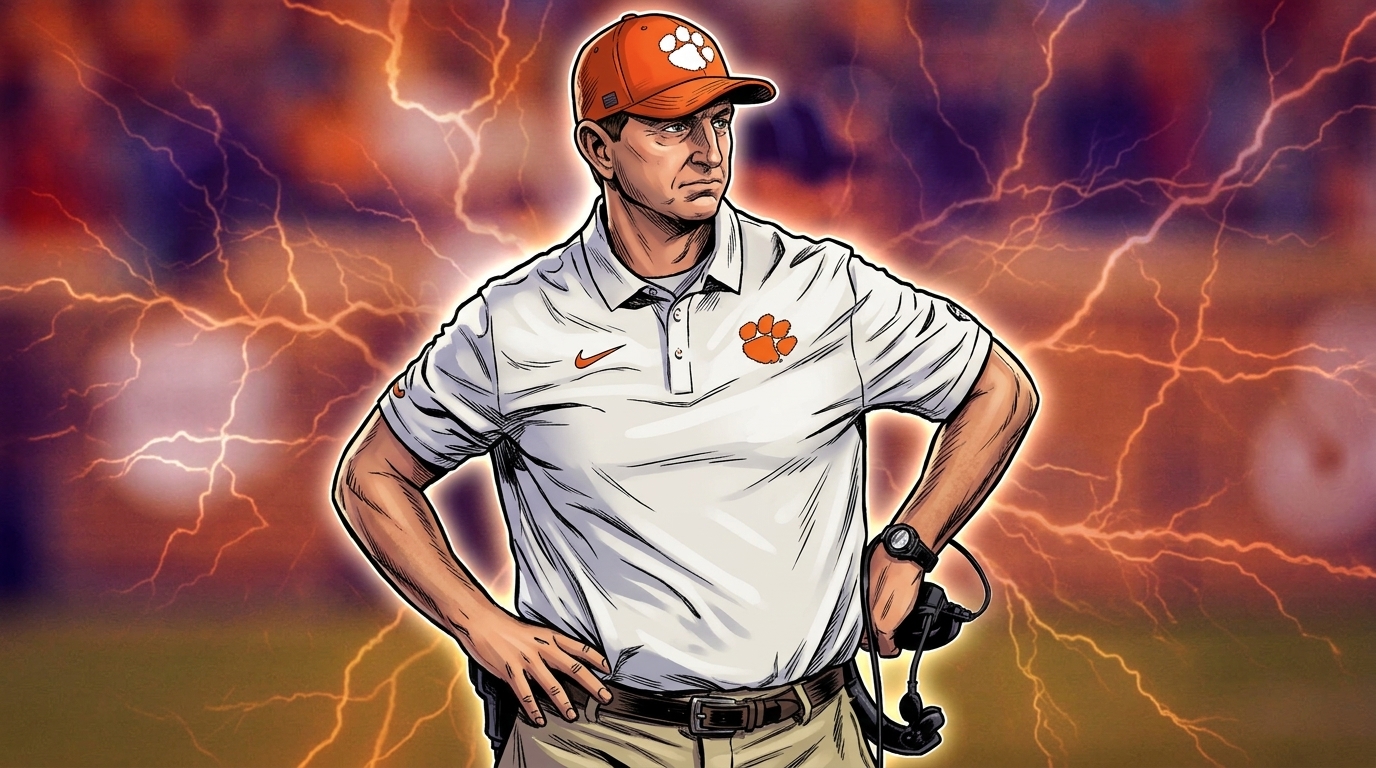

This week, Clemson and Georgia cancelled the next four games of a rivalry that already runs 66 meetings deep, and in that same week the Clemson Tigers boarded a flight to Berkeley for a Friday night game against a program they’ve played exactly once. Nobody engineered that timing. It just happened, which is the funnier and more damning version of this story.
The facts are dry enough to make you suspicious of how interesting they are. Georgia and Clemson had four games booked for 2029, 2030, 2032, and 2033. In March, Georgia athletic director Josh Brooks and Clemson athletic director Graham Neff signed an agreement wiping all four off the books; the document sat quietly until Sept. 22, when the Athens Banner-Herald pried it loose through an open-records request.
Both sides have a reason, and both reasons are the same reason wearing different jerseys. Clemson is moving to a nine-game ACC schedule while protecting its rivalry with South Carolina and starting a Notre Dame series in 2027. Georgia is staring down the SEC’s own nine-game future while still owing Georgia Tech a date every year. Add it up and there’s no room left for anyone; the marquee crossover game is the first thing the math throws overboard.
The Georgia Bulldogs currently own this rivalry anyway: 44-18-4 across 66 meetings, most recently a 34-3 rout in the 2024 season opener in Atlanta. That record makes the cancellation read like two programs independently reaching the same spreadsheet conclusion, which is almost worse than Clemson ducking a beating; the logic here isn’t personal, it’s structural, and it’s coming for everyone eventually.
Dabo Swinney, for his part, sounds like a man who watched this coming and couldn’t do anything about it:
“I hate it. Because I just think it’s great for fans but I get it.”
That’s the sentence of a man who understands the mechanism perfectly and still can’t operate the brake. He’s not defending the decision so much as narrating his own powerlessness inside it.
And then there’s the part where Swinney has been saying the quiet part out loud for a while now:
“I don’t think you’ll have many people play 11 Power Four games. You look around — we’ve been playing 10 forever around here. But going to nine conference games, a lot of these leagues are going — I wish it was less. I wish everybody played seven conference games and then you had more crossover games all throughout college football. But it is what it is.”
Swinney wants fewer conference games and more games exactly like the one his own program just lost. He is not lying, and he is not the villain of this story; he’s just a guy with a microphone standing next to a machine that doesn’t take requests. His preference and his program’s outcome pointed in opposite directions in the same calendar year, and the preference lost, because the preference was never actually driving.
Think of the sport’s scheduling apparatus as a poker table where every player announces their strategy out loud before the hand is dealt, then folds it the second a better card shows up. Conferences say they value nonconference marquee games; then they add a ninth conference game and marquee games are the first casualty. Athletic directors say rivalries matter; then they sign the cancellation paperwork and sit on it for six months. Coaches say they want more crossover football; then their own department cancels a crossover game while they’re mid-flight to a new one.
Nobody at that table is bluffing, exactly. They’re all just playing hands dealt by conference realignment, television contracts, and a calendar that only has so many Saturdays in it, and the stated preferences hold up right until the moment they cost something.
The ordinary version of this story calls Clemson’s Friday trip to Cal Golden Bears territory a replacement for Georgia. The game was already on the ACC schedule before the Georgia agreement became public; it’s Clemson’s first-ever conference game on the West Coast, and just the second all-time meeting between these two programs, 35 years after the first. The two stories share a news cycle, not a cause, and that’s exactly the point: you don’t need a conspiracy when a coincidence already indicts the system on its own.
Mark Packer put it more bluntly than I need to:
https://twitter.com/MarkPacker/status/2102524950359748941
He’s right that it’s absurd; he’s also, whether he meant to be or not, describing the entire operating model of modern college football in one sentence. Two programs close enough to schedule a home-and-home without touching an airport can’t keep a rivalry alive through 2033, but a flight to Berkeley clears every scheduling hurdle in its path without a second thought. The rivalry needed institutional cooperation. The Friday night game just needed a television slot.
Swinney will coach the Cal game like it’s the only one that ever mattered, because that’s the job. Somewhere underneath the pregame handshakes, though, is a coach who said what he wanted the sport to look like and then watched his own athletic department prove him wrong in the same news cycle, not out of malice, just because nobody currently steering college football is actually holding the wheel. For more of the sport’s scheduling apparatus quietly rearranging itself in real time, check out the rest of our college football coverage.