NHL All-Time Wins (Goaltending)
Martin Brodeur leads NHL goaltenders with 691 career wins, 116 ahead of Marc-André Fleury. See the all-time leaderboard, the chase and the era debates.
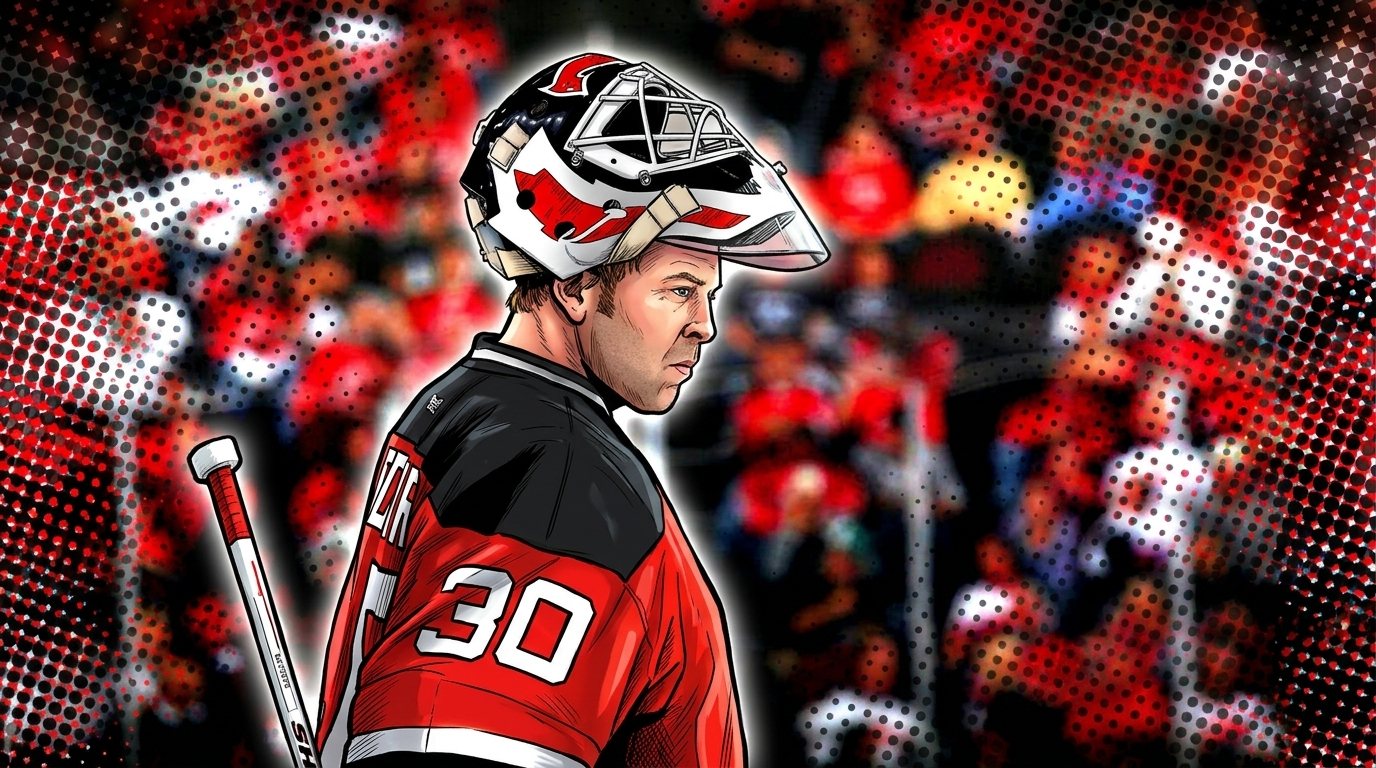
Martin Brodeur is the winningest goaltender in NHL history, with 691 regular-season victories over 22 seasons from 1991-92 to 2014-15. Through games of Nov. 7, 2026, the Hockey-Reference career leaderboard has Marc-André Fleury second with 575, Patrick Roy third with 551, Roberto Luongo fourth with 489 and Ed Belfour fifth with 484. Brodeur’s margin over second place is 116 wins, and no goaltender who was playing in the 2026-27 season was within 200 of him. He also holds the NHL records for career shutouts (125) and goaltender games played (1,266). That combination of volume and longevity is why the record is widely seen as one of the safest in the sport.
The leaderboard
| Rank | Name | Wins | Seasons |
|---|---|---|---|
| 1 | Martin Brodeur | 691 | 1991-92 to 2014-15 (NJD, STL) |
| 2 | Marc-André Fleury | 575 | 2003-04 to 2024-25 (PIT, VEG, CHI, MIN) |
| 3 | Patrick Roy | 551 | 1984-85 to 2002-03 |
| 4 | Roberto Luongo | 489 | 1999-00 to 2018-19 |
| 5 | Ed Belfour | 484 | 1988-89 to 2006-07 |
| T-6 | Sergei Bobrovsky | 459 | 2010-11 to 2026-27 (active) |
| T-6 | Henrik Lundqvist | 459 | 2005-06 to 2019-20 |
| 8 | Curtis Joseph | 454 | 1989-90 to 2008-09 |
| 9 | Terry Sawchuk | 445 | 1949-50 to 1969-70 |
| 10 | Jacques Plante | 437 | 1952-53 to 1972-73 |
| 11 | Tony Esposito | 423 | 1968-69 to 1983-84 |
| 12 | Jonathan Quick | 410 | 2007-08 to 2025-26 |
| 13 | Glenn Hall | 407 | 1952-53 to 1970-71 |
| 14 | Grant Fuhr | 403 | 1981-82 to 1999-00 |
| 15 | Chris Osgood | 401 | 1993-94 to 2010-11 |
At a glance
Per Hockey-Reference and NHL.com, through games of Nov. 7, 2026.
Brodeur took the record on March 17, 2009, when the New Jersey Devils beat the Chicago Blackhawks 3-2 at Prudential Center. He made 30 saves in that game for his 552nd win, breaking the tie with Roy. He had pulled level three nights earlier with a 3-1 win in Montreal, according to his Wikipedia biography. He added 139 more wins over the next six seasons. His Hockey-Reference page shows him leading the league in wins nine times, including 48 in 2006-07. That single-season record stood alone until Braden Holtby matched it in 2015-16. Brodeur’s career ended with a 691-397 record, a 2.24 goals-against average and a .912 save percentage. He won three Stanley Cups, four Vezina Trophies, five Jennings Trophies and the 1993-94 Calder Trophy, and he entered the Hockey Hall of Fame in 2018.
Fleury got to second the slow way. He tied Roy on Jan. 6, 2024, in Columbus and passed him on Jan. 15, 2024, with a 21-save, 5-0 shutout of the New York Islanders for the Minnesota Wild, per theScore. He played through 2024-25 and finished with 575 wins in 1,051 games, along with three Stanley Cups and the 2020-21 Vezina Trophy.
The 500-win club has three members: Brodeur (691), Fleury (575) and Roy (551). Luongo (489) and Belfour (484) are next, with Luongo the closest goaltender to 500 without reaching it.
The chase
Through games of Nov. 7, 2026, the closest active goaltender is Sergei Bobrovsky, tied with Henrik Lundqvist for sixth at 459 wins. Hockey-Reference lists Bobrovsky as 38 years old, born Sept. 20, 1988. He won 33 games in 2024-25 and 27 in 2025-26, and he had 3 wins in 12 appearances to open 2026-27. That leaves him 25 wins behind Belfour for fifth and 92 behind Roy for third. To reach Brodeur, he would need 232 more wins, which is about seven more seasons at his 2024-25 pace.
Jonathan Quick, 12th at 410, announced his retirement in April 2026 after a final season with the New York Rangers, finishing 281 wins behind Brodeur. Andrei Vasilevskiy, 19th at 378, is the highest-ranked active goaltender outside the top 15. He is 313 wins short, which would take eight seasons of 40 wins with nothing to spare. No goaltender has passed 48 wins in a single season, so the record would take sustained elite workloads for most of a decade, not one great run.
How it’s measured
A goaltender’s win goes to the goalie of record on the winning team. Under the format in place since the 2005-06 season, that includes games decided in overtime and in the shootout. The change matters for comparing eras. Before the shootout arrived in 2005, the NHL recorded 5,729 ties in its first 87 seasons, and in those games neither goaltender got a win. In the 20 years after, 2,486 games went to a shootout, according to the Associated Press report, and each one produced a winning goaltender.
Shootout frequency has varied too. About 15% of games reached the shootout in 2009-10, while the 3-on-3 overtime format introduced in 2015-16 nearly halved that share. By 2024-25, a record-low 5.9% of games went that far. Lundqvist, whose career started with the shootout’s first season, ranks second all time with 61 shootout wins.
Schedule length and workload shape the list as well. Sawchuk, Plante and Hall started their careers when seasons were far shorter than the modern 82-game schedule, and they still rank in the top 13. Brodeur’s 1,266 games reflect a workhorse model that later teams moved away from as goaltending tandems became common.
The arguments
The main caveat is that wins are a team statistic credited to one player. A goaltender on a strong defensive team will pile up wins that an equally good goaltender on a weak team cannot. That is why rate measures like save percentage and goals-against average are usually considered alongside career totals. By counting, Brodeur’s resume is unmatched. His .912 career save percentage is strong but not the best of the 1990s and 2000s. Supporters of a rate-based ranking point to goaltenders such as Dominik Hašek, who ranks 17th with 389 wins despite a much shorter NHL career. Supporters of the counting record answer that holding a starting job at an elite level for two decades is itself the skill being measured. On that view, Brodeur’s nine league-leading win totals, five Jennings Trophies and four Vezinas show that the volume came from performance, not opportunity alone.
The second debate is era. Ties-era goaltenders such as Roy, Sawchuk and Plante had many games end without a decision. Brodeur, Fleury, Lundqvist and Bobrovsky had some or all of their careers in the shootout era, where every regular-season game produces a winner. Brodeur played 10 of his 22 seasons under the shootout format, so the record spans both systems, and anyone adjusting for era has to decide how to treat a tie. The official list makes no such adjustment. It also counts regular-season wins only. Playoff wins are kept separately, which is where Roy’s case as the greatest winner at the position is usually made.
Per Hockey-Reference career wins leaders, Hockey-Reference (Brodeur) and the Associated Press, through Nov. 7, 2026.
Why it matters
The career wins record is goaltending’s equivalent of the all-time goals and points marks in the NHL all-time goals and NHL all-time points leaderboards. It measures how good a goaltender was and also how long his team trusted him with the net. Brodeur’s 691 wins combine both in a way the modern game, with its shared workloads, seems built to prevent. On Nov. 7, 2026, the nearest active challenger was 232 wins away. For goaltenders such as Connor Hellebuyck, the realistic targets are the 500-win club and the top-five places on the list, not Brodeur’s record.