NHL All-Time Goal Leaders
Alex Ovechkin became the NHL's all-time goal leader on April 6, 2025, passing Wayne Gretzky's 894 — the full career goals leaderboard and its history.
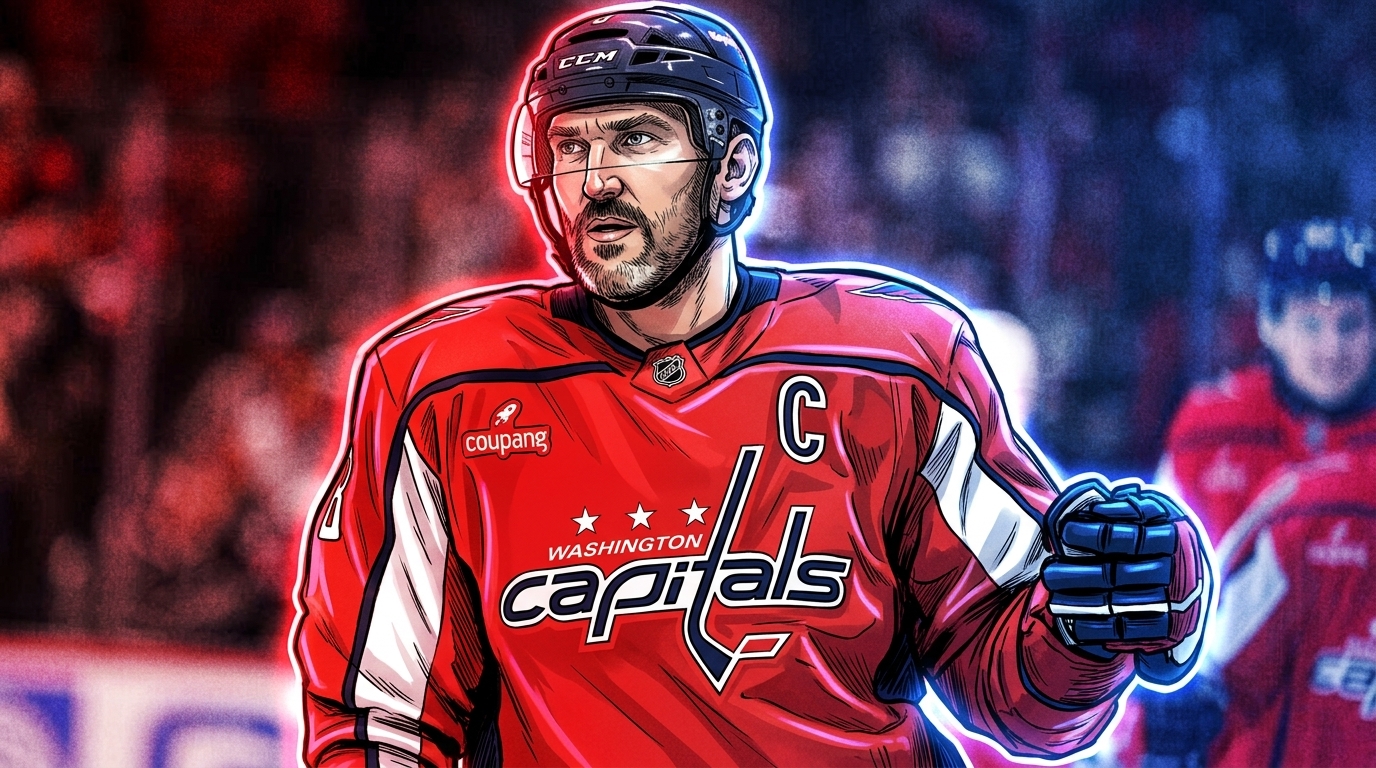
The all-time leader in NHL regular-season goals is Alex Ovechkin of the Washington Capitals, who reached 929 goals through the 2025-26 season. Ovechkin took sole possession of the record on April 6, 2025, when he scored his 895th career goal to pass Wayne Gretzky, whose 894 goals had stood as the mark since 1994. The list below reflects career NHL regular-season goals only; playoff goals and World Hockey Association totals are tracked separately.
The leaderboard
| Rank | Name | Goals | Team(s) / Years |
|---|---|---|---|
| 1 | Alex Ovechkin | 929 | Washington, 2005–26 |
| 2 | Wayne Gretzky | 894 | EDM / LAK / STL / NYR, 1979–99 |
| 3 | Gordie Howe | 801 | Detroit / Hartford, 1946–80 |
| 4 | Jaromír Jágr | 766 | multiple, 1990–2018 |
| 5 | Brett Hull | 741 | CGY / STL / DAL / DET / PHX, 1986–2006 |
| 6 | Marcel Dionne | 731 | DET / LAK / NYR, 1971–89 |
| 7 | Phil Esposito | 717 | CHI / BOS / NYR, 1963–81 |
| 8 | Mike Gartner | 708 | multiple, 1979–98 |
| 9 | Mark Messier | 694 | EDM / NYR / VAN, 1979–2004 |
| 10 | Steve Yzerman | 692 | Detroit, 1983–2006 |
| 11 | Mario Lemieux | 690 | Pittsburgh, 1984–2006 |
| 12 | Teemu Selänne | 684 | multiple, 1992–2014 |
| 13 | Luc Robitaille | 668 | LAK et al., 1986–2006 |
| 14 | Brendan Shanahan | 656 | multiple, 1987–2009 |
| 15 | Sidney Crosby | 654 | Pittsburgh, 2005–26 |
At a glance
Per Hockey-Reference, through the 2025-26 season.
The chase
No active player is within reasonable range of Ovechkin’s total. The only other active skater in the top 15 is Sidney Crosby, whose 654 goals leave him 275 behind; Crosby was 38 throughout the 2025-26 season, and closing a gap that large would require a scoring surge no player of his age has produced. The fastest active goal-scorer is Connor McDavid of the Edmonton Oilers, who scored 48 goals in the 2025-26 season but stood at roughly 409 career goals entering the 2026-27 season. Even sustaining an elite 40-plus-goal pace, a player at that total would need well over a decade to approach 929 — a timeline that assumes health and productivity into a player’s mid-to-late 30s.
The more immediate question is where Ovechkin’s own final number lands. Listed as active through the 2025-26 season at age 40, he continues to extend a record he already holds, and each goal he adds raises the bar a future challenger would have to clear. For the foreseeable future the chase is less about who is catching the leader than about how far out of reach the leader chooses to place the mark.
How it’s measured
The list counts regular-season goals scored in the National Hockey League. That definition matters for the players near the top who also competed in the World Hockey Association, which operated from 1972 to 1979 before its surviving franchises merged into the NHL. Gordie Howe’s 801 NHL goals do not include the goals he scored in the WHA, and Gretzky’s NHL total likewise excludes his one WHA season. Combined-professional tallies exist, but the canonical all-time list — the one Ovechkin now tops — is NHL regular-season only.
Scoring environment is the other complication. The NHL of the 1980s, when Gretzky did most of his work, was a high-event league in which teams routinely averaged more than four goals per game; the dead-puck era of the late 1990s and 2000s, and the tighter systems that followed, produced far fewer goals per game. A goal in a 4-3 era and a goal in a 2-1 era carry the same weight on this leaderboard even though they were far from equally common, which is why totals separated by decades are not straightforward apples-to-apples comparisons.
The arguments
The central debate is counting stat versus rate. Ovechkin passed Gretzky in total goals, but he needed more games to do it: his 929 goals came in 1,573 games — about 0.59 per game — while Gretzky scored his 894 in 1,487 games, a rate of roughly 0.60. On a per-game basis the two are nearly identical, and other names on the list scored at higher rates over shorter careers: Mario Lemieux, 11th all-time, reached 690 goals despite career-long health problems that cost him hundreds of games. Advocates for Ovechkin counter that longevity is itself a skill, and that scoring at a near-Gretzky rate through a lower-scoring era — while playing into his 40s — is precisely what makes the record durable.
There is also an era-adjustment argument, favored by analysts who translate raw totals into the scoring context of each season. By some era-adjusted models Gretzky’s peak remains the most dominant in league history even after Ovechkin claimed the counting record, because Gretzky’s goals came against the run of much higher league-wide totals. Supporters of the raw record reply that the leaderboard has always been kept in unadjusted goals, that Howe and Gretzky were credited the same way, and that changing the accounting after the fact moves the goalposts. Both positions are widely held; neither is the official standard, since the NHL and the reference sites publish the unadjusted list.
Per Hockey-Reference and NHL.com, through the 2025-26 season.
Why it matters
The all-time goals record is one of the few individual marks in North American team sport that had come to feel permanent. Gretzky broke Howe’s record on March 23, 1994 and held it for roughly 31 years, long enough that it was routinely listed among the records considered untouchable. Ovechkin’s pursuit, and the five goals that carried him from 890 to the record in early April 2025, reset the top line of a list that had not changed at No. 1 in a generation — and left the sport with a new number, 929 and climbing, that the next challenger will have to chase for years before anyone can seriously threaten it.