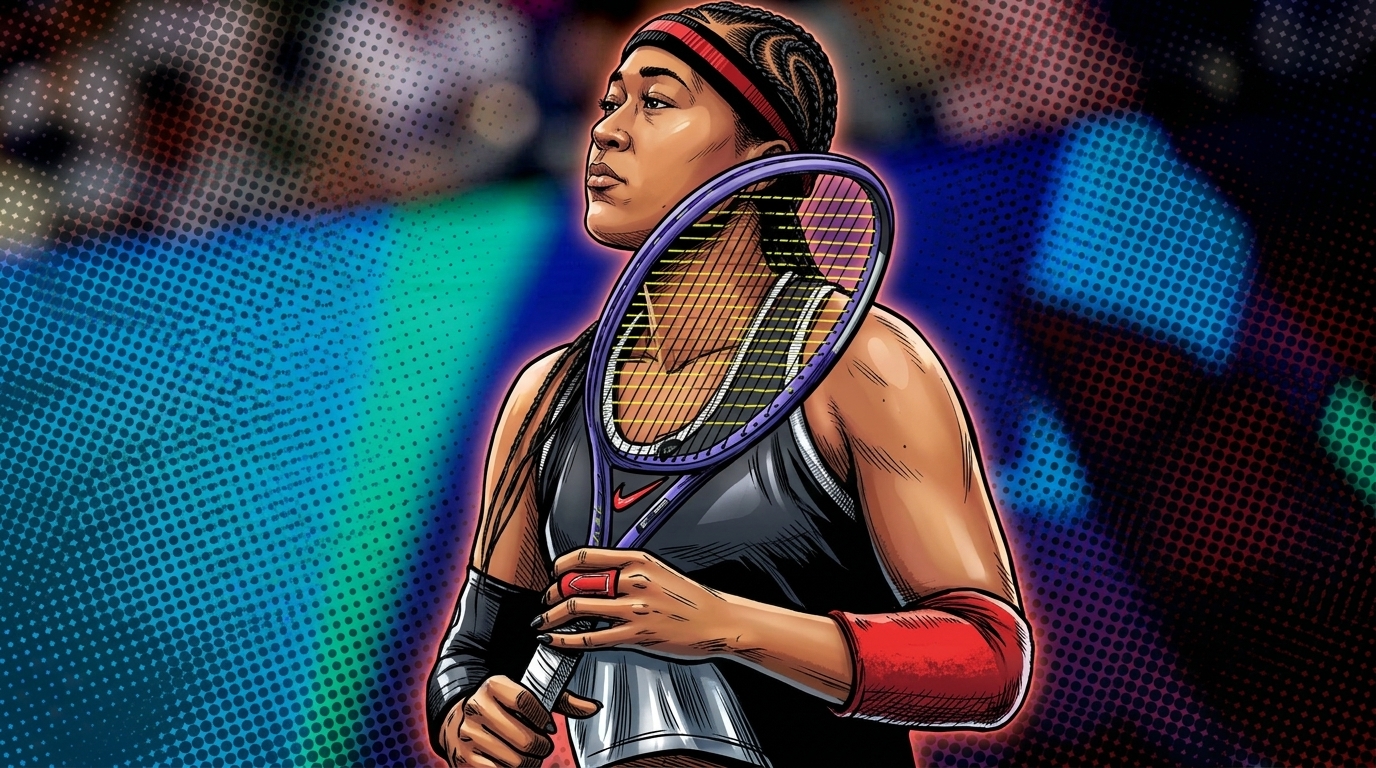

There’s a specific kind of internet reflex I’ve started timing: how fast a room settles on “cringe” before anyone has actually looked at the thing they’re mocking. I watch it happen in K-pop fandom constantly. A comeback drops and the verdict calcifies within minutes, usually before anyone’s broken down the styling or the references buried in it. Naomi Osaka’s Allen Iverson tribute at the US Open got the same treatment this week, except what nobody looked at closely was a full custom gown with newspaper clippings of her own career sewn into the fabric by hand.
Osaka wore the look for her first-round win over Anastasia Zakharova, a 7-6, 7-6 grind that mattered less online than what she had on: cornrows under a red-and-black headband, a sweatband on one arm, a single sleeve on the other, an asymmetrical light-gray hooded gown layered over the black tank and skirt she actually played in. Téla D’Amore and Ev Bravado of Who Decides War designed it, styled by Law Roach, built in roughly 30 hours around one specific reference — Iverson’s “gray sweats and the nonconformist cadence with which he moved through the world,” as the designers put it. And the discourse called it cringe before it called it good: headlines split between “Definition of Cringe” and “What an Entrance” inside the same news cycle, with critics telling a four-time major champion to focus more on her tennis.
The detail that got lost in the pile-on is the clippings themselves: not generic newsprint, her own career, stitched into an asymmetrical hood and sleeve that took two people roughly a day and a half to build. Iverson turned his body into the record of his life, ink and all, back when the NBA was trying to legislate his silhouette out of its arenas. Osaka’s gown does the same thing with fabric instead of skin: it wears the résumé so you don’t have to ask.
Osaka captioned the look “The Answer” on Instagram, Iverson’s old nickname, and if that reads like homework, that’s because it was. On media day she’d worn a T-shirt printed with his 1999 Slam cover and called him “a trailblazer” and “someone that I look up to,” someone who “shifted the way NBA players dress” and changed “the whole conversation about clothes in sports.” Asked why the theme was basketball at all, her answer was almost bored in its honesty: “Nike said basketball, so I said, ‘OK, you want basketball, I’ll give you basketball.’” That’s the sentence of someone slightly annoyed she has to explain the assignment, not someone chasing a viral moment.
Osaka’s Iverson tribute was the most detailed homage of the year in a sport that still treats fashion risk like a personality flaw, and it landed exactly where tennis discourse never wants to sit still: with the craft. Iverson spent his Philadelphia 76ers career fighting David Stern over the NBA’s 2005 dress code, a policy written specifically to keep cornrows, tattoos, and Timberlands out of league arenas. Translating that specific, contested history into tennis whites isn’t a costume. It’s a citation, made by someone who clearly did the reading.
Iverson’s own reaction said more than the critics did. He posted on Instagram: “Wow, what an honor!! BIG FAN can’t wait to meet you.” No hedging, no confusion about whether this counted as respect. The person the whole outfit was built around understood it in one sentence. It was strangers on tennis timelines, several sports removed from the reference, who needed it explained to them.
This isn’t new for her, either. She caught the same wave of mockery for a jellyfish look at the Australian Open, an Eiffel Tower design at the French Open, a kimono at Wimbledon — a full season of entrances treated as distractions instead of what they are, which is a four-time major champion using Grand Slam walk-ons as a canvas the same way Caitlin Clark’s signature shoe turned a Nike deal into a stage for her own self-expression. Tennis journalist James Gray pushed back on X, saying he was “fascinated by how triggered some people in tennis are by what Naomi Osaka wears.” Jon Wertheim made the same point with less heat: “We’re all for fashion and expression via attire.”
https://twitter.com/brkicks/status/2094645574649921896
That’s the clip that ended up circulating widest, cornrows, clippings, and all, stripped of the sneering headlines built around it, just the fit doing what it was built to do.
I don’t think the “cringe” crowd was lying about the reaction. It was real, it was fast, and it arrived before the information did. That’s the same gap from the top of this piece — the verdict lands before anyone’s actually looked at the thing they’re judging, and by the time the correction shows up, almost nobody’s still around to read it. Our culture coverage keeps landing on this pattern: craft gets a headline, then a correction nobody reads. Osaka handed tennis something that rewarded a second look, built out of her own career, sewn by hand, finished in under two days. Some people were always going to clock the effort a beat too late to say anything useful about it. I’m not sure that’s fixable. I just know which side of the reaction I’d rather be standing on.