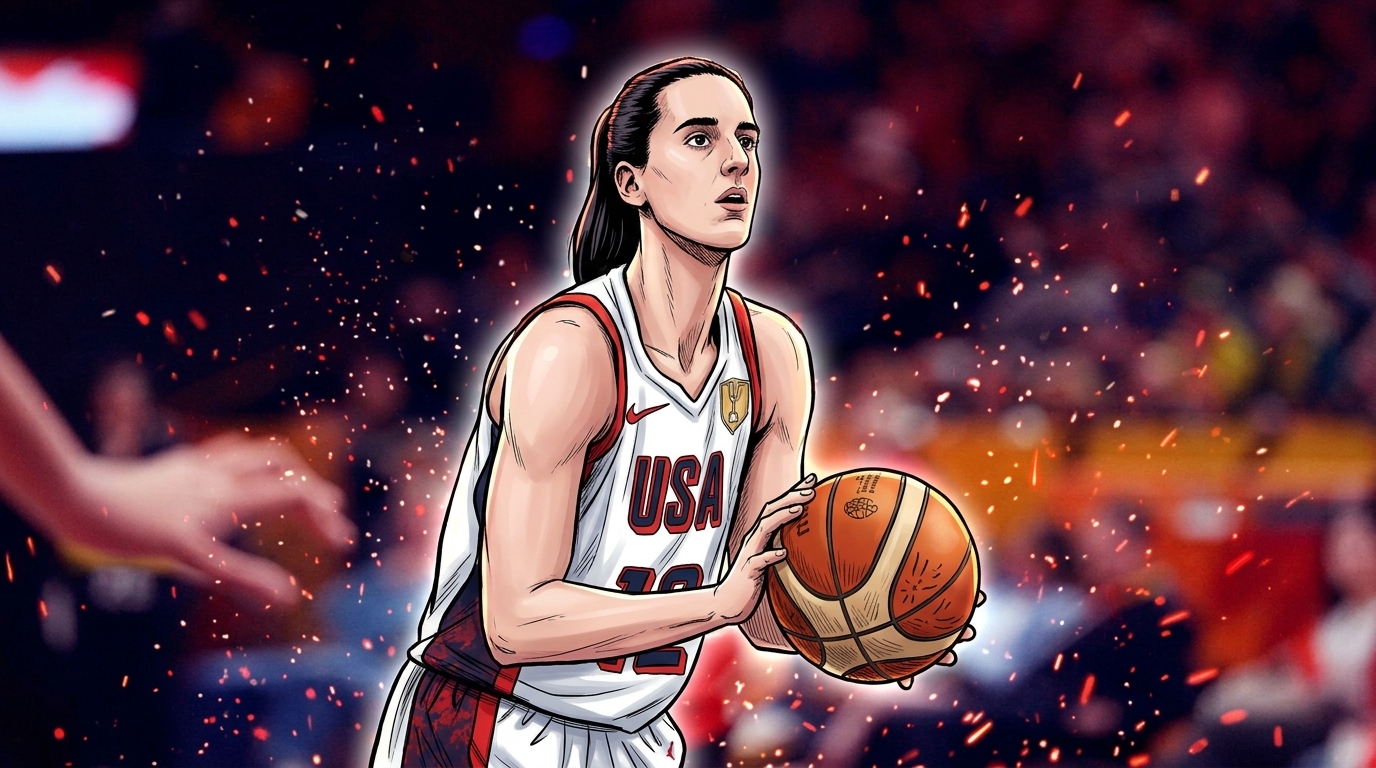

Paige Bueckers’ Sophomore Leap Fixed the Wings
There’s a number that explains more about the Dallas Wings’ 2026 turnaround than the box score from Paige Bueckers’ 22-point, 11-assist clinching night: 10-34. That’s the record Dallas posted the season Bueckers won Rookie of the Year, and it’s the reason this isn’t a story about one dominant rookie season. It’s a story about what took a full extra year to build around her.
The Wings beat the Portland Fire 96-78 on August 25 to clinch their first playoff berth since 2023, improving to 23-16 with five games still on the schedule — a franchise record for regular-season wins. Bueckers had 22 and 11, her 23rd 20-point game of the season, and all five starters scored in double figures. That’s a genuinely good basketball team. Roughly speaking, it isn’t the same team that finished 24 games under .500 twelve months earlier with the same best player on the floor.
Did Paige Bueckers Really Save the Wings as a Rookie?
No. Bueckers won the 2025 Rookie of the Year award, taking 70 of 72 first-place votes, on a Wings team that finished 10-34 and missed the playoffs by a wide margin. The actual playoff turnaround (23-16, a franchise-best win total, the first postseason appearance since 2023) arrived a year later, in her second season, once the roster around her caught up to what she does on the floor.
That gap is the whole article. Somewhere in the sports media cycle this summer, the Wings’ 2026 run got filed as a feel-good footnote to a Caitlin Clark and Indiana Fever storyline everyone already knows how to talk about. The interesting question isn’t “wow, Bueckers is good.” Everyone already knew that in May 2025. The interesting question is why 19.2 points and 5.4 assists a night from a generational rookie produced 10 wins, while a similar skill set, barely upgraded on paper one year later, produced 23.
The Year One Numbers Nobody Wants to Talk About
Bueckers’ rookie season was, statistically, excellent: 19.2 points, 3.9 rebounds, 5.4 assists, and 1.6 steals per game, with a 33.1 percent clip from three that was fine but unremarkable for a lead guard carrying that much offensive load. All-WNBA Second Team. Rookie of the Year, practically unanimous. None of it moved the record past 10-34.
That’s not a knock on Bueckers. It’s a data point about how basketball actually works. A rookie point guard putting up star numbers on a roster that isn’t built to play off her doesn’t produce wins at the rate people assume — she can only touch the ball so many times a game, and the four other players on the floor still have to make the corresponding reads, screens, and shots. Dallas in 2025 had the engine. It didn’t have the car built around the engine yet.
What Actually Changed Between Year One and Year Two
Two things happened, and only one of them is about Bueckers herself. The one that is: her efficiency jumped in a way that should worry the rest of the league. Her three-point percentage climbed from 33.1 to 38.1 despite more attempts per game, she’s shooting 51.6 percent from the field and 86.7 percent from the line, and by late August she was still flirting with a 50-40-90 season, a shooting-efficiency club so exclusive that most All-Stars never sniff it once in a career, let alone in year two.
The part that isn’t about her is the roster reorganizing itself around that gravity. Arike Ogunbowale is scoring about five points below her career average this season, and that’s not a decline so much as a role adjustment: less usage, more room for everyone else. Jessica Shepard’s line in the clincher, 21 points, 9 rebounds, 6 assists, reads like a player who finally has room to operate instead of a system asking her to do too much. Awak Kuier’s 12-and-12 with 5 blocks is a frontcourt anchor doing frontcourt-anchor things because somebody else is drawing the defense’s attention 25 feet from the basket. None of that shows up in Bueckers’ individual stat line. All of it shows up in the win column.
Bueckers said as much herself after the win, crediting the group rather than her own shot chart: “It means a lot, just in terms of all we’ve overcome throughout this season and how we did it together,” she said. Read against the 10-34 record from a year earlier, that’s an accurate diagnosis. The overcoming happened at the roster level, not just the shot chart.
Call it Dallas’s Two-Year Rule: a true No. 1 pick didn’t fix this particular bad roster the day she was drafted. It took a full year for the front office to figure out which pieces complemented her and which ones were only ever load-bearing because nobody better existed. It took the player herself a full year to turn obvious talent into the efficiency that makes everyone else’s job easier.
Is a No. 1 Pick a More Replicable Rebuild Than a Trade?
The Fever ran their own version of the same bet on Clark, and the timeline diverged in a useful way: Indiana made the playoffs in Clark’s rookie year, while Dallas needed Bueckers’ second. The Dallas front office didn’t do anything wrong; this is the honest range of outcomes when the strategy works. Both franchises are evidence that landing a true No. 1 pick is a more repeatable rebuild plan than waiting on a superstar trade request that may never come. A trade requires another team’s disaster and a star willing to force the issue. A high pick just requires being bad enough, for long enough, to earn one, and then, sometimes, the patience to sit through a second year before it shows up in the standings.
That patience part is the piece nobody wants to write in real time, because “we finished 10-34 and it’s actually fine, be patient” is not a sentence beat writers get to file in the moment. It only reads as correct in retrospect, once the record catches up. Dallas is the retrospective case now. Bueckers has been setting individual records all along, and they mattered as media stories in the moment. None of them mattered as a wins story until this season.
I run three amateur fantasy baseball projection models in my spare time, and not one of them has a clean input for “wins Rookie of the Year, team still loses 34 games.” That’s a real blind spot in how rookie seasons get graded across sports. We score the player’s box score and assume the team’s record catches up on its own. The Wings are the cleanest recent example of why it doesn’t, not right away.
Bueckers made an All-Star team of her own this year, at the same All-Star Weekend that put her alongside Caitlin Clark as the faces of the league’s next generation. But the number that should follow her into that conversation isn’t 19.2 or 22-and-11. It’s 10-34 sitting next to 23-16, same player, twelve months apart. That gap is the actual Rookie of the Year story. The award just got handed out a year before the wins showed up to back it.
Here’s the Wings making it official:
https://twitter.com/DallasWings/status/2092429710672187535
Give me the rebuild that takes two years and ends with a healthy playoff roster over the one that takes zero years and ends with a disgruntled star demanding a trade. The Dallas Wings just ran the two-year version in public. It only looks obvious now that the second year is finished.