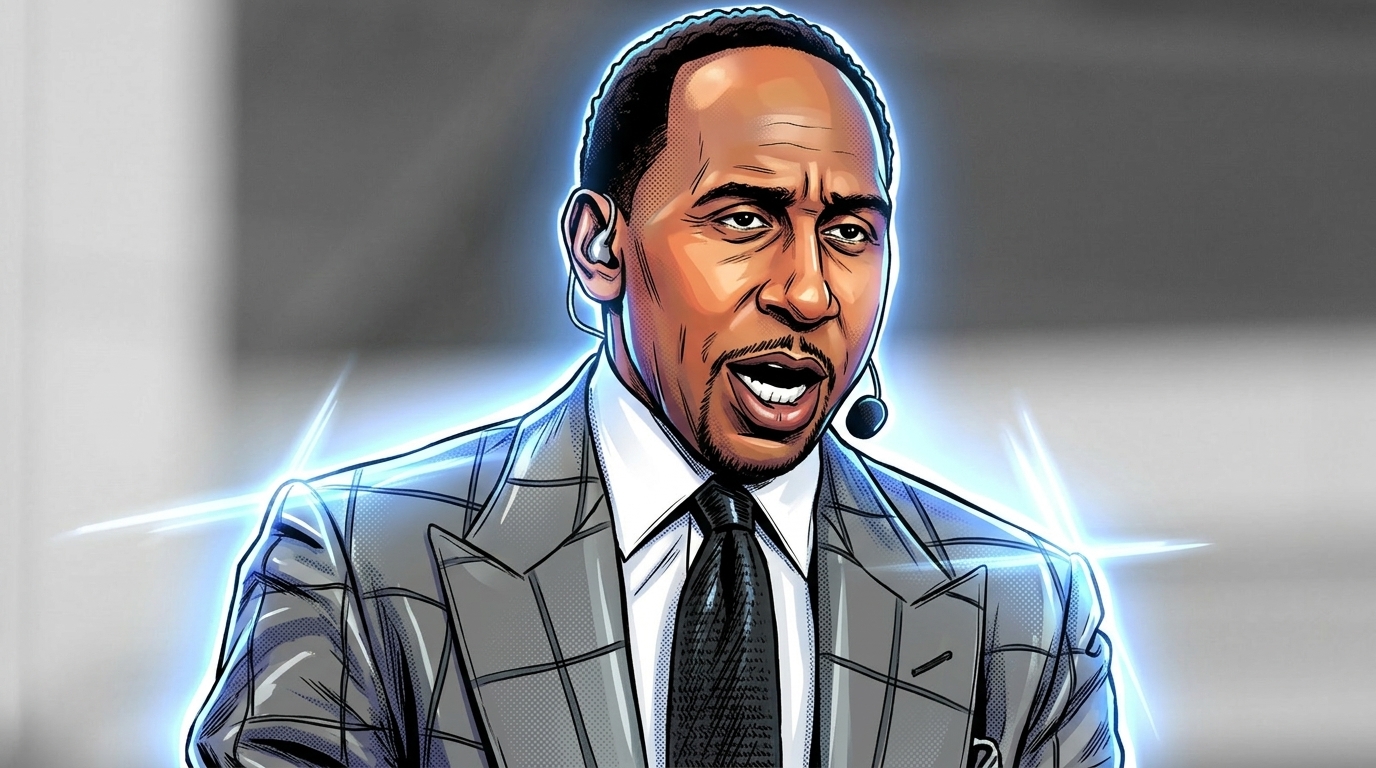

Stephen A. Smith has apologized on air twice in five days, and the second apology was for something stranger than the first: he invented a $25 million divorce settlement for Teyana Taylor, handed Iman Shumpert a quote he never said, and only found out either was wrong after the story was already loose in the world.
Five days earlier, Smith was mocking Lane Johnson’s mental-health-related retirement on the air, a stunt that also ended in an apology. “It doesn’t matter what my intent was; it’s how it was perceived,” he said that time, a tidy sentence that lets him own the outcome without ever naming the behavior that caused it. Round two arrived this time against a smaller target: not a player with a locker room and a league behind him, but a retired NBA player and his ex-wife, which made the invention easier to float and slower to catch.
On The Culture Table, the podcast Smith runs through his own company, Straight Shooter Media, he told his audience that Taylor received $25 million in cash plus another $10 million in property, luxury cars and other assets in the divorce, while Shumpert was left with roughly $2 million and no house to his name. He also delivered quotes he attributed directly to Shumpert, presented as things Shumpert had actually said. Shumpert never said them. Smith reported it as fact anyway.
“Those statements were inaccurate, and I want to sincerely apologize to both Iman Shumpert and Teyana Taylor,” Smith said on air, which is one way to describe telling millions of people a false number about another person’s divorce. “The quotes attributed to him, however, were not his statements at all, and the financial figures presented were inaccurate,” he continued, a sentence doing an enormous amount of work to make a fabricated quote sound like a clerical error. Then came the line that should have ended the show for the day instead of just the segment: “Straight Shooter Media and I, as the CEO, have a responsibility to ensure that information presented is properly sourced. We didn’t meet that standard here. Plain and simple.”
Smith said he called Taylor himself and she confirmed the figures were false, which means the correction required one phone call he could have made before he went on the air instead of after. Straight Shooter Media pulled the original episode once the backlash arrived.
There’s a useful way to think about what an apology like this actually costs Stephen A. Smith, and it’s the overdue library book, not the courtroom. A library doesn’t revoke your card the first time you bring a book back three weeks late; it charges you a nickel a day, you pay it at the counter without making eye contact, and you walk out with a new book under your arm five minutes later. Nobody involved considers you a thief. The system isn’t built to stop you from checking out more books. It’s built to let you keep checking them out, forever, as long as you eventually show up and pay the fine.
That’s the cycle Smith has run twice in five days: invent or distort something loud enough that it travels, let it work as programming for however many news cycles it earns, then walk it back on the same air that carried it, framed as integrity rather than cleanup. The fine gets paid on camera, publicly, which almost makes it look like a cost. It isn’t. The show doesn’t go dark. The audience doesn’t leave. The library reopens the next morning with the same guy behind the desk, and the only thing anyone remembers by Thursday is that he seemed sorry.
Marcus “Doc” Holliday, a former NFL running back, wasn’t interested in the apology’s sincerity so much as the process that made it necessary. He posted his reaction straight to Smith:
https://twitter.com/The_DocHolliday/status/2109485361290428708
“Stephen A. look, man, you just shut the hell up sometimes, bro. Or at least do your research,” Holliday said, calling the whole thing “junk food journalism,” a phrase more accurate than it sounds; junk food isn’t poison, it’s just manufactured to be consumed fast and in volume, with the nutrition facts buried where nobody reads them. Jalen Rose, watching the same apology, needed two fewer words: “tap dancing.”
Tap dancing is generous. A tap dancer at least has to learn the steps before the curtain goes up; Smith composes his routine in real time, in front of the audience, and still gets the standing ovation for admitting he missed a cue. He’ll be back on the air tomorrow, loud about something else entirely, and the library will take him at his word again, because that’s the whole arrangement. Nobody actually expects him to stop checking out books. They just want to see the nickel hit the counter.