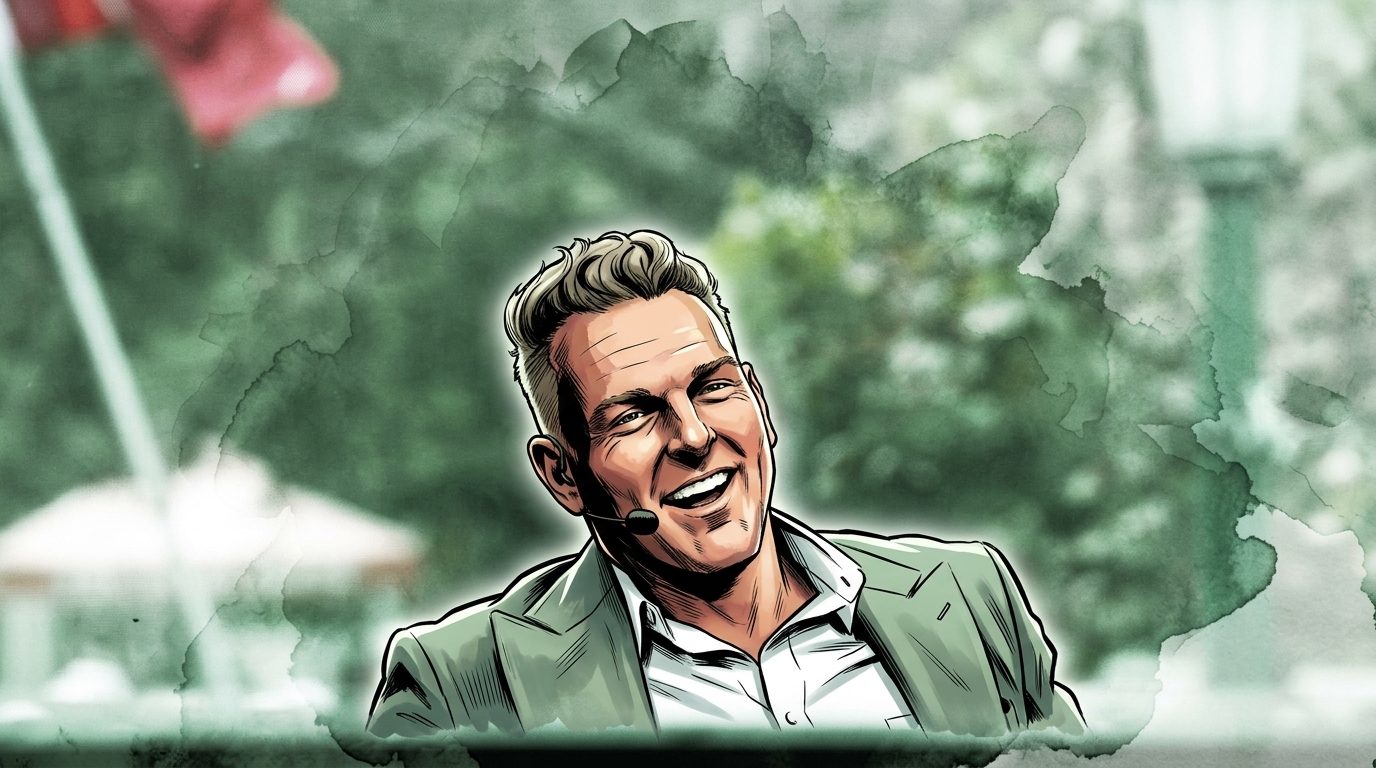

Joe Scarborough spent Tuesday morning on “Morning Joe” telling his audience that Pat McAfee is “a shame for the viewer,” which is a strange verdict to reach about a show that is drawing more people than it did a year ago. McAfee hosts College GameDay, and Scarborough does not care for what he has turned it into. He praised co-hosts Nick Saban, Rece Davis, Desmond Howard and Kirk Herbstreit by name and said they are being “eclipsed,” as though airtime is a pie and McAfee is eating more than his slice. The insult critics keep reaching for, that McAfee is running the MrBeast playbook on college football, making himself the main character and dancing as fast as he can to keep a number climbing, is supposed to be damning. It accidentally names the mechanism instead: that number is climbing.
That is the part nobody arguing against McAfee wants to sit with. College GameDay’s ratings are up 4 percent year over year in the exact stretch where McAfee has allegedly been ruining the broadcast; Week 9’s trip to Bloomington pulled 2.5 million viewers, 3.2 million for the final hour. An audience being alienated by a host does not grow 4 percent. It leaves, and it takes the ad money with it.
Scarborough’s complaint was that he has “had enough of this Pat McAfee ruining College GameDay.” He delivered it in the same stretch where McAfee’s reaction to a University of Utah student video mocking him, later deleted by the school, had dominated the conversation around GameDay’s Utah stop. “It is a shame for the viewer,” Scarborough said, apparently on behalf of the 2.5 million viewers who tuned in anyway. That is the logic behind Joe Scarborough’s shame for the viewer line in full: shame is supposed to be something people share, and these particular people seem fine with it.
The complaints keep landing on the same framing error: that controversy and quality are opposites, and a show getting louder must be getting worse. ESPN has heard a version of this complaint before, about a different host on a different medium. Howard Stern spent decades being told by terrestrial radio’s old guard that he was ruining the format; the stations that dropped him lost listeners to the ones that kept him, because Stern’s business case for thirty years was that “ruining” the legacy format was the product itself, not an unfortunate side effect of chasing one.
That comparison is exactly the one a recent piece draws between McAfee and Stern, and it is offered as flattery. It also quietly guts the case against him. If McAfee is doing to GameDay what Stern did to morning radio, the people calling it a shame are describing, with total accuracy, the exact engine that made Stern’s model a ratings monopoly for a generation.
https://twitter.com/TheAthletic/status/2117610577971564898
Will Leitch is not wrong that the broadcast’s center of gravity has moved. His read is sharper than Scarborough’s, and his prediction that McAfee burns out before the audience does is a claim that can actually be checked against future ratings, instead of a mood dressed up as analysis. Right now the only evidence on the table points the other direction. ESPN’s calculus on McAfee’s persona was never about taste; it is about a number, and the number keeps answering yes.
Scarborough can find the whole act exhausting. He does not get to call it a shame for the viewer when the viewers, in growing numbers, keep showing up anyway. Check the rest of our media coverage for how long it takes cable news to notice the same math works against most of its own lineup.