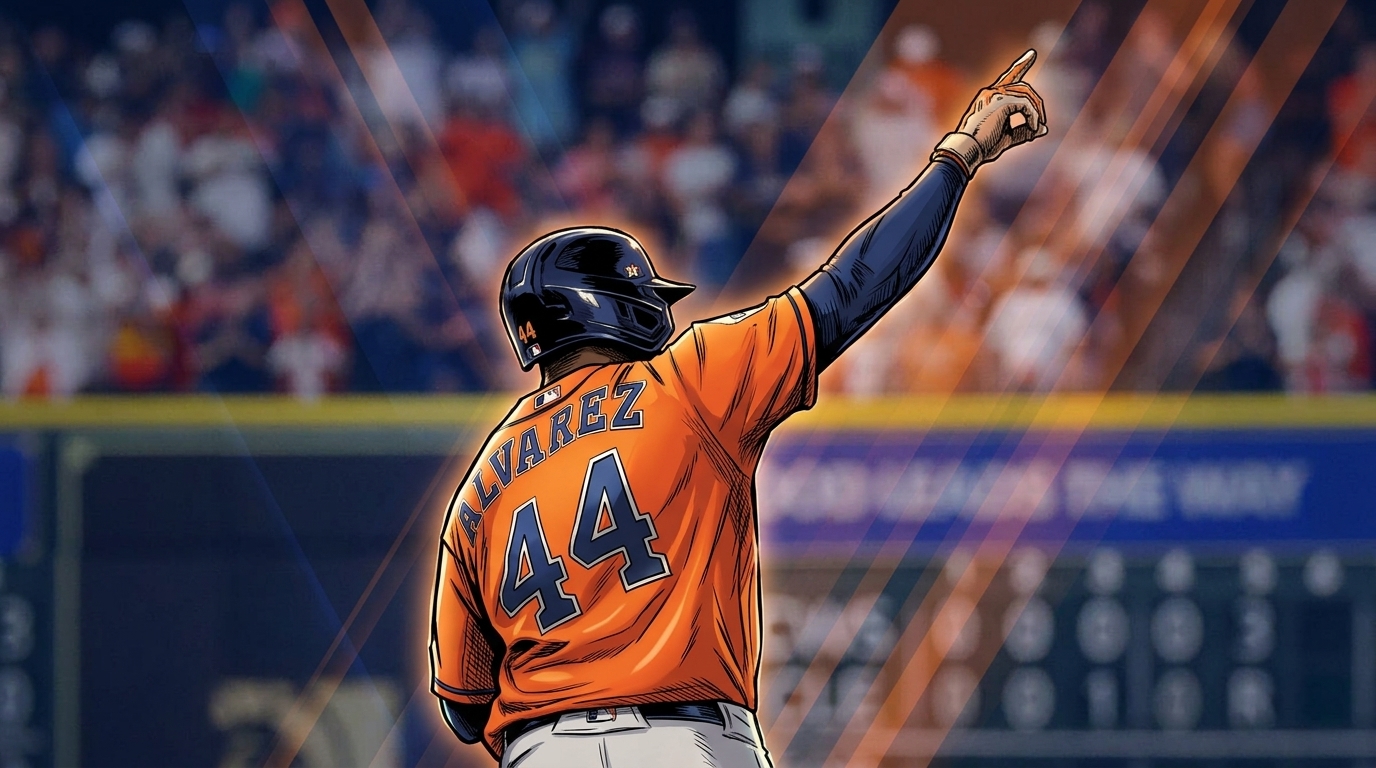

How do you talk yourself out of the exact outcome you’re trying to prevent? That’s the question every pitching staff facing Yordan Alvarez has been answering wrong for a month, and the data says so. Pitching around Alvarez this aggressively is baseball quietly admitting nobody wants to be the answer to a trivia question: who let him win the sport’s first Triple Crown since Miguel Cabrera did it for the Tigers in 2012?
The deeper problem lives underneath that fear. The league-leading intentional-walk rate isn’t just a defensive reaction to a great hitter. It may be the actual mechanism suppressing the counting stats a Triple Crown requires. Home runs and RBI don’t accumulate on bases on balls. Every walk-around is one more plate appearance where Alvarez can’t add to the two categories his case depends on, which means the avoidance strategy could be costing him the exact record teams are trying so hard to keep him from reaching.
The Record Nobody Wants to Watch Him Win
Start with what Alvarez has actually done, because it’s not close in two of the three categories. He leads the American League in batting average at .322, 14 points clear of Chandler Simpson’s .308, and his 36 home runs put him a hair ahead of Junior Caminero and Ben Rice, who are tied at 35. A 14-point batting average gap in late August is a real cushion. A one-homer lead over two players is a coin flip that could flip again on any given weekend.
RBI is where the story turns. Alvarez and Pete Alonso of the Orioles are tied at 91 apiece as of August 27, and that tie is new. Nine RBI in a calendar month is a modest stretch for a middle-of-the-order bat. Twenty-two in the same month is a hot one. That gap is the entire swing that turned a real Alvarez lead into a flat tie, and it opened during the identical window in which opponents decided the safest pitch to throw him is the one four feet outside. Alonso’s own recent history with a blown replay call in a game against the Orioles got more attention than his steady climb up the RBI board, but the board doesn’t care which story got the headline.
Can Yordan Alvarez Still Win the Triple Crown?
Yes, but narrowly. Alvarez still leads the AL in batting average and in home runs, but his once-solid RBI lead evaporated into a tie with Pete Alonso as opponents intentionally walked him a franchise-record 28 times, directly limiting his RBI chances down the stretch.
The Math Problem Hiding Inside the Strategy
Twenty-eight intentional walks isn’t a modest bump. It’s a new Astros franchise single-season record, breaking Jeff Bagwell’s mark of 27 from 1997, a record that had stood for almost three decades. Alvarez’s previous career high in intentional walks was 16, set two seasons ago. He has nearly doubled it with a month still to play.
The situational data is where the strategy stops looking like caution and starts looking like reflex. With a runner on second, first base open, and two outs, the exact spot where a manager decides he will not let the best hitter in the lineup beat him, teams have walked Alvarez 14 times out of 18 chances, a 78% clip. The four times they didn’t, he went 2-for-4 with a home run. I ran that split back and forth looking for a defense of the approach and kept landing in the same place: the tiny sample where teams trusted their pitcher produced exactly the outcome they’re avoiding, and they walked him anyway the next 14 times.
It gets stranger downstream. Isaac Paredes bats behind Alvarez and has a modest .260 average and .782 OPS on the season, but he’s hit .349 with a .990 OPS over his last dozen games, the kind of heater that should make intentionally walking the guy in front of him look like a bad bet. Teams have kept doing it anyway. A pitch-by-pitch matchup read on Paredes would have flipped by now. A season-long threat assessment on Alvarez, frozen since spring, apparently has not.
This is the kind of pattern that breaks a projection model before it ever shows up in a box score. I run three fantasy baseball leagues off a valuation system I built myself, and the input that system has the hardest time accounting for is opponent behavior that has nothing to do with matchup quality. A model built on rate stats and matchup-adjusted expectations keeps forecasting RBI totals as if Alvarez is seeing a normal share of hittable pitches. He isn’t. Those 28 walks are a decision made by opposing front offices, not a reflection of his skill, and they show up in the numbers as missing production rather than as a line item labeled fear.
https://twitter.com/theaceofspaeder/status/2047680252160418197
What Five Weeks of This Looks Like
The 2026 regular season ends September 27, which leaves right around a month for this to resolve one way or the other. If the current approach holds, Alvarez keeps his batting average and home run leads on cruise control while his RBI count grinds against a wall built almost entirely out of intentional walks. Alonso doesn’t need to get hot. He just needs Houston’s opponents to keep doing what they’re already doing.
The broader 2026 season has made room for more than one record chase to matter at once. Kyle Schwarber’s own home-run pace chase in Philadelphia has pulled attention north all summer, and the Astros have had their own moments in the spotlight, including a walk-off win over Seattle that mattered more for the AL West race than for any individual leaderboard. Alvarez’s Triple Crown bid has had to compete for oxygen with all of it, which may be part of why the strangeness of his situation hasn’t gotten the attention it deserves: a historically great offensive season getting quietly strangled by opponents who are terrified of exactly the thing they’re causing.
The evidence here is unambiguous on one point. Whatever happens with the Triple Crown, the intentional-walk strategy is not free. Every walk is a run that can’t be driven in, a chance that can’t become a home run, a data point removed from the ledger teams claim to be protecting. If Alvarez finishes the season short of Alonso in that column, the box score won’t record the 28 walks as the reason. It should. Baseball’s oldest defensive instinct — don’t let the best hitter beat you — might be the exact thing that keeps this era’s best hitter from becoming the answer to a question nobody in the league wants asked out loud for another decade.