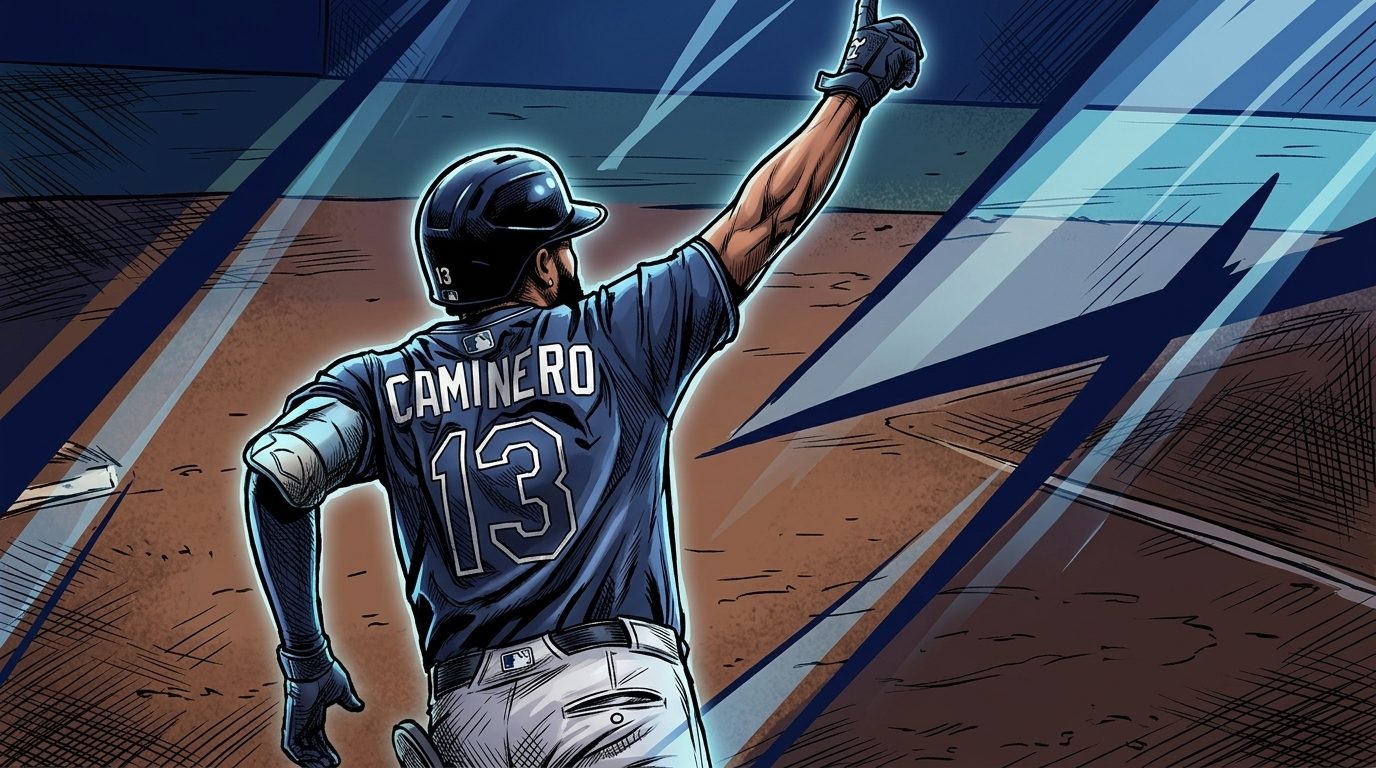
There’s a version of Chandler Simpson who gets drafted in 2016 instead of 2022, plays out a five-year career as a defensive replacement who occasionally pinch-runs in the eighth inning, and never sniffs an everyday lineup spot. That player had elite wheels and not much else. The sport had no rule structure that rewarded him, and a lot of coaches who’d tell you outright that stealing bases wasn’t worth the risk. Simpson is playing in 2026, batting .308 with 41 stolen bases for the Tampa Bay Rays, and the gap between those two timelines isn’t about him getting better. It’s about MLB deciding, deliberately, to build a game that pays off exactly what he does.
The Speed MLB Spent Twenty Years Coaching Out
For most of the 2010s, stealing bases was a losing bet by the numbers front offices actually trusted. Getting caught cost you an out and often a scoring position, and the math said most stolen-base attempts weren’t worth the downside. Teams internalized that. League stolen-base rates fell for a decade leading into 2023, dropping to 0.51 steals per game in 2022, down from 0.66 a decade earlier. That’s close to a quarter of the running game disappearing, one cautious front office at a time.
Speed didn’t get worse. The incentive to use it did. Pickoff throws had no real limit, plate appearances dragged on long enough for a catcher to reset and think, and analytics departments kept producing spreadsheets that told base coaches to sit still. A player built like Simpson, minor-league track record and all, would have been an inefficiency in that environment. Not because the tool wasn’t real. Because the sport had built a set of incentives that made the tool not worth using.
Why the Rules Actually Changed in 2023
MLB noticed the same decline and made a call most leagues never make about their own product: the rules themselves were the problem, so change them. Effective 2023, bases grew from 15 inches to 18 inches square, shrinking the physical distance a runner has to cover between bags. A pitch clock forced pitchers to work in 15 seconds with the bases empty and 20 with a runner on, killing the stall-and-reset approach that used to neutralize a fast runner. And pitchers got capped at two “disengagements” per plate appearance, meaning two pickoff throws or step-offs before a third one that misses is scored a balk.
None of those changes touch a bat or a swing. All three are aimed directly at making a stolen-base attempt a better bet than it used to be, which is a strange thing for a sport to admit about its own product. MLB looked at a skill it had quietly buried under a decade of cautious analytics and decided to dig it back up on purpose.
Is Chandler Simpson Really the Fastest Man in Baseball?
Chandler Simpson’s 29.5 feet-per-second sprint speed ranks him roughly 26th among qualified MLB runners in 2026, comfortably in the sport’s elite tier and well above the league average of about 27 ft/sec. He isn’t the single fastest player tracked by Statcast this year, but he’s fast enough that the gap barely matters once you add what he does with it.
What separates Simpson from most burners is that the speed comes attached to a real bat. He’s hitting .308 with a .337 on-base percentage and a .695 OPS through 138 games, plus 41 stolen bases against 14 times caught. A track star who can’t get on base is a personnel curiosity. A .308 hitter who steals 40-plus bags is a lineup problem for every opposing pitching staff, every single night.
By midseason, betting markets had already caught on. Simpson had emerged as the favorite to lead MLB in stolen bases, carrying a 37% implied probability that had climbed 11 points since Opening Day, ahead of Elly De La Cruz at 19% and Bobby Witt Jr. at 12%. Markets don’t move 11 points on name recognition. They move because a guy kept doing the thing every single week and the odds had to catch up.
None of this happened out of nowhere. Simpson stole 225 bases across four minor-league seasons while running a 9.8% strikeout rate, the exact contact-heavy, low-swing-and-miss profile that makes a burner’s speed usable instead of theoretical. A speedster who strikes out constantly rarely gets on base often enough for the wheels to matter. Simpson doesn’t have that problem, which is precisely why the jump to the majors looks less like a fluke and more like a running total that just kept going.
A tweet made the rounds this year arguing that a player with Simpson’s speed profile would have had front offices “moving mountains” to get him twenty years ago. That’s color, not fact — but it’s aimed at something real. Twenty years ago, teams weren’t building rosters, or rulebooks, around this skill. Now the league office is.
MLB has been on the record about what Simpson’s speed has meant for Tampa Bay this year:
https://twitter.com/MLB/status/2052576830918410474
The Numbers Behind the Stolen-Base Revival
The rule changes didn’t just nudge the running game. They broke it wide open. In 2023, MLB’s stolen-base success rate jumped to a record 80.1%, shattering the previous record of 75.7% set in 2021. Attempts per game climbed from 1.4 to 1.8. Teams stole 3,503 bases that season, the most since 1987. In 2024, that number climbed again to 3,617, the most since the 1910s, up from roughly 2,486 total steals in 2022.
Run that comparison in plain terms: MLB went from a league where stealing second was a coin flip with bad odds to one where it succeeds four times out of five, in the span of a single offseason. I ran the pre- and post-2023 numbers side by side more than once expecting a smaller jump, and each time the math came back the same. That’s not incremental change. That’s a sport hitting reset on an entire style of play, and a generation of players who grew up sprinting instead of standing still is now walking into a league built to use them.
What Simpson Proves About Where Speed Goes Next
Simpson isn’t an outlier who happened to get lucky with timing. He’s the shape of what the position looks like once the incentives actually reward it: high-contact bat, elite bottom-of-the-scale sprint speed, a stolen-base clip that keeps climbing without the caught-stealing totals spiraling with it. Teams spent a decade coaching that profile toward the bench. The Rays are running him out every day and watching him produce a top-tier stolen-base season while hitting .308.
Give it two or three more draft classes and this stops looking like a Simpson story and starts looking like a pipeline story — programs and scouts chasing exactly this shape of player because the league finally pays for it. For more storylines like this one, check out the rest of our MLB coverage. Bet on Simpson leading the stolen-base race this September, and bet on him not being the last of his kind.