Tampa Bay Rays
The Tampa Bay Rays are MLB's low-payroll AL East overachievers, three-time American League champions through 2026 who are chasing a first World Series title.
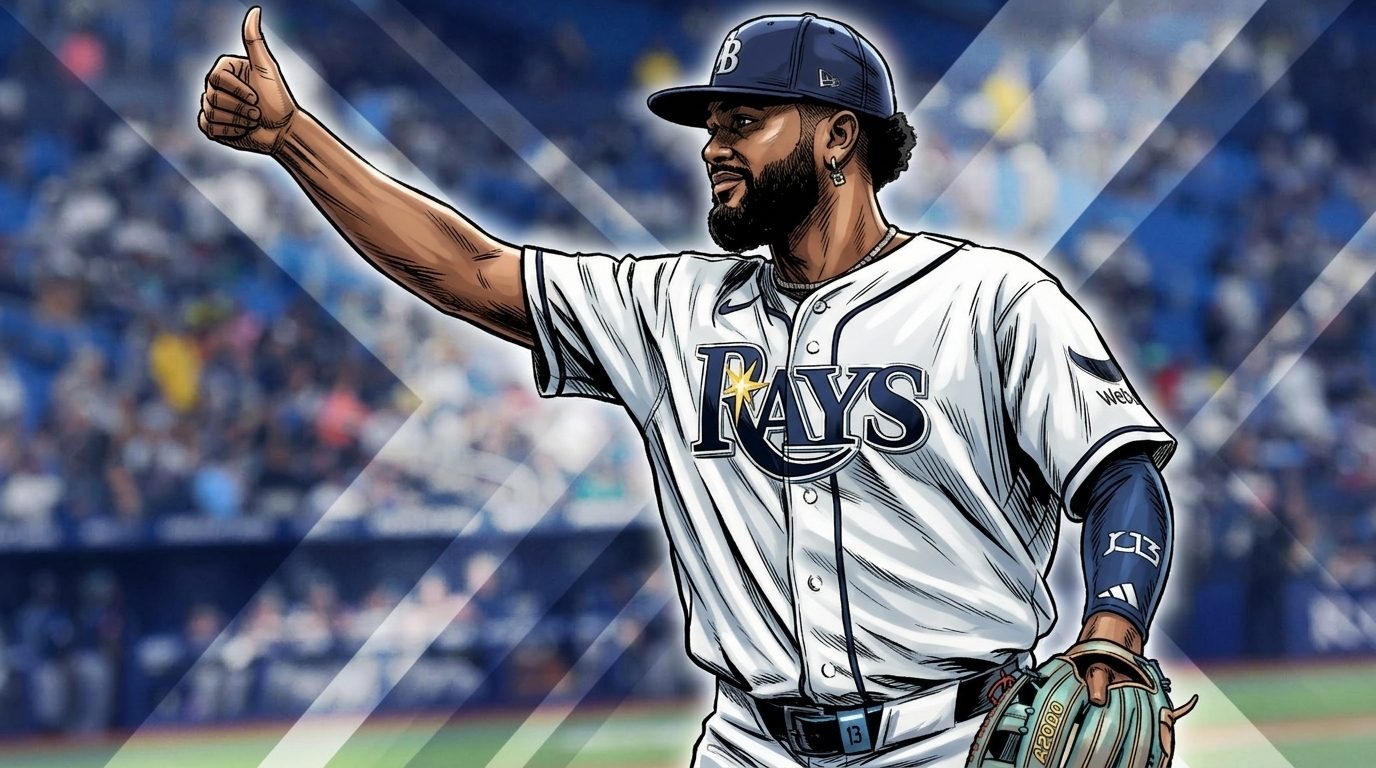
The Tampa Bay Rays are a Major League Baseball franchise in the American League East, a small-market club that turned a decade of losing into one of the sport’s most durable contenders by committing earlier and harder to analytics than almost anyone else. Founded in 1998 as the Tampa Bay Devil Rays and rebranded simply the Rays for 2008, they have won three American League pennants — in 2008, 2020 and 2026 — and lost all three World Series, which through the 2026 season makes them the rare perennial winner still without a championship. They play at Tropicana Field in St. Petersburg, carry among the lowest payrolls and smallest crowds in the majors, and in 2025 were sold for roughly $1.7 billion to a group that inherited both a pennant-caliber roster and an unresolved stadium question.
| Vitals | |
|---|---|
| Founded | 1998 (as the Tampa Bay Devil Rays) |
| League / division | MLB — American League East |
| Stadium | Tropicana Field, St. Petersburg, Fla. (new Tampa ballpark planned for 2029) |
| Owner | Group led by Patrick Zalupski (since Sept. 30, 2025) |
| Manager | Kevin Cash (as of Nov. 4, 2026) |
| Pennants | AL champions 2008, 2020, 2026 — no World Series title |
The Devil Rays: a decade in the cellar (1998–2007)
An expansion team that started at the bottom. A group led by financier Vince Naimoli was awarded the franchise, and the Tampa Bay Devil Rays played their first game on March 31, 1998, an 11–6 loss to Detroit at Tropicana Field. The roster leaned on aging names — Wade Boggs and Fred McGriff — brought in to sell tickets in a baseball-hungry market that had chased a team for two decades. On Aug. 7, 1999, Boggs became the first player in history to record his 3,000th hit with a home run, connecting at the Trop.
Losing as a way of life. The early Devil Rays finished last in the AL East in nine of their first ten seasons, bottoming out at a franchise-worst 55–106 in 2002. Lou Piniella, a Tampa native, managed from 2003 to 2005 without moving the needle. What the losing did produce was draft capital: young talent such as Carl Crawford, Scott Kazmir and B.J. Upton, and — crucially — the No. 3 overall pick used on third baseman Evan Longoria in 2006 and the No. 1 overall pick spent on left-hander David Price in 2007.
2008: worst to first
New owners, a new name. Stuart Sternberg bought controlling interest in 2005, installed a young analytics-minded front office under Andrew Friedman, and hired Joe Maddon as manager. For 2008 the club dropped “Devil” from its name, swapped its green color scheme for navy, Columbia blue and gold, and reintroduced itself as the Tampa Bay Rays.
The turnaround nobody saw coming. The 2008 Rays went 97–65 after a 66–96 finish the year before, winning the first division title and first winning season in franchise history. Longoria took AL Rookie of the Year. Tampa Bay dispatched the Chicago White Sox in the Division Series, then beat the defending-champion Boston Red Sox in a seven-game AL Championship Series, closing it out at the Trop. The run ended in the World Series, a four-games-to-one loss to the Philadelphia Phillies whose Game 5 was suspended by rain and finished two days later.
The Rays Way: Maddon, Friedman and sustained contention (2009–2014)
Winning on a shoestring. The 2008 pennant hardened into a philosophy — the “Rays Way” — of competing against the Yankees and Red Sox on a fraction of their payroll. Friedman’s front office leaned into defensive shifts, platoon matchups, rotation depth and relentless roster churn, turning Tampa Bay into a laboratory the rest of the sport eventually copied. They won another AL East title in 2010 at 96–66 and took the Texas Rangers to a decisive Game 5 in the Division Series.
Twice through the back door. The Rays reached October as a wild card in 2011 on the final night of the regular season, Sept. 28, when Longoria’s walk-off home run in the twelfth inning completed a comeback from a 7–0 deficit against the Yankees. They returned in 2013 through a Game 163 tiebreaker and a Wild Card Game win. David Price won the AL Cy Young Award in 2012, and Jeremy Hellickson (2011) added a Rookie of the Year to the Longoria haul. The era closed when Maddon exercised an opt-out and Friedman left for the Los Angeles Dodgers after the 2014 season.
The Kevin Cash era and the next wave (2015–2019)
A manager hired to reinvent, again. Kevin Cash took over in December 2014 as one of the youngest managers in the majors and oversaw a reload rather than a teardown. The Rays again pushed the margins of the sport, popularizing “the opener” in 2018 — starting a reliever for the first inning before handing off to a bulk pitcher — a tactic that caught on across the league. Blake Snell anchored it, going 21–5 and winning the AL Cy Young Award in 2018.
Back to October. Behind Snell, Tyler Glasnow, Charlie Morton and emerging bats Austin Meadows and Brandon Lowe, the 2019 Rays won 96 games and returned to the postseason, falling to the pennant-winning Houston Astros in a five-game Division Series; Houston went on to lose the 2019 World Series to the Washington Nationals in seven games. Wil Myers had earlier given the franchise a third Rookie of the Year in 2013.
The 2020 pennant and 2021’s 100 wins
A second flag. In the pandemic-shortened 2020 season the Rays posted the American League’s best record at 40–20, beat the Yankees in a five-game Division Series and reached the World Series behind the postseason explosion of Randy Arozarena, whose 10 home runs and 29 hits set October records. They lost the series to the Dodgers in six games — a defeat defined by Game 4’s walk-off on a botched play and by Game 6, when Cash’s decision to pull a dominant Snell in the sixth inning drew national second-guessing.
The franchise peak. The 2021 Rays won a club-record 100 games and a second straight division title, with Arozarena taking AL Rookie of the Year, before a surprising four-game Division Series loss to the Red Sox. It remains the highest win total in franchise history.
The stadium saga, the sale and a third pennant (2022–2026)
Contention, then disruption. Tampa Bay stayed in the mix with a wild-card berth in 2022 and a 99-win 2023, each ending in a first-round Wild Card Series sweep. Off the field, the long-running fight over a replacement for Tropicana Field — and the question of whether the team belonged in St. Petersburg, Tampa or the region at all — overshadowed the baseball.
Milton and the road year. In October 2024, Hurricane Milton tore the roof off Tropicana Field and flooded the interior, forcing the Rays to play the entire 2025 season at the Yankees’ spring-training home, George M. Steinbrenner Field in Tampa. The roughly 10,000-seat ballpark produced the second-lowest attendance in the majors, an average of about 9,713 per game — 786,750 for the season — trailing only the Athletics’ 9,487. After repairs, the team returned to a restored Tropicana Field for 2026, and on Aug. 28, 2026, Hillsborough County approved funding toward a new Tampa ballpark targeted to open in 2029.
New ownership. Sternberg agreed to sell the franchise he had run for two decades. MLB owners unanimously approved the sale on Sept. 22, 2025, and it closed Sept. 30, 2025: a group led by Jacksonville homebuilder Patrick Zalupski, founder of Dream Finders Homes, bought the team for roughly $1.7 billion, a figure that dwarfed the club’s $1.25 billion Forbes valuation.
A third flag, a third defeat. The 2026 Rays went 98–64 for their first AL East title since 2021, with young third baseman Junior Caminero’s walk-off home run against Houston on Sept. 11 helping clinch the berth. They swept the Yankees in the Division Series and beat the Cleveland Guardians in a six-game Championship Series to win the pennant, then lost the World Series to the Milwaukee Brewers in five games — the franchise’s third pennant and third World Series loss, with the title drought intact.
Retired numbers
The Rays honor four numbers, a short list for a young franchise and one that spans a three-time batting champion, a baseball lifer, the sport’s universal tribute and, as of 2026, the face of the organization. Evan Longoria’s No. 3 was raised on July 12, 2026, making him the first homegrown Ray so honored; Wade Boggs and Don Zimmer are recognized for their Tampa Bay chapters, and No. 42 hangs for Jackie Robinson across all of MLB.
| No. | Player | Pos. | Team tenure | Retired |
|---|---|---|---|---|
| 3 | Evan Longoria | 3B | 2008–2017 | July 12, 2026 |
| 12 | Wade Boggs | 3B | 1998–1999 | 2000 |
| 42 | Jackie Robinson | 2B | — (leaguewide) | April 15, 1997 |
| 66 | Don Zimmer | Coach / advisor | 2004–2014 | April 6, 2015 |
Season by season
Every season in franchise history, folded by decade, newest first.
The 2020s 580–452 · 5 playoff berths · 2 pennants
| Season | W–L | Finish | Playoffs |
|---|---|---|---|
| 2026 | 98–64 | 1st | Lost WS (MIL 1–4) |
| 2025 | 77–85 | 4th | — |
| 2024 | 80–82 | 4th | — |
| 2023 | 99–63 | 2nd | Lost ALWC (TEX 0–2) |
| 2022 | 86–76 | 3rd | Lost ALWC (CLE 0–2) |
| 2021 | 100–62 | 1st | Lost ALDS (BOS 1–3) |
| 2020 | 40–20 | 1st | Lost WS (LAD 2–4) |
The 2010s 860–761 · 4 playoff berths · 0 pennants
| Season | W–L | Finish | Playoffs |
|---|---|---|---|
| 2019 | 96–66 | 2nd | Lost ALDS (HOU 2–3) |
| 2018 | 90–72 | 3rd | — |
| 2017 | 80–82 | 3rd | — |
| 2016 | 68–94 | 5th | — |
| 2015 | 80–82 | 4th | — |
| 2014 | 77–85 | 4th | — |
| 2013 | 92–71 | 2nd | Lost ALDS (BOS 1–3) |
| 2012 | 90–72 | 3rd | — |
| 2011 | 91–71 | 2nd | Lost ALDS (TEX 1–3) |
| 2010 | 96–66 | 1st | Lost ALDS (TEX 2–3) |
The 2000s 694–923 · 1 playoff berth · 1 pennant (Devil Rays through 2007)
| Season | W–L | Finish | Playoffs |
|---|---|---|---|
| 2009 | 84–78 | 3rd | — |
| 2008 | 97–65 | 1st | Lost WS (PHI 1–4) |
| 2007 | 66–96 | 5th | — |
| 2006 | 61–101 | 5th | — |
| 2005 | 67–95 | 5th | — |
| 2004 | 70–91 | 4th | — |
| 2003 | 63–99 | 5th | — |
| 2002 | 55–106 | 5th | — |
| 2001 | 62–100 | 5th | — |
| 2000 | 69–92 | 5th | — |
The 1990s 132–192 · 0 playoff berths · expansion era as the Devil Rays
| Season | W–L | Finish | Playoffs |
|---|---|---|---|
| 1999 | 69–93 | 5th | — |
| 1998 | 63–99 | 5th | — |
By the numbers
Franchise marks
Per Baseball-Reference, through the 2026 season.
Ranks
- 29th MLB franchise valuation, 2025 ($1.25 billion)
- 29th MLB average home attendance, 2025 (≈9,713)
- 3 AL pennants won without a World Series title
Per Forbes, Baseball America and Baseball-Reference.
Honors
- 3× AL champions (2008, 2020, 2026)
- 5× AL East champions (2008, 2010, 2020, 2021, 2026)
- 2× AL Cy Young (David Price 2012, Blake Snell 2018)
- 4× AL Rookie of the Year (Longoria 2008, Hellickson 2011, Myers 2013, Arozarena 2021)
- Franchise-record 100 wins (2021)
- 10 postseason appearances
Per Baseball-Reference and the BBWAA, through the 2026 season.
The arguments
Proof of concept, or a broken system? Supporters of the Rays Way hold the franchise up as evidence that a smart, disciplined small-market club can compete indefinitely against the sport’s giants — six division titles’ worth of contention on a bottom-of-the-league payroll. Critics read the same record as an indictment of baseball’s economics: Tampa Bay develops stars such as David Price, James Shields, Blake Snell and Wander Franco and then trades or loses them because it cannot pay to keep them, so the model, however clever, is a symptom of a revenue gap the sport has never fixed.
The team that can’t win the last one. Three pennants and no title invite the question of whether an organization optimized for the long regular season is built to win a short series. The sharpest flashpoint remains Game 6 of the 2020 World Series, when Cash pulled a dominant Snell in the sixth inning in keeping with the Rays’ matchup math; the Dodgers rallied and clinched, and the decision became shorthand, for one camp, for analytics overriding feel, and for another, for a process-driven choice that simply did not break their way.
Does the market belong in the majors? The stadium saga — years of failed sites, the smallest crowds in baseball, a season exiled to a spring-training park after Hurricane Milton — fuels a long-running debate over whether the franchise is viable in St. Petersburg, Tampa or the region at all, a debate the 2025 sale and the planned 2029 ballpark aimed to settle without fully resolving.
Why it matters
The Rays are baseball’s enduring test case: a franchise with the sport’s thinnest wallet and emptiest ballpark that nonetheless spent most of two decades winning, exporting ideas — the shift, the platoon, the opener — that reshaped how every team plays. Through 2026 they are also its great unfinished story, three times an American League champion and three times a World Series runner-up, carrying both the model everyone copied and the title that has never come.