
Notre Dame didn’t lose to BYU on Saturday night; it lost to a pattern that college football’s governing bodies keep insisting is a coincidence. With the Notre Dame Fighting Irish down four and throwing into the end zone on the final play, quarterback CJ Carr found Jaden Greathouse, a BYU Cougars defender arrived with his arms wrapped around Greathouse instead of the ball, and no flag came out. The 16-game winning streak ended at 28-24, and Notre Dame went home with nothing but a sideline interview and a grievance.
That grievance has company. In Week 1, the Michigan Wolverines beat Western Michigan 13-12 after officials put one second back on the clock for a Hail Mary touchdown, and the NCAA’s own football oversight committee later said the result would have been different under correct replay protocol, even as the Big Ten reviewed the same play and called it fine. In Week 4, the Texas Longhorns held off the Tennessee Volunteers on an onside kick the SEC admitted afterward was executed illegally. In Week 6, the Georgia Bulldogs beat the Alabama Crimson Tide on a defensive pass interference that never got whistled, one the Georgia defender involved later admitted he’d have wanted flagged had the jerseys been reversed. Four marquee games, four blown officiating decisions, four conferences that found the error only after it no longer mattered. The sport keeps treating each one as weather, a freak system that rolled through on an otherwise clear Saturday, instead of as four data points on the same chart.
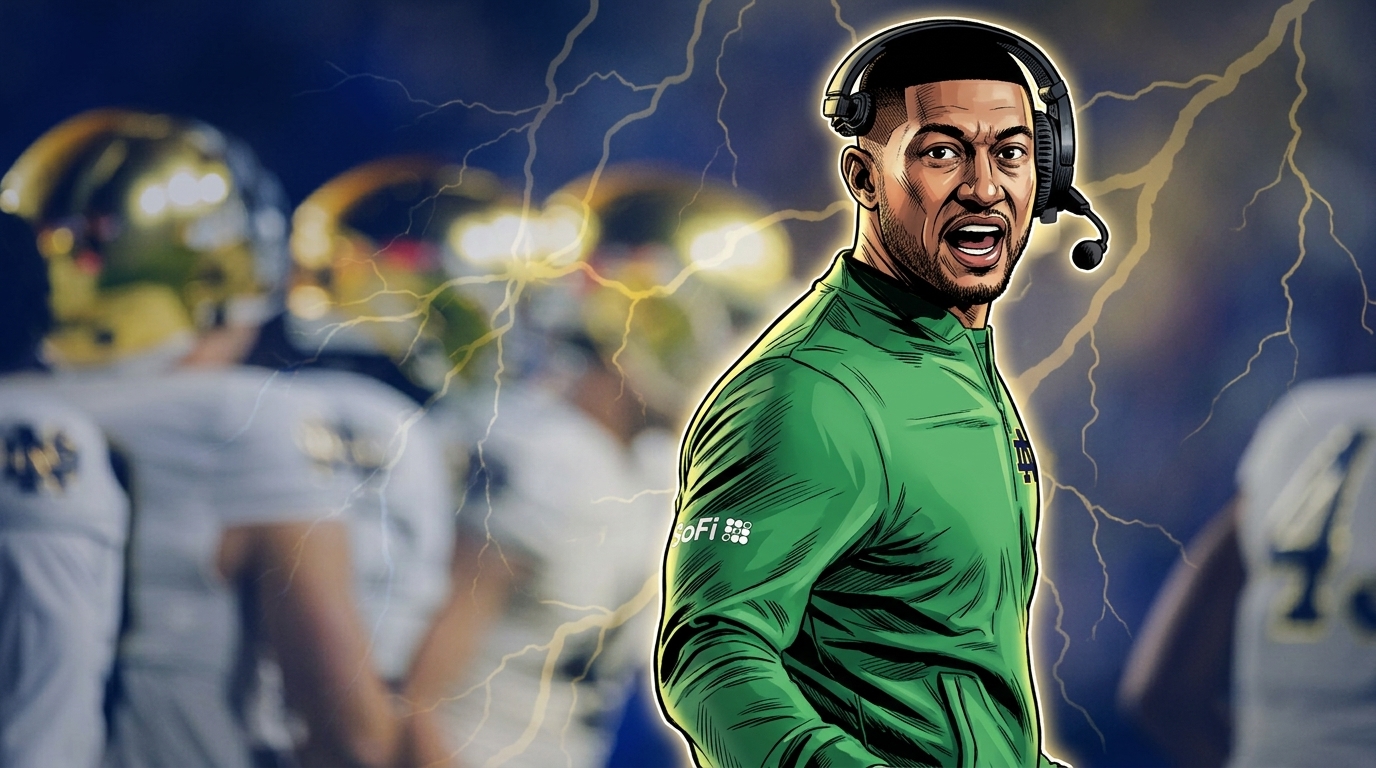
Marcus Freeman had the option to say the loss belonged to the officials, and had, by any reasonable read of the broadcast, the grounds to do it. He went a different way. “Chaos, man,” he said, then pivoted to blaming his offense’s execution on the final snap. It read like equanimity. It functioned as cover. Freeman’s restraint didn’t protect Notre Dame from anything; it protected the sport’s replay infrastructure from a head coach with a national platform saying, on the record, that it failed his team twice in one night.
College football’s accountability model works like a malpractice system with no plaintiffs. The conferences self-report the error after the verdict is already final, issue a statement expressing regret or confirming a mistake, and close the file. Nobody loses the game that’s already been played; nobody loses a job, either. The Big 12, which staffed the officiating crew for Notre Dame-BYU, acknowledged after the final whistle that one second should have remained on the clock when Carr’s incomplete pass hit the turf, which meant the replay booth should have handed Notre Dame one more snap instead of ending the game outright.
That admission came on top of a no-call the broadcast itself didn’t buy. ESPN rules analyst Matt Austin said as much on air, and NBC’s Terry McAulay flagged a separate problem on X: the in-stadium clock still read one second when Carr’s pass hit the turf, the same clock error the Big 12 would go on to confirm.
https://x.com/awfulannouncing/status/2111665252010254759
Two rules analysts, employed by two different networks, independently caught problems with the same final sequence that the officials on the field didn’t reach in real time. That’s the sport’s own hired experts confirming, after the fact, that the officiating crew missed obvious violations of its own rulebook.
Run the tape back further and the shape holds. Texas’s win over Tennessee survived an onside kick the SEC itself called illegal days later, with a “regrets” quote attached and zero change to the standings. The NCAA and the Big Ten couldn’t even agree with each other about Michigan’s Hail Mary, which is its own quiet admission that nobody actually knows what correct replay protocol looks like under pressure. Georgia’s game-winning non-call against Alabama got a cleaner dodge. Commissioner Greg Sankey wouldn’t even issue the regret: “We don’t comment on judgment calls,” he said, drawing a line between plays the SEC will own and plays it won’t. Three different conferences, three different degrees of candor, one identical outcome: nobody loses the win, and nobody has to build a system that catches the error before the scoreboard does.
None of this requires a conspiracy. It requires only that nobody with the power to fix the replay and officiating pipeline has an incentive to admit it is broken in a way that would cost anyone money or a job. The postgame statement is the whole system: it manufactures the appearance of accountability while guaranteeing none is actually assigned.
Notre Dame will get its participation-trophy apology sometime this week, probably by Tuesday, and it will change nothing about how BYU’s win is recorded or how the Big 12 staffs its crews. This is the fourth time since September that a game-deciding error got filed as an outlier instead of a trend, and anyone still following the rest of this season’s college football coverage should expect a fifth, sometime, somewhere, with its own apology already pre-written.