Texas Longhorns football
The definitive history of Texas Longhorns football: four national titles, the Royal and Mack Brown eras, Vince Young, Arch Manning and the move to the SEC.
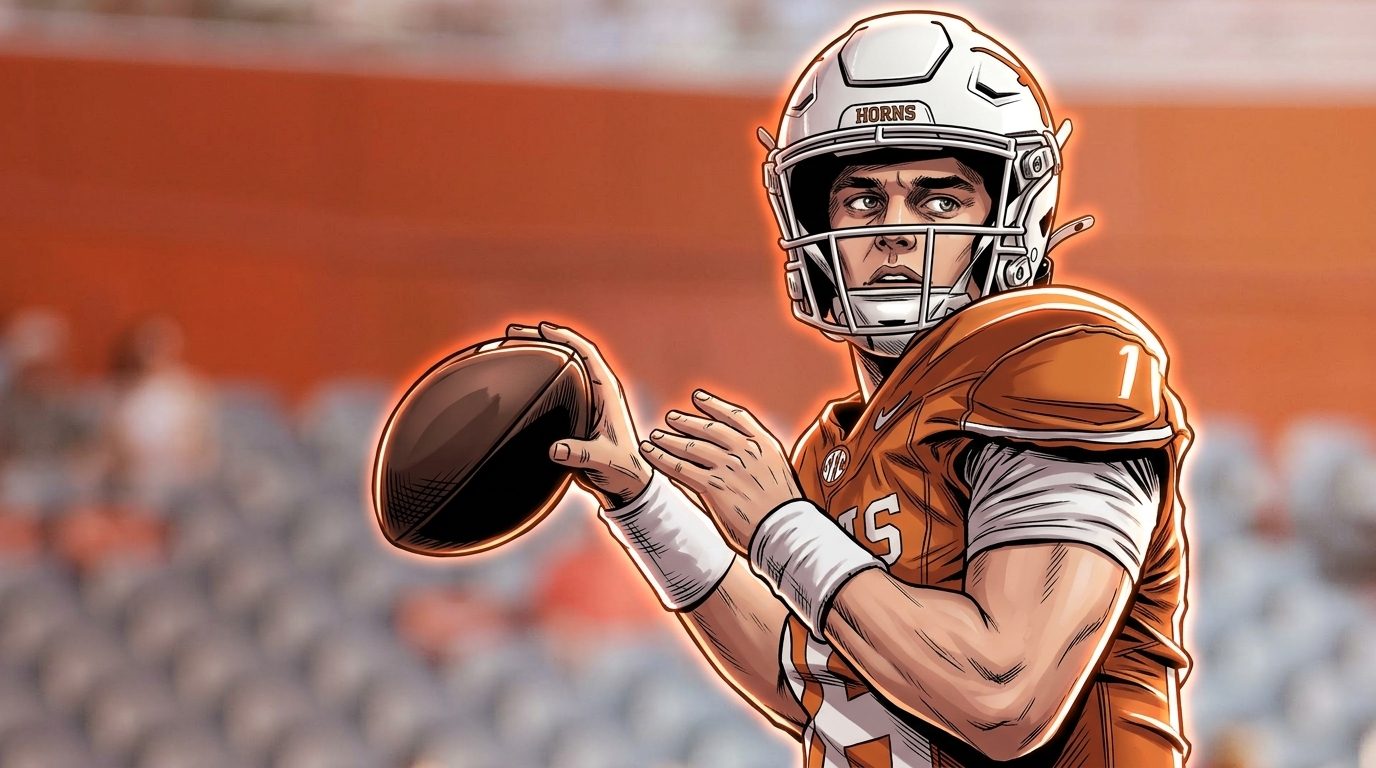
The Texas Longhorns are the football program of the University of Texas at Austin, one of the sport’s blue-blood powers and, through the 2025 season, the owner of a 975–397–33 all-time record that ranks among the winningest in major college football. Texas has won four claimed national championships, produced two Heisman Trophy winners, and spent most of its history as the dominant member of first the Southwest Conference and then the Big 12 before joining the Southeastern Conference in 2024. The program is defined by two dynasties a generation apart — Darrell Royal’s wishbone juggernaut of the 1960s and Mack Brown’s Vince Young–led 2005 champions — and by the Red River Rivalry against Oklahoma, one of the fiercest and oldest series in the sport. For a franchise that has rarely been far from the national conversation, the entry below is the full account that a Longhorns fan can take into any argument.
| Vitals | |
|---|---|
| Founded | 1893 (first season) |
| League / conference | NCAA Division I FBS · Southeastern Conference (since 2024); previously Big 12 (1996–2023), Southwest Conference (1915–1995), independent |
| Stadium | Darrell K Royal–Texas Memorial Stadium, Austin, Texas (opened 1924; capacity 100,119) |
| Owner | University of Texas at Austin |
| Head coach | Steve Sarkisian (since 2021), as of Oct. 16, 2026 |
| National titles | 1963, 1969, 1970, 2005 |
Origins and the early game (1893–1936)
Texas played its first football in 1893, a 4–0 season for a university barely a decade old. The program spent its formative years as a regional independent and member of the Southern Intercollegiate Athletic Association and the Texas Intercollegiate Athletic Association, posting unbeaten campaigns in 1900 (6–0), 1914 (8–0) and 1918 (9–0). The nickname “Longhorns” and the burnt-orange-and-white colors took hold in these decades, as did the move into a permanent home: Texas Memorial Stadium opened in 1924.
Texas was a charter member of the Southwest Conference, which began play in 1915 and would be the program’s home for eighty years. Early SWC titles came under Berry Whitaker (1920) and Clyde Littlefield (1928, 1930), but the program’s identity as a conference bully was not yet fixed; the mid-1930s under Jack Chevigny slid to 4–6 and 2–6–1 finishes, the low point before a deliberate rebuild.
Dana X. Bible and the postwar Longhorns (1937–1956)
The hiring of Dana X. Bible in 1937 was the first time Texas committed the resources of a national program. Bible was given an extraordinary salary and a mandate to win; after bottoming out at 1–8 in 1938, he built the Longhorns into a Southwest Conference force, winning league titles in 1942, 1943 and 1945 and finishing 10–1 with a Cotton Bowl victory in 1945. Bible’s era produced the program’s first consensus stars, including No. 22 Bobby Layne, the quarterback and kicker who played from 1944 to 1947 and went on to the Pro Football Hall of Fame.
Blair Cherry and Ed Price kept Texas near the top of the SWC into the 1950s, with Cherry winning the 1947 Sugar Bowl and the 1948 Orange Bowl and Price taking the 1952 Cotton Bowl. But the decade ended in collapse: Price’s 1956 team went 1–9, the worst season in modern program history, and the athletic department went looking for a young coach to restart everything.
The Darrell Royal dynasty (1957–1976)
Darrell Royal arrived in 1957 and built the most successful era in Texas history. Over twenty seasons he went 167–47–5, the most wins of any coach in school history, and won three national championships. His stadium — renamed Darrell K Royal–Texas Memorial Stadium in his honor in 1996 — still carries his name. Royal’s teams won the Cotton Bowl and the program’s first claimed national title in 1963, finishing 11–0 behind linebacker No. 60 Tommy Nobis, the two-way star who anchored the defense.
The wishbone offense made Texas the sport’s dominant team at the end of the 1960s. Installed with assistant Emory Bellard before the 1968 season, the triple-option attack powered a 30-game winning streak and back-to-back national titles. The 1969 team, celebrating college football’s centennial, met No. 2 Arkansas in the “Big Shootout” on Dec. 6, 1969, with President Richard Nixon in attendance, and won 15–14 before beating Notre Dame in the Cotton Bowl to finish 11–0. The 1970 team extended the run to a second straight UPI coaches’ national championship at 10–1, though a Cotton Bowl loss to Notre Dame cost it the AP title, which went to Nebraska.
Royal never slowed in the conference even as the national titles stopped. Texas won or shared the Southwest Conference crown in 1968, 1970, 1971, 1972, 1973 and 1975, and in 1977 — one year after Royal’s retirement — his successor inherited a program that had become the standard of the Southwest. Royal’s final championship talent included the backfield that would define the next era.
The Fred Akers near-misses (1977–1986)
Fred Akers took over in 1977 and nearly won it all twice. His first team went 11–1, rode Earl Campbell — the bruising tailback who won the 1977 Heisman Trophy and whose No. 20 is retired — to the No. 1 ranking for most of the season, and reached the Cotton Bowl needing only a win over Notre Dame to claim the title; the Longhorns lost 38–10. Akers’ 1983 team repeated the pattern almost exactly, going 11–0 into a Cotton Bowl against Georgia, only to fall 10–9 and surrender the national championship.
Akers won two Southwest Conference titles (1977, 1983) and finished 86–31–2, third-most wins in school history, but a 2–7 bowl record and those two one-game-short seasons left a sense of a program that could reach the doorstep and not through it. A 5–6 finish in 1986 ended his tenure.
The wilderness years (1987–1997)
For a decade Texas was merely good, and sometimes not that. David McWilliams delivered one golden season — a 10–2, undefeated-in-conference 1990 campaign that reached the Cotton Bowl — but surrounded it with losing records. John Mackovic followed and won the final true Southwest Conference championship in 1995 (10–2–1), then authored one of the program’s signature upsets: as 21-point underdogs in the inaugural 1996 Big 12 Championship Game, Texas beat No. 3 Nebraska 37–27 on James Brown’s fourth-and-inches gamble. Mackovic’s 4–7 collapse in 1997 ended the interregnum and set up the hire that would restore the program.
Mack Brown and the 2005 national championship (1998–2009)
Mack Brown rebuilt Texas into a national power and won its first title in 35 years. Over sixteen seasons he went 158–48, second only to Royal, and his teams reached double-digit wins nine straight years from 2001 to 2009. The early Brown era produced Ricky Williams, who won the 1998 Heisman Trophy and broke the NCAA career rushing record; his No. 34 is retired. But the ceiling was set by Oklahoma, which beat Texas five straight times from 2000 to 2004.
The 2005 season remains the defining campaign in modern program history. Led by quarterback Vince Young, Texas went 13–0 and met No. 1 USC — winners of 34 straight — in the BCS National Championship Game at the 2006 Rose Bowl. Young ran for 200 yards and passed for 267, and scored on an 8-yard fourth-and-5 keeper with 19 seconds left to win 41–38, ending the Trojans’ dynasty and claiming Texas’s fourth national title. Young’s No. 10 is retired.
Brown’s second wave came up a half-step short. Behind quarterback Colt McCoy — whose No. 12 is retired — Texas went 12–1 and won the 2009 Fiesta Bowl over Ohio State, then returned to the title game in the 2009 season at 13–1. In the January 2010 BCS National Championship Game, McCoy was knocked out on the fifth snap with a shoulder injury and Texas lost 37–21 to Alabama. It was the last elite season of the Brown era.
Decline, Strong, and Herman (2010–2020)
The program fell abruptly after 2009. Texas went 5–7 in 2010, its first losing season since 1997, and Brown resigned after the 2013 Alamo Bowl. The decade that followed was the longest competitive drought in modern program history. Charlie Strong, hired in 2014, never finished above .500 and was dismissed after three straight losing seasons. Tom Herman arrived in 2017 and briefly raised expectations — his 2018 team went 10–4 and beat Georgia 28–21 in the Sugar Bowl, after which quarterback Sam Ehlinger, not Herman, declared “Longhorn Nation — we’re baaaack!” while Herman himself pointedly declined to say Texas was “back” — but consecutive drop-offs and a 7–3 finish in 2020 led to his firing. Across the 2010s Texas went 71–57, a decade without a conference title.
The Sarkisian era and the move to the SEC (2021–present)
Steve Sarkisian was hired in January 2021 and rebuilt Texas into a playoff program. His first team went 5–7 in 2021, including a six-game losing streak — the program’s first since 1956 — before snapping it with a win over Kansas State, but the turnaround was fast. Texas improved to 8–5 in 2022 and then, in 2023, won the Big 12 — the program’s first conference title since 2009 — finishing 12–2 and reaching the College Football Playoff as the No. 3 seed before losing 37–31 to Washington in the Sugar Bowl semifinal.
The leap coincided with a seismic conference change. In July 2021, Texas and Oklahoma announced they would leave the Big 12 for the SEC; in February 2023 the two schools agreed to pay the Big 12 a combined $100 million to accelerate the move to 2024, a year ahead of schedule. Texas’s first SEC season was a success: the 2024 team went 13–3, lost 22–19 in overtime to Georgia in the SEC Championship Game, then won two CFP games — over Clemson and, in double overtime, Arizona State in the Peach Bowl — before falling 28–14 to Ohio State in the Cotton Bowl semifinal. The Peach Bowl win, per the school, made Texas the first program to win all six New Year’s Six bowls.
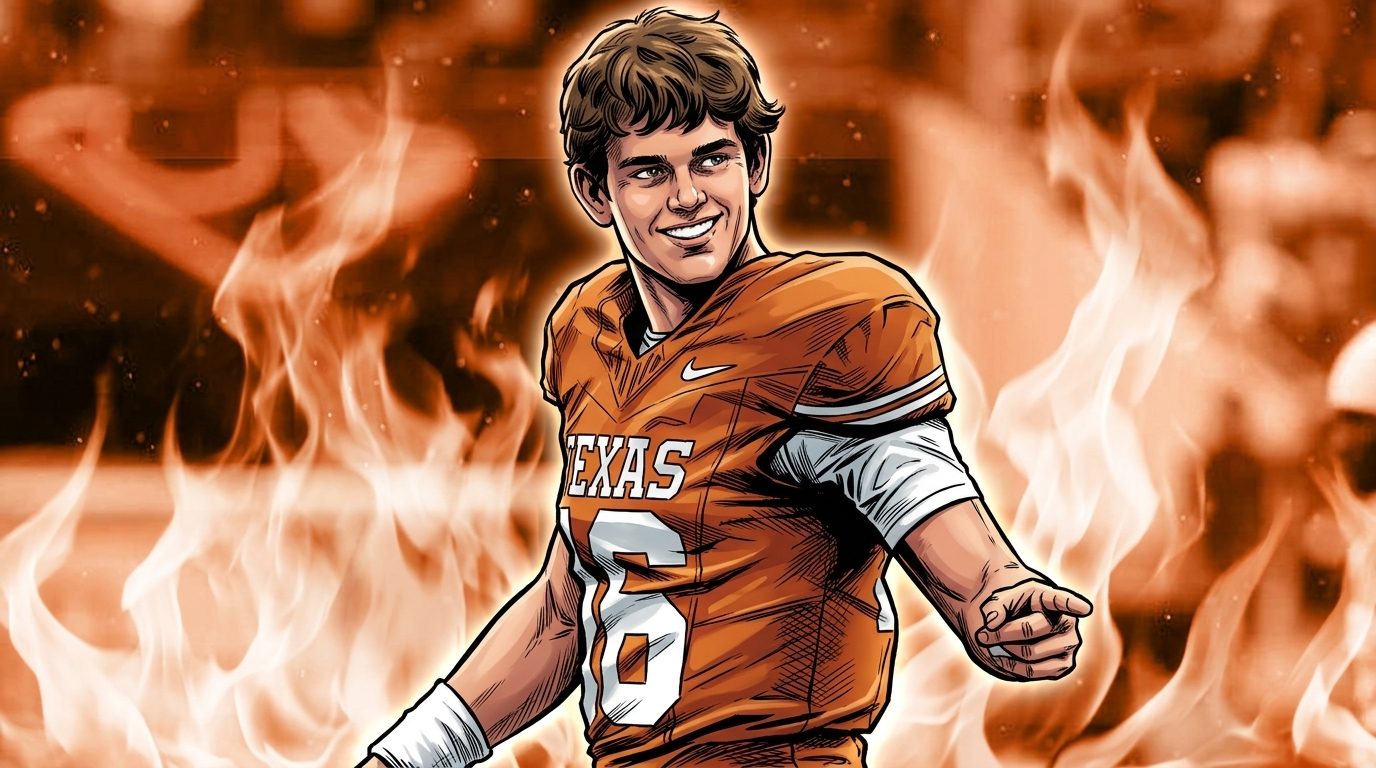
Arch Manning became the starter in 2025. The nephew of Peyton and Eli Manning and the most heavily recruited quarterback of his class, Manning sat behind Quinn Ewers for two years before taking the job. Entering 2025 ranked No. 1 in the preseason polls, Texas opened with a 14–7 loss at Ohio State and stumbled to additional defeats against Florida and Georgia, but Manning grew into the role — the Longhorns won seven of their final eight, beat Oklahoma 23–6 in the Red River Rivalry, and finished 10–3 with a Citrus Bowl win over Michigan. Manning threw for 3,163 yards with 26 touchdowns and ten rushing scores, and announced he would return for the 2026 season rather than enter the NFL draft. The era has been underwritten by spending that matches the ambition: ahead of the 2025 season, multiple outlets reported Texas’s roster cost between $35 million and $40 million in revenue-sharing and NIL money, with Manning’s personal NIL valuation reported as the highest of any college athlete.
Retired numbers
Texas has retired six jersey numbers, honoring a Hall of Fame quarterback from the 1940s, two Heisman-winning running backs, a two-way linebacker, and the two quarterbacks who led the program’s deepest modern runs.
| No. | Player | Pos. | Team tenure | Retired |
|---|---|---|---|---|
| 10 | Vince Young | QB | 2003–2005 | Aug. 30, 2008 |
| 12 | Colt McCoy | QB | 2006–2009 | Oct. 30, 2010 |
| 20 | Earl Campbell | RB | 1974–1977 | Nov. 24, 1979 |
| 22 | Bobby Layne | QB/K | 1944–1947 | Sept. 13, 2008 |
| 34 | Ricky Williams | RB | 1995–1998 | Sept. 30, 2000 |
| 60 | Tommy Nobis | LB | 1963–1965 | Sept. 13, 2008 |
Season by season
Every season since 1893, folded by decade with newest first. Records are overall W–L(–T); conference finish and bowl/CFP result are shown where applicable.
The 2020s 55–23 · 2 CFP semifinals (2023, 2024) · SEC move 2024
| Season | W–L | Finish | Bowl / CFP |
|---|---|---|---|
| 2020 | 7-3 | 3rd (Big 12) | Won Alamo Bowl |
| 2021 | 5-7 | 7th (Big 12) | — |
| 2022 | 8-5 | 3rd (Big 12) | Lost Alamo Bowl |
| 2023 | 12-2 | 1st (Big 12) | Lost Sugar Bowl (CFP semifinal) |
| 2024 | 13-3 | 2nd (SEC) | Won Peach Bowl; lost Cotton Bowl (CFP semifinal) |
| 2025 | 10-3 | T-5th (SEC) | Won Citrus Bowl |
The 2010s 71–57 · 0 conference titles · 2018 Sugar Bowl
| Season | W–L | Finish | Bowl / CFP |
|---|---|---|---|
| 2010 | 5-7 | 6th (Big 12 South) | — |
| 2011 | 8-5 | T-6th (Big 12) | Won Holiday Bowl |
| 2012 | 9-4 | T-3rd (Big 12) | Won Alamo Bowl |
| 2013 | 8-5 | T-2nd (Big 12) | Lost Alamo Bowl |
| 2014 | 6-7 | T-6th (Big 12) | Lost Texas Bowl |
| 2015 | 5-7 | T-5th (Big 12) | — |
| 2016 | 5-7 | T-6th (Big 12) | — |
| 2017 | 7-6 | T-4th (Big 12) | Won Texas Bowl |
| 2018 | 10-4 | 2nd (Big 12) | Won Sugar Bowl |
| 2019 | 8-5 | T-3rd (Big 12) | Won Alamo Bowl |
The 2000s 110–19 · 2005 national title · 2 BCS title games
| Season | W–L | Finish | Bowl / CFP |
|---|---|---|---|
| 2000 | 9-3 | 2nd (Big 12 South) | Lost Holiday Bowl |
| 2001 | 11-2 | T-1st (Big 12 South) | Won Holiday Bowl |
| 2002 | 11-2 | T-1st (Big 12 South) | Won Cotton Bowl |
| 2003 | 10-3 | 2nd (Big 12 South) | Lost Holiday Bowl |
| 2004 | 11-1 | 2nd (Big 12 South) | Won Rose Bowl |
| 2005 | 13-0 | 1st (Big 12 South) | Won Rose Bowl (BCS national champion) |
| 2006 | 10-3 | 2nd (Big 12 South) | Won Alamo Bowl |
| 2007 | 10-3 | 2nd (Big 12 South) | Won Holiday Bowl |
| 2008 | 12-1 | T-1st (Big 12 South) | Won Fiesta Bowl |
| 2009 | 13-1 | 1st (Big 12 South) | Lost BCS National Championship |
The 1990s 74–44–2 · last SWC title (1995) · first Big 12 title (1996)
| Season | W–L | Finish | Bowl / CFP |
|---|---|---|---|
| 1990 | 10-2 | 1st (SWC) | Lost Cotton Bowl |
| 1991 | 5-6 | T-5th (SWC) | — |
| 1992 | 6-5 | T-2nd (SWC) | — |
| 1993 | 5-5-1 | T-2nd (SWC) | — |
| 1994 | 8-4 | T-1st (SWC) | Won Sun Bowl |
| 1995 | 10-2-1 | 1st (SWC) | Lost Sugar Bowl |
| 1996 | 8-5 | 1st (Big 12 South) | Lost Fiesta Bowl |
| 1997 | 4-7 | T-4th (Big 12 South) | — |
| 1998 | 9-3 | 2nd (Big 12 South) | Won Cotton Bowl |
| 1999 | 9-5 | 1st (Big 12 South) | Lost Cotton Bowl |
The 1980s 73–42–2 · 2 SWC titles (1981, 1983)
| Season | W–L | Finish | Bowl / CFP |
|---|---|---|---|
| 1980 | 7-5 | T-4th (SWC) | Lost Bluebonnet Bowl |
| 1981 | 10-1-1 | 2nd (SWC) | Won Cotton Bowl |
| 1982 | 9-3 | 2nd (SWC) | Lost Sun Bowl |
| 1983 | 11-1 | 1st (SWC) | Lost Cotton Bowl |
| 1984 | 7-4-1 | T-3rd (SWC) | Lost Freedom Bowl |
| 1985 | 8-4 | T-2nd (SWC) | Lost Bluebonnet Bowl |
| 1986 | 5-6 | 5th (SWC) | — |
| 1987 | 7-5 | T-2nd (SWC) | Won Bluebonnet Bowl |
| 1988 | 4-7 | T-4th (SWC) | — |
| 1989 | 5-6 | T-4th (SWC) | — |
The 1970s 88–26–1 · 1970 national title · 6 SWC titles
| Season | W–L | Finish | Bowl / CFP |
|---|---|---|---|
| 1970 | 10-1 | 1st (SWC) | Lost Cotton Bowl (national champion) |
| 1971 | 8-3 | 1st (SWC) | Lost Cotton Bowl |
| 1972 | 10-1 | 1st (SWC) | Won Cotton Bowl |
| 1973 | 8-3 | 1st (SWC) | Lost Cotton Bowl |
| 1974 | 8-4 | T-2nd (SWC) | Lost Gator Bowl |
| 1975 | 10-2 | T-1st (SWC) | Won Bluebonnet Bowl |
| 1976 | 5-5-1 | 5th (SWC) | — |
| 1977 | 11-1 | 1st (SWC) | Lost Cotton Bowl |
| 1978 | 9-3 | T-2nd (SWC) | Won Sun Bowl |
| 1979 | 9-3 | 3rd (SWC) | Lost Sun Bowl |
The 1960s 86–19–3 · 2 national titles (1963, 1969)
| Season | W–L | Finish | Bowl / CFP |
|---|---|---|---|
| 1960 | 7-3-1 | T-2nd (SWC) | Tied Bluebonnet Bowl |
| 1961 | 10-1 | T-1st (SWC) | Won Cotton Bowl |
| 1962 | 9-1-1 | 1st (SWC) | Lost Cotton Bowl |
| 1963 | 11-0 | 1st (SWC) | Won Cotton Bowl (national champion) |
| 1964 | 10-1 | 2nd (SWC) | Won Orange Bowl |
| 1965 | 6-4 | T-4th (SWC) | — |
| 1966 | 7-4 | 2nd (SWC) | Won Bluebonnet Bowl |
| 1967 | 6-4 | T-3rd (SWC) | — |
| 1968 | 9-1-1 | T-1st (SWC) | Won Cotton Bowl |
| 1969 | 11-0 | 1st (SWC) | Won Cotton Bowl (national champion) |
The 1950s 64–38–2 · 2 SWC titles · 1956 low point (1–9)
| Season | W–L | Finish | Bowl / CFP |
|---|---|---|---|
| 1950 | 9-2 | 1st (SWC) | Lost Cotton Bowl |
| 1951 | 7-3 | T-3rd (SWC) | — |
| 1952 | 9-2 | 1st (SWC) | Won Cotton Bowl |
| 1953 | 7-3 | T-1st (SWC) | — |
| 1954 | 4-5-1 | 5th (SWC) | — |
| 1955 | 5-5 | 3rd (SWC) | — |
| 1956 | 1-9 | 7th (SWC) | — |
| 1957 | 6-4-1 | 2nd (SWC) | Lost Sugar Bowl |
| 1958 | 7-3 | 4th (SWC) | — |
| 1959 | 9-2 | T-1st (SWC) | Lost Cotton Bowl |
The 1940s 78–21–3 · 3 SWC titles · 2 Cotton Bowl wins
| Season | W–L | Finish | Bowl / CFP |
|---|---|---|---|
| 1940 | 8-2 | T-3rd (SWC) | — |
| 1941 | 8-1-1 | T-2nd (SWC) | — |
| 1942 | 9-2 | 1st (SWC) | Won Cotton Bowl |
| 1943 | 7-1-1 | 1st (SWC) | Tied Cotton Bowl |
| 1944 | 5-4 | 2nd (SWC) | — |
| 1945 | 10-1 | 1st (SWC) | Won Cotton Bowl |
| 1946 | 8-2 | 3rd (SWC) | — |
| 1947 | 10-1 | 2nd (SWC) | Won Sugar Bowl |
| 1948 | 7-3-1 | 2nd (SWC) | Won Orange Bowl |
| 1949 | 6-4 | T-3rd (SWC) | — |
The 1930s 47–44–6 · the Bible rebuild begins
| Season | W–L | Finish | Bowl / CFP |
|---|---|---|---|
| 1930 | 8-1-1 | 1st (SWC) | — |
| 1931 | 6-4 | 5th (SWC) | — |
| 1932 | 8-2 | 2nd (SWC) | — |
| 1933 | 4-5-2 | 5th (SWC) | — |
| 1934 | 7-2-1 | 2nd (SWC) | — |
| 1935 | 4-6 | T-6th (SWC) | — |
| 1936 | 2-6-1 | T-6th (SWC) | — |
| 1937 | 2-6-1 | 7th (SWC) | — |
| 1938 | 1-8 | T-6th (SWC) | — |
| 1939 | 5-4 | 4th (SWC) | — |
The 1920s 64–18–7 · unbeaten in 1920 and 1923
| Season | W–L | Finish | Bowl / CFP |
|---|---|---|---|
| 1920 | 9-0 | 1st (SWC) | — |
| 1921 | 6-1-1 | 2nd (SWC) | — |
| 1922 | 7-2 | 2nd (SWC) | — |
| 1923 | 8-0-1 | 2nd (SWC) | — |
| 1924 | 5-3-1 | 6th (SWC) | — |
| 1925 | 6-2-1 | 2nd (SWC) | — |
| 1926 | 5-4 | T-3rd (SWC) | — |
| 1927 | 6-2-1 | 4th (SWC) | — |
| 1928 | 7-2 | 1st (SWC) | — |
| 1929 | 5-2-2 | T-4th (SWC) | — |
The 1910s 65–18 · unbeaten in 1914 and 1918 · SWC charter member
| Season | W–L | Finish | Bowl / CFP |
|---|---|---|---|
| 1910 | 6-2 | — (TIAA) | — |
| 1911 | 5-2 | — (TIAA) | — |
| 1912 | 7-1 | — (TIAA) | — |
| 1913 | 7-1 | 1st (TIAA) | — |
| 1914 | 8-0 | 1st (TIAA) | — |
| 1915 | 6-3 | — (SWC) | — |
| 1916 | 7-2 | 1st (SWC) | — |
| 1917 | 4-4 | 4th (SWC) | — |
| 1918 | 9-0 | 1st (SWC) | — |
| 1919 | 6-3 | 4th (SWC) | — |
The 1900s 60–21–6 · early independent and SIAA years
| Season | W–L | Finish | Bowl / CFP |
|---|---|---|---|
| 1900 | 6-0 | — (SIAA) | — |
| 1901 | 8-2-1 | — (SIAA) | — |
| 1902 | 6-3-1 | — (SIAA) | — |
| 1903 | 5-1-2 | — (SIAA) | — |
| 1904 | 6-2 | — (SIAA) | — |
| 1905 | 5-4 | — (SIAA) | — |
| 1906 | 9-1 | — (SIAA) | — |
| 1907 | 6-1-1 | — | — |
| 1908 | 5-4 | — | — |
| 1909 | 4-3-1 | — | — |
The 1890s 36–8–1 · the first seasons (from 1893)
| Season | W–L | Finish | Bowl / CFP |
|---|---|---|---|
| 1893 | 4-0 | — | — |
| 1894 | 6-1 | — | — |
| 1895 | 5-0 | — | — |
| 1896 | 4-2-1 | — (SIAA) | — |
| 1897 | 6-2 | — (SIAA) | — |
| 1898 | 5-1 | — (SIAA) | — |
| 1899 | 6-2 | — (SIAA) | — |
By the numbers
Franchise marks
Ranks
- 5th FBS all-time wins (975)
- 5th Home attendance, 2025 (102,367 avg.)
- 7th Largest on-campus stadium (100,119)
Honors
- 4× national champion (1963, 1969, 1970, 2005)
- 2× Heisman Trophy (Earl Campbell 1977, Ricky Williams 1998)
- 31 conference championships (27 SWC, 4 Big 12)
- 2005 BCS national champion (Vince Young)
- First program to win all six New Year's Six bowls (2025)
- 2× College Football Playoff semifinalist (2023, 2024)
Per Sports Reference (CFB) and program records, through the 2025 season.
The arguments
Is Texas a four-time or a three-time national champion? The program claims 1963, 1969, 1970 and 2005, but the 1970 title is the contested one: Texas finished atop the UPI coaches’ poll, which crowned its champion before the bowls, then lost the Cotton Bowl to Notre Dame, while the AP awarded its championship to Nebraska. Supporters note the UPI title was legitimately won; critics argue a team that lost its bowl game is a shaky national champion. The other three are undisputed.
Did Texas get “bailed out” in the 2005 Rose Bowl? USC partisans point to a fourth-and-2 late in the game when the Trojans did not give the ball to Heisman winner LenDale White, and to officiating decisions in the final minutes. Texas backers answer that Vince Young’s 467 total yards and the game-winning drive settle the debate. The game is routinely cited as one of the greatest in college football history regardless of which side is telling it.
Was the money, not the coaching, the real engine of the Sarkisian revival? As Texas’s reported roster spending climbed into the $35–40 million range for 2025, some observers framed the playoff runs as a product of the richest collective in the sport. Others counter that Sarkisian’s 5–7 debut came with similar institutional resources, and that quarterback development — Ewers, then Manning — and recruiting under a modern staff did the heavy lifting. The debate mirrors a larger one about money in the NIL and revenue-sharing era.
Did leaving for the SEC devalue the Red River Rivalry and the Big 12 history? Oklahoma and Texas carried their rivalry into the SEC intact, but the move ended an eighty-year run through the Southwest Conference and Big 12 and recast old conference titles as relics of leagues Texas no longer plays in. Whether that history still “counts” the way it once did is a genuine point of disagreement among the fan base.
Why it matters
Texas football is one of the sport’s permanent powers — a program with four national titles, two of the most famous games ever played, a stadium bearing the name of its greatest coach, and the resources to reload in any era. It has been the dominant brand of three different conferences, home to Heisman winners and a Vince Young drive that sits in the sport’s permanent memory, and, in the Sarkisian and Manning era, a fixture of the College Football Playoff. For a state that treats the game as civic religion, the Longhorns are the flagship, and their history is close to the history of the sport itself.