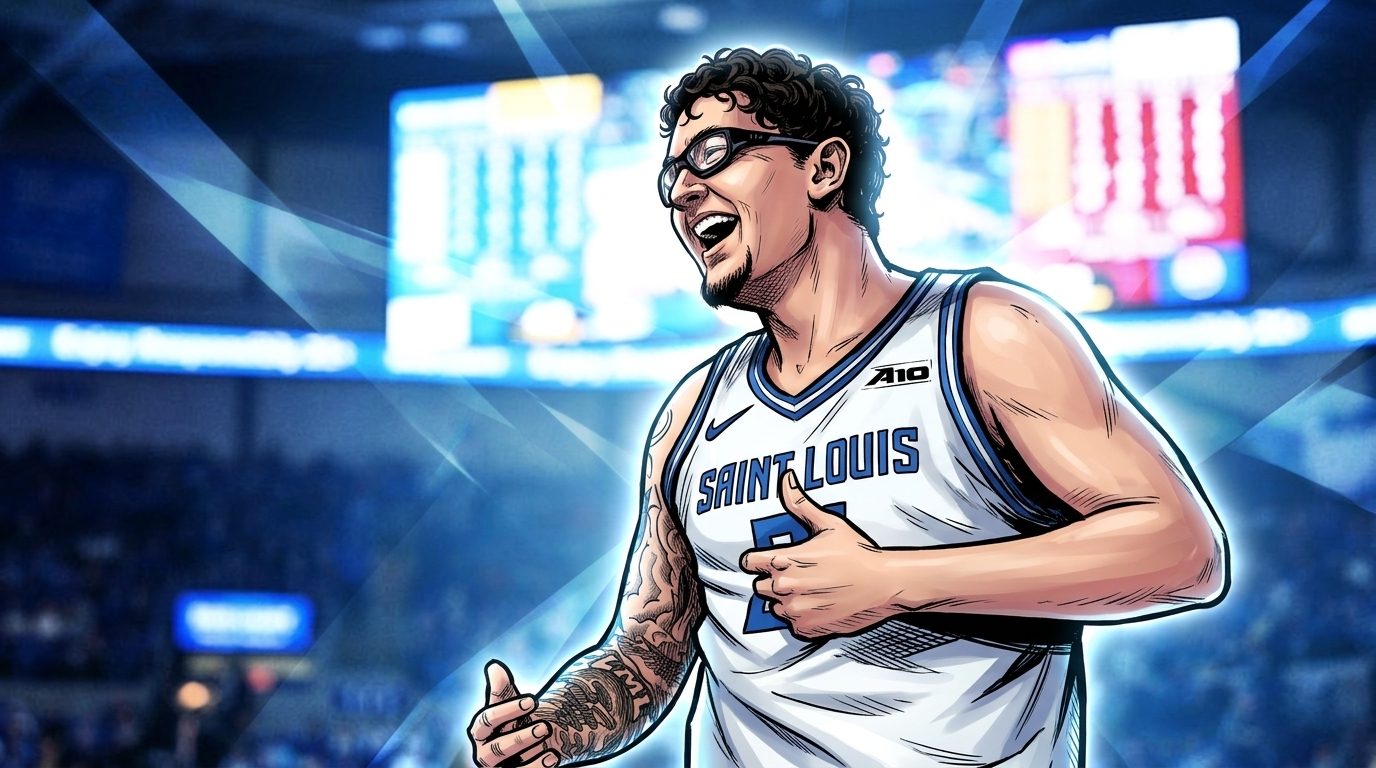

A St. Louis circuit judge needed fifteen days to do what the NCAA’s entire enforcement office apparently could not: identify the actual rule barring Robbie Avila from playing for Saint Louis this season. Judge Jason Sengheiser granted Avila a temporary restraining order Friday, clearing the Billikens’ star center to suit up while the NCAA defends itself at a Nov. 4 preliminary injunction hearing. Nobody in college basketball sounded surprised, which is the funniest part of the entire story.
Avila followed head coach Josh Schertz from Indiana State to Saint Louis in 2024, and last season quietly became the best player most of the sport hadn’t bothered to notice: 12.8 points, 4.5 rebounds, and 4.1 assists a game, a trip to the NCAA Tournament’s second round, and a nickname collection that includes “College Jokic” and “Larry Nerd,” one for the vision, one for the goggles. He went undrafted in the 2026 NBA Draft, signed an Exhibit 10 deal with the Los Angeles Lakers, a non-guaranteed camp-and-Summer-League arrangement with no roster promise attached, and by the time Lakers camp wrapped he was a player without an NBA job and, in the NCAA’s eyes, without college eligibility either.
The dispute underneath Avila’s case against the NCAA is almost administratively boring on its face. The NCAA’s five-in-five model gives athletes five seasons of competition within a five-year window, and the COVID-19 season extended that window for players enrolled during the pandemic. The NCAA has treated the 2022 high school class, Avila’s class, as excluded from that extra year, as a matter of policy. Avila’s lawyers argue the manual itself never says that; the NCAA just started enforcing it as though it does. Sengheiser’s order enjoins the NCAA from enforcing that exclusion and from using roster limits to shut Avila out of SLU’s season. Translated: show your work, or stop pretending the rule exists.
The calendar is the absurd part, not the courtroom. Saint Louis opens its season against Lehigh on Nov. 2, two days before the hearing that decides whether Avila is actually, legally allowed to be on campus. For that one game, the Billikens field a player whose eligibility exists only because a judge said so, for fifteen days, while NCAA lawyers prepare their follow-up argument. A 15-day restraining order and a Nov. 4 injunction hearing are now Avila’s real roster paperwork, which says more about the state of college basketball’s eligibility rules than anything printed in the NCAA manual.
Think of NCAA eligibility less as law and more as a bouncer’s clipboard: the rule is whatever’s written on it until someone asks to see the actual list, at which point half the clipboard turns out to be blank. The Atlantic 10, unlike the ACC, Big 12, Big Ten, and SEC, has never written its own guidelines for pros returning to college ball; there was no conference rule to sue over, because the conference never bothered writing one down. The NCAA wrote something down, applied it as a blanket exclusion anyway, and is now discovering in open court that “we’ve always done it this way” isn’t the same thing as a rule.
Avila isn’t an isolated case. The NCAA’s five-in-five rule has drawn lawsuits from former pros, draft picks, and players who’d already used up their college eligibility, all running some version of the same argument through different courtrooms. Vanderbilt quarterback Diego Pavia got there first, winning a federal injunction against the NCAA in December 2024 over junior-college seasons the NCAA had counted against him; that ruling survived its appeals and is now the template everyone else is running. Kaufman-Renn’s TRO was the same eligibility mess in a different jersey, and Michigan didn’t win a recruiting battle, it won a lawsuit. The pattern is the story: college basketball’s eligibility rules hold up until someone sues, and lately, someone always sues.
The news broke with the same flat affect it was always going to get:
https://twitter.com/TheFieldOf68/status/2113764346186563805
A straight news drop, no exclamation points, no disbelief in sight. The kind of tone you reach for once you’ve watched this exact trick land for what feels like the fourth time this year.
Congress just handed the NCAA its cartel back, passing a bill meant to shield the association from the antitrust exposure cases like this one keep creating, an odd moment for it, given how often courtrooms keep finding new ways to tell the NCAA its own rulebook doesn’t mean what it says. Robbie Avila plays basketball for Saint Louis on Nov. 2 because a judge said so for fifteen days, not because the NCAA decided he belonged there. The NCAA’s actual rule, it turns out, is whichever version survives the next hearing.