2018 FIFA World Cup
France won the 2018 FIFA World Cup in Russia, beating Croatia 4-2 in Moscow on July 15, 2018, for its second title behind a teenage Kylian Mbappé.
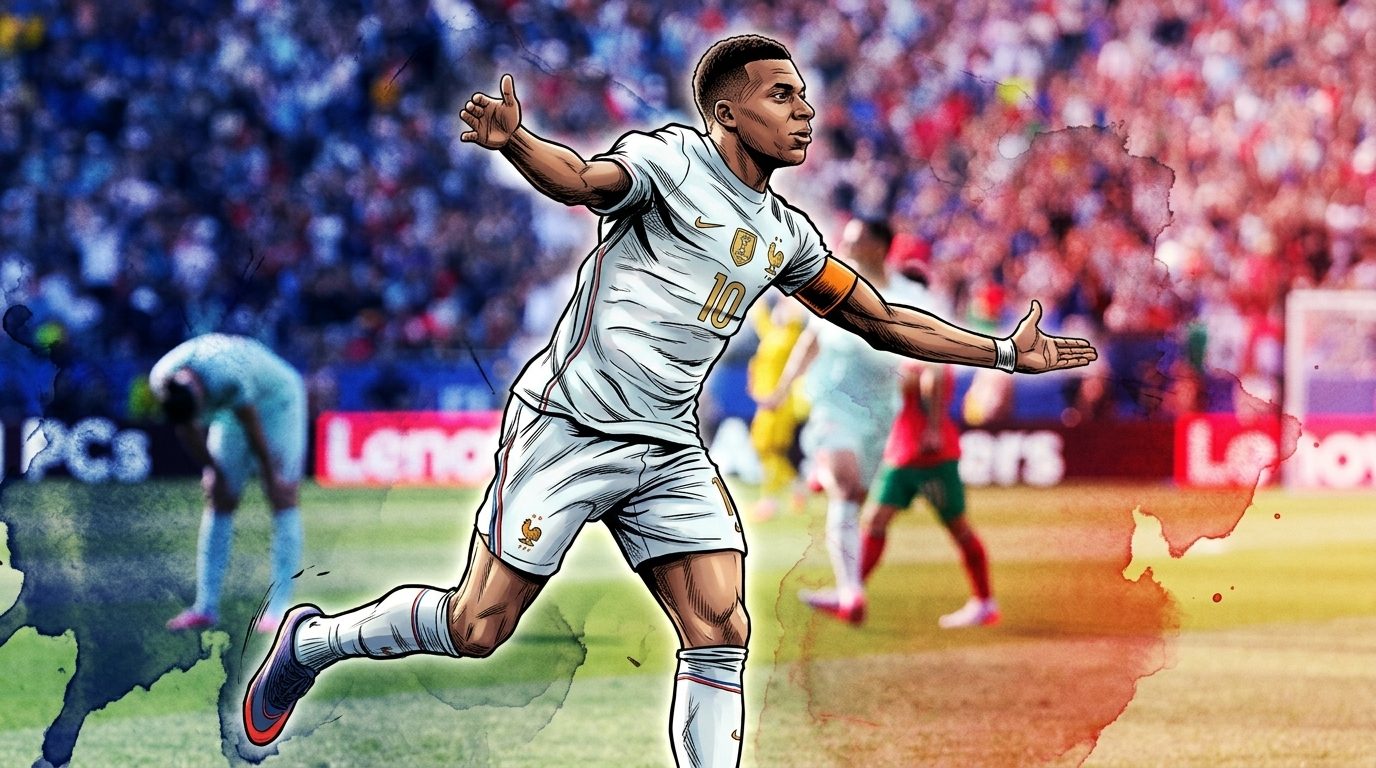
France won the 2018 FIFA World Cup. It beat Croatia 4-2 in the final at Luzhniki Stadium in Moscow on July 15, 2018 for the country’s second world title, 20 years after its first. The win made Didier Deschamps the third person to win the World Cup as both a player and a coach, after Mario Zagallo and Franz Beckenbauer. The tournament in Russia was also the first World Cup to use the video assistant referee. It knocked holders Germany out after three group matches. And it introduced Kylian Mbappé, who at 19 became the first teenager since Pelé in 1958 to score in a World Cup final.
| Fast facts | |
|---|---|
| Champion | France (second title) |
| Runner-up | Croatia |
| Third place | Belgium (2-0 over England) |
| Dates | June 14 – July 15, 2018 |
| Venue(s) | 12 stadiums in 11 Russian host cities; final at Luzhniki Stadium, Moscow |
| Tournament result | France 4-2 Croatia in the final |
| Tournament MVP (Golden Ball) | Luka Modrić, Croatia |
| Golden Boot | Harry Kane, England (6 goals) |
| Final attendance | 78,011 |
| Tournament attendance | 3,031,768 (47,371 per match) |
| Audience as reported | 3.572 billion total reach; 1.12 billion for the final |
The setup
The 21st World Cup was the first held in Russia, which was awarded hosting rights on December 2, 2010. Thirty-two teams played 64 matches in 12 venues across 11 host cities. Russia qualified automatically as host, and Iceland and Panama played at the finals for the first time. The draw was held in Moscow on December 1, 2017.
Germany arrived as holders after winning the 2014 tournament in Brazil. FIFA described the Germans as the reigning champions and top-ranked team. France was coached by Deschamps, who had captained the 1998 champions. Its squad was built around goalkeeper and captain Hugo Lloris, midfielders N’Golo Kanté and Paul Pogba, forward Antoine Griezmann and the teenage Mbappé, and all five started the final, according to FIFA’s official match report. Croatia, coached by Zlatko Dalić and captained by Modrić, had never reached a World Cup final.
How it happened
Group stage. France won Group C without much flourish. It beat Australia 2-1 on June 16, and Griezmann’s goal in that match was the first World Cup penalty awarded through a VAR review. France then beat Peru 1-0 on June 21 and drew 0-0 with Denmark on June 26. The goal against Peru made Mbappé the tournament’s youngest scorer, at 19 years, six months and one day. The Denmark draw was the only goalless match of the group stage. Croatia won all three Group D matches: 2-0 over Nigeria, 3-0 over Argentina and 2-1 over Iceland. It finished with nine points and a goal difference of +6.
Germany’s title defense collapsed in Group F. The holders lost 1-0 to Mexico in Moscow on June 17 and recovered to beat Sweden 2-1 in Sochi on June 23. They then lost 2-0 to South Korea in Kazan on June 27, with Kim Young-gwon and Son Heung-min scoring late, as recorded in FIFA’s match review. Germany finished last in the group with three points. It was Germany’s first first-round exit since 1938. FIFA noted it was the third straight World Cup at which the defending champion failed to get out of its group.
Round of 16. France’s 4-3 win over Argentina in Kazan on June 30 was the tournament’s signature knockout match. Griezmann scored a penalty, and Benjamin Pavard equalized after Argentina had taken a 2-1 lead. Mbappé then scored twice in four minutes, in the 64th and 68th. FIFA cited those two goals when it named him Best Young Player. On July 1, Croatia and Denmark traded goals in the opening minutes and drew 1-1, and Croatia won the shootout 3-2. The same day, hosts Russia knocked out Spain on penalties in Moscow.
Quarterfinals. France beat Uruguay 2-0 in Nizhny Novgorod on July 6, with goals from Raphaël Varane and Griezmann. Belgium beat Brazil 2-1 in Kazan the same night. Croatia drew 2-2 with Russia in Sochi on July 7 and advanced 4-3 on penalties. Domagoj Vida had put Croatia ahead in extra time before Mário Fernandes equalized.
Semifinals. France beat Belgium 1-0 in Saint Petersburg on July 10 with a Samuel Umtiti header. Croatia fell behind to a Kieran Trippier free kick against England in Moscow on July 11. Ivan Perišić equalized, and Mario Mandžukić won it 2-1 in the 109th minute. It was Croatia’s third straight match to go to extra time. FIFA recorded that Croatia became the first team to avoid defeat after trailing in three knockout matches at a single World Cup. Belgium took third place by beating England 2-0 on July 14.
The final. France went ahead in the 18th minute when Mandžukić headed a Griezmann free kick into his own net. It was the first own goal in a World Cup final. Perišić equalized in the 28th minute. Referee Néstor Pitana of Argentina then reviewed a Perišić handball on VAR and awarded a penalty, which Griezmann scored in the 38th minute. After halftime, Pogba made it 3-1 in the 59th minute and Mbappé struck from the edge of the area for 4-1 in the 65th, per FIFA’s official match report. Mandžukić scored in the 69th minute after a mistake by Lloris. The six goals made it the highest-scoring final since Brazil beat Sweden 5-2 in 1958. Griezmann was named man of the match.
By the numbers
| Match | Date | Score | Note |
|---|---|---|---|
| Group C: France v Australia | June 16, 2018 | France 2-1 | First VAR-awarded World Cup penalty (Wikipedia) |
| Group D: Croatia v Nigeria | June 16, 2018 | Croatia 2-0 | (Wikipedia) |
| Group F: Germany v Mexico | June 17, 2018 | Mexico 1-0 | Holders lose opener in Moscow (Wikipedia) |
| Group C: France v Peru | June 21, 2018 | France 1-0 | Mbappé, 19, tournament’s youngest scorer (FIFA) |
| Group D: Argentina v Croatia | June 21, 2018 | Croatia 3-0 | (Wikipedia) |
| Group F: Germany v Sweden | June 23, 2018 | Germany 2-1 | Sochi (Wikipedia) |
| Group C: Denmark v France | June 26, 2018 | 0-0 | Only goalless group match (Wikipedia) |
| Group D: Iceland v Croatia | June 26, 2018 | Croatia 2-1 | Croatia 9 points, +6 (Wikipedia) |
| Group F: South Korea v Germany | June 27, 2018 | South Korea 2-0 | Germany out, last in group (FIFA) |
| Round of 16: France v Argentina | June 30, 2018 | France 4-3 | Mbappé scores twice, Kazan (Wikipedia) |
| Round of 16: Croatia v Denmark | July 1, 2018 | 1-1 (Croatia 3-2 pens) | Extra time (Wikipedia) |
| Quarterfinal: Uruguay v France | July 6, 2018 | France 2-0 | Nizhny Novgorod (Wikipedia) |
| Quarterfinal: Russia v Croatia | July 7, 2018 | 2-2 (Croatia 4-3 pens) | Extra time, Sochi (Wikipedia) |
| Semifinal: France v Belgium | July 10, 2018 | France 1-0 | Umtiti 51’, Saint Petersburg (Wikipedia) |
| Semifinal: Croatia v England | July 11, 2018 | Croatia 2-1 (a.e.t.) | Mandžukić 109’ (FIFA) |
| Third place: Belgium v England | July 14, 2018 | Belgium 2-0 | (Wikipedia) |
| Final: France v Croatia | July 15, 2018 | France 4-2 | Luzhniki Stadium, attendance 78,011 (FIFA) |
The record
Per FIFA's Stats of the Day wrap-up (July 16, 2018) and FIFA's audience audit, through July 15, 2018.
The tournament produced 169 goals in 64 matches, an average of 2.64 per game. Its 12 own goals doubled the previous tournament record of six, set in 1998, according to the tournament record. Referees awarded 29 penalties, and 22 were converted. FIFA’s audit put total reach at 3.572 billion viewers. The final drew 1.12 billion, and the average live audience was 191 million per match.
Honors
- 2018 World Cup champion: France
- Golden Ball: Luka Modrić (Croatia)
- Golden Boot: Harry Kane (England), 6 goals
- Silver Ball: Eden Hazard (Belgium)
- Bronze Ball: Antoine Griezmann (France)
- Silver Boot: Antoine Griezmann (France), 4 goals
- Golden Glove: Thibaut Courtois (Belgium)
- Best Young Player: Kylian Mbappé (France)
- Fair Play Trophy: Spain
Per FIFA's 2018 awards announcement, through July 15, 2018.
Modrić won the Golden Ball ahead of Eden Hazard and Griezmann. Kane’s six goals made him the second England player to finish as a World Cup’s top scorer, after Gary Lineker, who also scored six in 1986. Griezmann and Mbappé each finished with four goals, according to FIFA’s final match report.
The arguments
The main dispute about the 2018 title is the penalty in the final. According to Sports Illustrated’s account, the play was first ruled a goal kick for Croatia before the officials used VAR to check it and awarded a penalty for a Perišić handball. Former Premier League referee Dermot Gallagher called it “100% not a penalty”, arguing Perišić was too close to the ball for the handball to be deliberate. Dalić said that “in a World Cup final you do not give such a penalty.” He also called VAR “a good thing for football” and said the decision “in no way diminishes France’s win,” according to theScore. ESPN’s match analysis noted that the free kick behind France’s first goal came after Griezmann went down easily, an incident VAR could not review. On the other side, France led by three goals before Croatia scored its second, and Dalić himself declined to dispute the result.
The VAR debut is also still debated more broadly. The tournament’s record number of penalties has been partly attributed to video review. Supporters of the technology point to decisions it corrected, and critics point to the final as an example of a subjective call being decided by a screen.
Why it matters
The 2018 World Cup gave France its second title and made Deschamps one of three men to win the trophy as a player and as a coach. It took Croatia to its first World Cup final and gave Modrić the Golden Ball. It brought video review into the sport’s biggest event, a change that has applied at every World Cup since, including the 2022 tournament in Qatar and the 2026 tournament in North America. And it was where Mbappé, at 19, scored in a final and was named the tournament’s best young player.