Argentina National Team
Argentina's national soccer team has won three World Cups — 1978, 1986 and 2022 — and a record 16 Copa Américas, led by all-time great Lionel Messi.
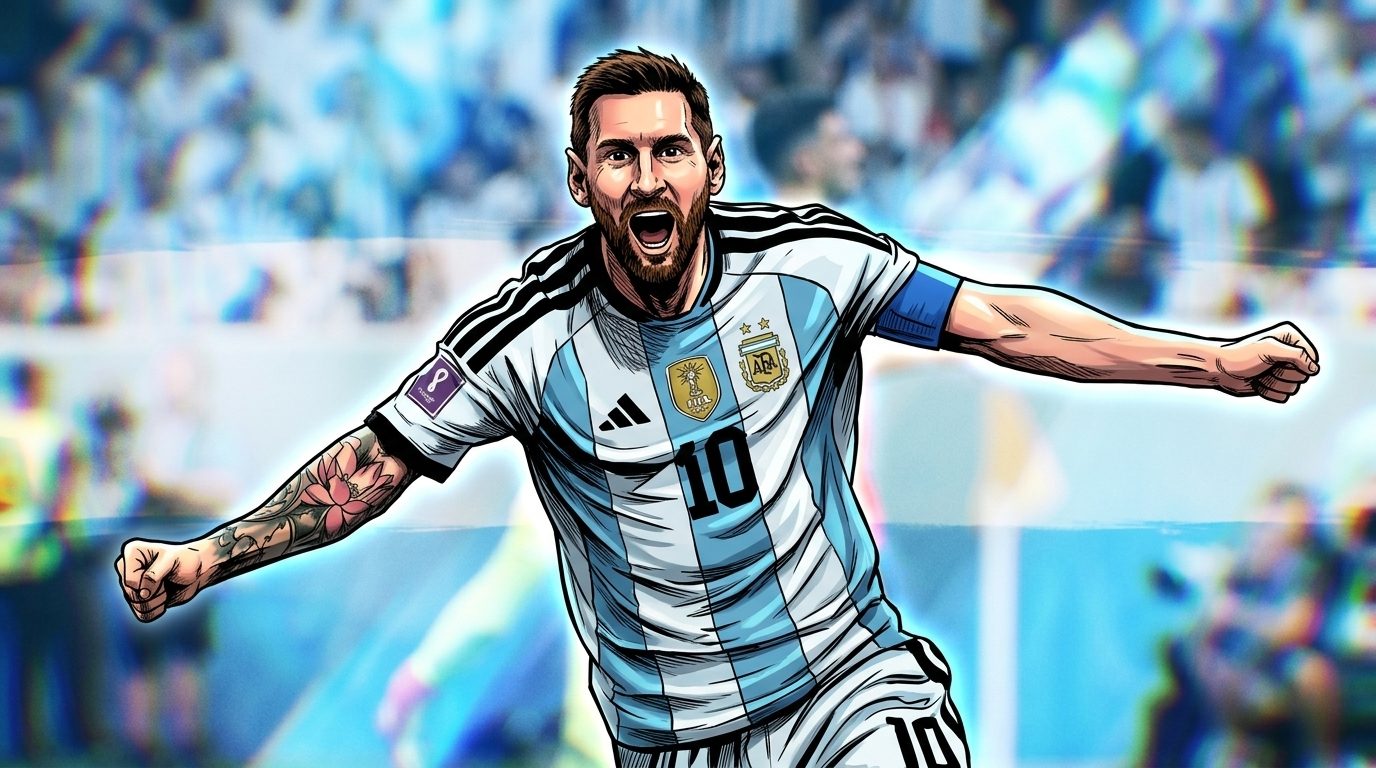
Argentina’s men’s national soccer team — La Albiceleste, the white-and-sky-blue — is one of the sport’s historic superpowers, a program that produced both Diego Maradona and Lionel Messi and won the World Cup in 1978, 1986 and 2022. It has reached a total of seven World Cup finals and holds a record 16 Copa América titles. For a century it has carried a national faith that borders on identity: the belief that the best footballer alive will, sooner or later, wear its number 10. On December 18, 2022, that faith was finally repaid in full.
| Vitals | |
|---|---|
| Founded | Argentine Football Association formed Feb. 21, 1893; first international July 20, 1902 (6–0 v Uruguay) |
| Confederation | CONMEBOL (founding member, 1916) |
| Primary stadium | Estadio Monumental, Buenos Aires |
| Governing body | Argentine Football Association (AFA) |
| Head coach | Lionel Scaloni (since 2018) |
| Titles | 3 World Cups (1978, 1986, 2022); 16 Copa América; 1 Confederations Cup (1992); 2 Finalissima/Cup of Champions (1993, 2022); 2 Olympic golds (2004, 2008) |
Origins and the amateur-era crown (1893–1934)
Argentine football is nearly as old as the organized game itself. The Argentine Football Association was formed in Buenos Aires on February 21, 1893 by the Scottish-born educator Alejandro Watson Hutton, making it one of the oldest governing bodies outside the British Isles. The national team’s first international came on July 20, 1902, a 6–0 win over Uruguay in Montevideo — the beginning of the oldest international rivalry played anywhere beyond Britain.
The team’s first golden age came in the South American Championship, the tournament now called the Copa América. Argentina won its first continental title in 1921 and added crowns in 1925, 1927 and 1929, trading supremacy with Uruguay and Brazil across the amateur decades.
The 1930 World Cup announced Argentina to the world. At the inaugural tournament in Uruguay, Argentina reached the final and led at halftime before falling 2–4 to the hosts in Montevideo on July 30, 1930. Forward Guillermo Stábile finished as the tournament’s leading scorer with eight goals, a single-tournament standard for an Argentine that would stand for the better part of a century. A first-round exit in 1934 followed, and then Argentina largely withdrew from the World Cup for two decades.
The golden decade of Copa América (1937–1959)
While Argentina boycotted the World Cup, it dominated its own continent. AFA disputes and political friction kept the team out of the 1938, 1950 and 1954 World Cups, so a generation of gifted players never appeared on the global stage in Argentine colors — most famously Alfredo Di Stéfano, who went on to win European Cups with Real Madrid and later represented Spain.
On the continent the titles kept coming: Copa América crowns in 1937, 1941, 1945, 1946 and 1947, then again in 1955, 1957 and 1959. The 1957 side, built around the elegant forward trio nicknamed los Carasucias — the “Dirty Faces,” Humberto Maschio, Antonio Angelillo and Omar Sívori — is still remembered as one of the most purely talented teams Argentina ever assembled.
The return to the World Cup was a humiliation. Back at the 1958 finals in Sweden, Argentina was thrashed 6–1 by Czechoslovakia and crashed out in the group stage, a defeat that forced a national reckoning about how far the game had moved on while Argentina stayed home. Quarter-final appearances in 1966 and 1974 followed, but the world title remained elusive.
Menotti and the first star: 1978
Argentina’s long wait ended at home. Under coach César Luis Menotti, Argentina hosted the 1978 World Cup and won it, beating the Netherlands 3–1 after extra time in the final at the Estadio Monumental on June 25, 1978. Striker Mario Kempes scored twice in the final and claimed the Golden Boot as the tournament’s top scorer with six goals; captain Daniel Passarella lifted the first trophy in the program’s history.
The triumph has never been free of controversy. The tournament was staged under Argentina’s military dictatorship, and the team’s decisive 6–0 group win over Peru — the result it needed to reach the final ahead of Brazil — has been dogged by match-fixing allegations for decades. No wrongdoing was ever formally proven, and the on-field achievement stands in the record books, but the circumstances remain part of how the 1978 title is debated.
Maradona’s World Cup: 1986
The 1986 tournament belonged to one man. Carlos Bilardo’s team was built entirely around Diego Maradona, who delivered the most singular individual World Cup any player has produced. In the quarter-final against England at the Estadio Azteca on June 22, 1986, Maradona scored both goals in a 2–1 win — the illegal “Hand of God” and, minutes later, the slaloming “Goal of the Century.” He then scored twice more to beat Belgium in the semi-final.
The final delivered Argentina’s second star. On June 29, 1986 at the Azteca, Argentina beat West Germany 3–2, with goals from José Luis Brown, Jorge Valdano and an 84th-minute winner by Jorge Burruchaga set up by a Maradona through-ball. Maradona won the Golden Ball as the tournament’s best player, and Argentina had its second world title.
The long drought (1990–2018)
For 28 years, Argentina chased a senior title it could not catch. Maradona dragged a weaker 1990 side to the final in Italy, where West Germany won 1–0 on an 85th-minute Andreas Brehme penalty. Copa América crowns in 1991 and 1993 — the latter a 2–1 win over Mexico — proved to be the last trophies of any kind for a generation.
The Batistuta and early-Messi years brought near-misses and heartbreak. Gabriel Batistuta became the all-time leading scorer of his era with 56 goals, but World Cup campaigns stalled, including a shock group-stage exit in 2002. Argentina’s under-23 teams did win Olympic gold in 2004 and 2008, yet the senior drought ground on.
The Messi generation kept reaching finals and losing them. Argentina lost the 2014 World Cup final to Germany 1–0 after extra time on Mario Götze’s 113th-minute goal, with Messi named the tournament’s best player. The team then lost the 2015 and 2016 Copa América finals to Chile, both on penalties, and Messi briefly announced his international retirement in 2016 before reversing the decision. The sense that Argentina’s greatest player would never win with his country had hardened into conventional wisdom.
Scaloni, Messi and the golden era (2019–2024)
Lionel Scaloni rebuilt the team and broke the curse. Appointed in 2018, Scaloni paired Messi with a hungry supporting cast, and on July 10, 2021 Argentina beat Brazil 1–0 at the Maracanã — an Ángel Di María goal — to win the Copa América and end the 28-year wait for a senior trophy. Messi was named player of the tournament. The team added the 2022 Finalissima on June 1, 2022, routing European champion Italy 3–0 at Wembley.
The 2022 World Cup in Qatar is the campaign Argentine fans will tell their grandchildren about. It began in disaster: a 1–2 loss to Saudi Arabia in the opener ended a 36-match unbeaten run, one short of the international record. Argentina responded by winning out — past Mexico and Poland, then Australia in the round of 16, and the Netherlands in a 2–2 quarter-final settled 4–3 on penalties, with goalkeeper Emiliano Martínez saving twice. A 3–0 semi-final dismantling of Croatia, fueled by a Julián Álvarez brace, set up the final.
The final on December 18, 2022 is widely called the greatest in World Cup history. Argentina led France 2–0 through Messi and Di María, saw Kylian Mbappé level it with two goals in 97 seconds, went ahead again in extra time through Messi, and was pegged back once more to 3–3 by an Mbappé penalty — the first final hat-trick since 1966. Argentina won the shootout 4–2, Martínez the decisive saver. Messi won the Golden Ball with seven goals; Martínez took the Golden Glove. It was the third star, and Messi’s first.
They proved it was no fluke. On July 14, 2024 Argentina beat Colombia 1–0 after extra time on a Lautaro Martínez goal to win back-to-back Copa Américas, its record 16th continental crown.
The 2026 World Cup and Messi’s farewell
Defending champions, Argentina came within one goal of a dynasty. At the 2026 World Cup co-hosted by Canada, Mexico and the United States, Argentina reached its seventh final and a chance to repeat. On July 19, 2026, at the New York New Jersey Stadium, Spain won 1–0: Ferran Torres scored in the 106th minute after Argentina was reduced to ten men by Enzo Fernández’s second yellow card. It was Spain’s second world title and left Argentina runner-up for the fourth time.
Messi’s final act rewrote the record book anyway. He scored eight goals in the 2026 tournament — matching Guillermo Stábile’s 1930 Argentine single-tournament mark — and became the first player, man or woman, to reach 20 career World Cup goals. In October 2026 he retired from international football for the second and final time, closing a career with Argentine records of 208 caps and 126 goals. Scaloni remained head coach, with defender Cristian Romero taking the captain’s armband; Argentina stood second in the FIFA world ranking on October 7, 2026.
Retired numbers
Unlike club franchises, international teams cannot permanently retire a shirt number: FIFA and CONMEBOL rules require squads to use numbers consecutively at every tournament. Argentina has twice tried anyway. The AFA moved to retire the number 10 in honor of Diego Maradona ahead of the 2002 World Cup, and FIFA rejected it; the shirt was reassigned. The federation signaled the same intent for Lionel Messi’s 10 in 2024, with the same regulatory wall in the way. The two figures Argentina has sought to honor this way:
| No. | Player | Pos. | Tenure | Retired |
|---|---|---|---|---|
| 10 | Diego Maradona | AM/FW | 1977–1994 | Sought 2001–02; FIFA rejected, shirt reassigned |
| 10 | Lionel Messi | FW | 2005–2026 | Intent signaled 2024; barred by FIFA squad-numbering rule |
Season by season
National teams measure their years in tournaments, not league seasons. The full major-competition record — every World Cup finish and every Copa América — folded by decade, newest first.
The 2020s 2 Copa América · 1 World Cup · 1 World Cup final lost
| Year | Competition | Result |
|---|---|---|
| 2021 | Copa América | Champions (1–0 v Brazil) |
| 2022 | World Cup | Champions (3–3, 4–2 pens v France) |
| 2024 | Copa América | Champions (1–0 aet v Colombia) |
| 2026 | World Cup | Runners-up (0–1 v Spain) |
The 2010s 3 finals reached · 0 titles
| Year | Competition | Result |
|---|---|---|
| 2011 | Copa América | Quarter-finals |
| 2014 | World Cup | Runners-up (0–1 aet v Germany) |
| 2015 | Copa América | Runners-up (lost pens v Chile) |
| 2016 | Copa América Centenario | Runners-up (lost pens v Chile) |
| 2018 | World Cup | Round of 16 |
| 2019 | Copa América | Third place |
The 2000s 2 Copa finals lost · 2 Olympic golds (U-23)
| Year | Competition | Result |
|---|---|---|
| 2004 | Copa América | Runners-up (lost pens v Brazil) |
| 2006 | World Cup | Quarter-finals |
| 2007 | Copa América | Runners-up (0–3 v Brazil) |
The 1990s 2 Copa América · 1 World Cup final
| Year | Competition | Result |
|---|---|---|
| 1990 | World Cup | Runners-up (0–1 v West Germany) |
| 1991 | Copa América | Champions |
| 1993 | Copa América | Champions (2–1 v Mexico) |
| 1994 | World Cup | Round of 16 |
| 1998 | World Cup | Quarter-finals |
The 1980s 1 World Cup title
| Year | Competition | Result |
|---|---|---|
| 1982 | World Cup | Second group stage |
| 1986 | World Cup | Champions (3–2 v West Germany) |
The 1970s 1 World Cup title
| Year | Competition | Result |
|---|---|---|
| 1974 | World Cup | Second group stage |
| 1978 | World Cup | Champions (3–1 aet v Netherlands) |
The 1950s–60s 3 Copa América · World Cup returns
| Year | Competition | Result |
|---|---|---|
| 1955 | Copa América | Champions |
| 1957 | Copa América | Champions |
| 1958 | World Cup | Group stage |
| 1959 | Copa América | Champions |
| 1966 | World Cup | Quarter-finals |
The 1930s–40s 5 Copa América · 1 World Cup final
| Year | Competition | Result |
|---|---|---|
| 1930 | World Cup | Runners-up (2–4 v Uruguay) |
| 1934 | World Cup | First round |
| 1937 | Copa América | Champions |
| 1941 | Copa América | Champions |
| 1945 | Copa América | Champions |
| 1946 | Copa América | Champions |
| 1947 | Copa América | Champions |
The 1920s 4 Copa América titles
| Year | Competition | Result |
|---|---|---|
| 1921 | Copa América | Champions |
| 1925 | Copa América | Champions |
| 1927 | Copa América | Champions |
| 1929 | Copa América | Champions |
By the numbers
Franchise marks
Per Wikipedia records and Argentina at the World Cup, through Oct. 29, 2026.
Ranks
- 1st Copa América titles, all-time (16, ahead of Uruguay's 15)
- 2nd FIFA World Ranking (Oct. 7, 2026)
- 3rd World Cup titles, all-time (3)
Per Copa América records and the FIFA World Ranking, through Oct. 29, 2026.
Honors
- World Cup champion (1978, 1986, 2022)
- 16× Copa América champion (record)
- Copa América 2021, 2024
- 2022 Finalissima champion
- 1992 FIFA Confederations Cup
- Olympic gold (2004, 2008)
- World Cup runners-up (1930, 1990, 2014, 2026)
Per Wikipedia and Olympics.com, through Oct. 29, 2026.
The arguments
Was 1978 earned or engineered? Supporters point to a worthy champion with Kempes in full flight and a deserved win over a strong Dutch side. Critics have argued for decades that the tournament was a propaganda vehicle for the military junta and that the 6–0 win over Peru — the exact margin Argentina needed — was tainted. No fix was ever proven, and the title remains official, but the debate has never fully gone away.
Maradona or Messi? For one camp, Maradona’s 1986 — carrying an ordinary team to the trophy almost by himself — is the single greatest individual tournament anyone has played, and nothing tops it. For the other, Messi’s longevity, his 208 caps and 126 goals, and the 2021–2022 sweep that finally delivered the senior titles make him the more complete national-team great. Both are honored with the sacred number 10; the argument is unlikely to be settled.
Is the “Hand of God” cheating or genius? English accounts frame Maradona’s handball against England as a flat act of cheating that should have been disallowed. Argentine accounts tend to fold it into the folklore of the same match’s “Goal of the Century,” treating the two as inseparable halves of a single, defining performance. Both readings are true to the people who hold them.
Why it matters
Argentina is one of a tiny handful of nations that can claim three World Cups, and it did so while producing the two players most often named the greatest of all time. Its 16 Copa Américas are the outright record for the oldest continental competition on earth, and its 2022 title in Qatar gave the sport perhaps its most satisfying ending — the best player of his generation lifting the one trophy that had eluded him, in a final that refused to end. To understand modern soccer’s mythology, from the Hand of God to the shootout in Lusail, you have to understand La Albiceleste.