Kevin Durant
Kevin Durant is a four-time NBA scoring champion and two-time Finals MVP who ranks fifth on the NBA's all-time scoring list, from Seattle to Houston.
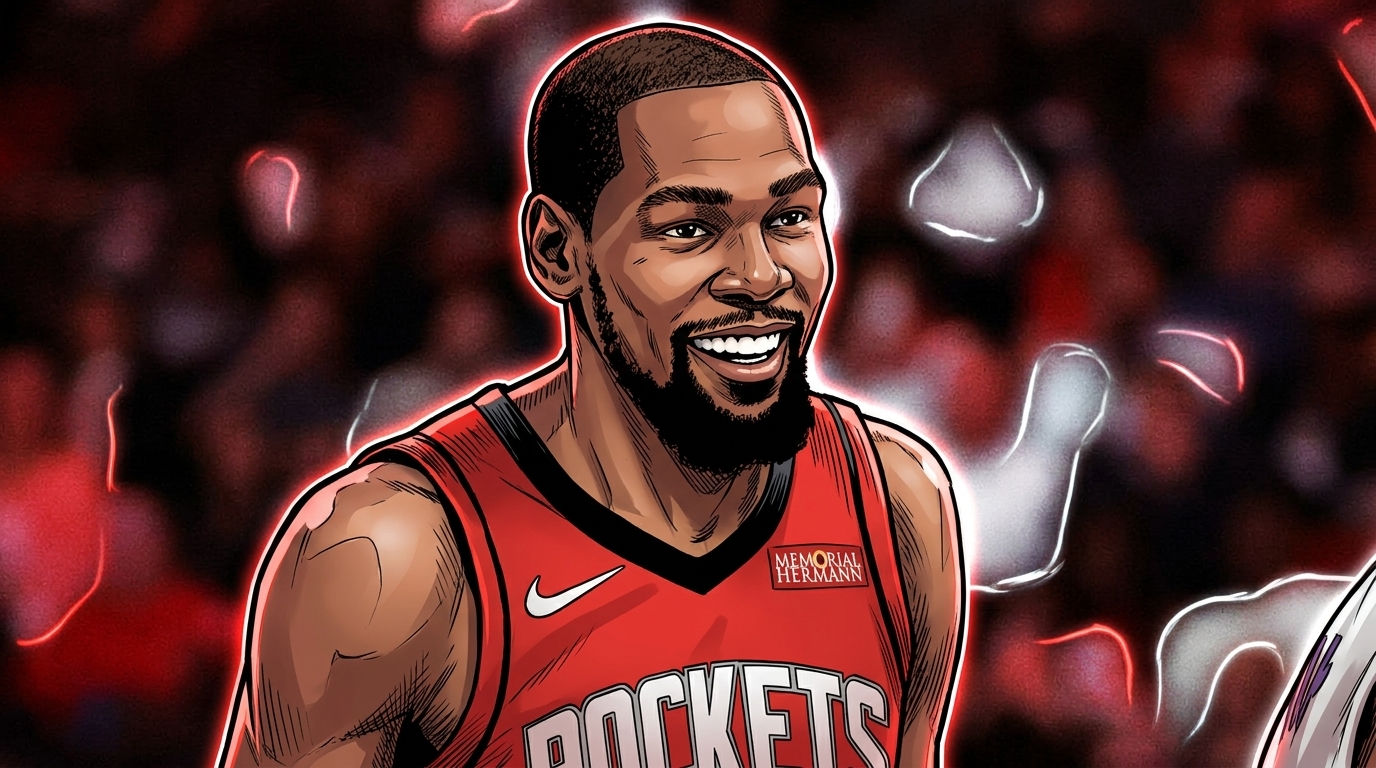
Kevin Durant is one of the most efficient high-volume scorers in basketball history, a 6-foot-11 forward whose blend of guard skill and length redrew the boundaries of what a player his size could do with the ball. Across 18 seasons and five franchises he won four scoring titles, a regular-season MVP, and two championships with the Golden State Warriors, taking Finals MVP honors both times. By the end of the 2025-26 season he had climbed to fifth on the NBA’s all-time scoring list, a position reached not through longevity alone but through two decades of nightly 25-plus scoring on elite efficiency.
| Vitals | |
|---|---|
| Born | September 29, 1988, Washington, D.C. |
| Position | Forward (small forward / power forward) |
| Teams | Seattle SuperSonics (2007–08), Oklahoma City Thunder (2008–2016), Golden State Warriors (2016–2019), Brooklyn Nets (2019–2023), Phoenix Suns (2023–2025), Houston Rockets (2025–) |
| Draft | 2nd overall, 2007, by the Seattle SuperSonics |
| Contract status (Oct. 6, 2026) | Under a two-year, $90M extension with Houston, with a 2027-28 player option |
| Number | 35 |
Texas
Before the league. Durant spent a single season at the University of Texas in 2006-07, dominating as a freshman and becoming the first first-year player to be named national college player of the year. He declared for the 2007 NBA Draft and was selected second overall by the Seattle SuperSonics, one pick behind Greg Oden — a sequence that would be revisited for years as Durant’s career outstripped the top selection.
Seattle and Oklahoma City
The arrival. Durant averaged 20.3 points as a rookie and was named NBA Rookie of the Year for 2007-08, the franchise’s final season in Seattle before its relocation to Oklahoma City in 2008.
The scoring crown. In Oklahoma City he won three consecutive scoring titles from 2009-10 through 2011-12, the last of them at age 23 — the youngest player to win three straight. He led the Thunder, alongside Russell Westbrook and James Harden, to the 2012 NBA Finals.
The MVP. The 2013-14 season was his individual peak: 32.0 points per game, a fourth scoring title, and the regular-season MVP award. A foot injury limited him to 27 games the following year, and in the summer of 2016 he left Oklahoma City in free agency.
Golden State
The decision. Durant signed with a Golden State team that had just set the single-season wins record and had eliminated his Thunder in the Western Conference Finals — a move that divided observers and defined the debate around his legacy.
The rings. The partnership delivered immediately. Golden State won the championship in 2017 and 2018, and Durant was named Finals MVP both times, averaging better than 28 points across the two series. The run ended in the 2019 Finals, when he ruptured his right Achilles tendon.
Brooklyn
The recovery. Durant joined the Brooklyn Nets in the 2019 offseason and sat out the entire 2019-20 season rehabilitating the Achilles. He returned in 2020-21 at close to his prior level, pairing with Kyrie Irving and James Harden, but the team never advanced past the second round before he requested a trade.
Phoenix
The Suns. Brooklyn traded Durant to the Phoenix Suns at the February 2023 deadline. He remained a high-volume, high-efficiency scorer across two-plus seasons, but the expensive roster around him failed to reach its goals, and after missing the playoffs the Suns moved him again.
Houston
The seven-team trade. In June 2025 the Suns sent Durant to the Houston Rockets for Jalen Green, Dillon Brooks, the No. 10 pick and additional selections — part of a transaction the league called the most teams ever involved in a single trade, reuniting Durant with the state where he played college basketball. He later signed a two-year, $90 million extension, reportedly about $30 million below the maximum, to preserve Houston’s roster flexibility.
The climb. Over the 2025-26 season Durant passed Wilt Chamberlain, Dirk Nowitzki and Michael Jordan on the career scoring chart, finishing the year fifth all-time with 32,597 points.
By the numbers
| Season | Team | GP | PPG | RPG | APG | FG% | 3P% |
|---|---|---|---|---|---|---|---|
| 2007-08 | SEA | 80 | 20.3 | 4.4 | 2.4 | .430 | .288 |
| 2008-09 | OKC | 74 | 25.3 | 6.5 | 2.8 | .476 | .422 |
| 2009-10 | OKC | 82 | 30.1 | 7.6 | 2.8 | .476 | .365 |
| 2010-11 | OKC | 78 | 27.7 | 6.8 | 2.7 | .462 | .350 |
| 2011-12 | OKC | 66 | 28.0 | 8.0 | 3.5 | .496 | .387 |
| 2012-13 | OKC | 81 | 28.1 | 7.9 | 4.6 | .510 | .416 |
| 2013-14 | OKC | 81 | 32.0 | 7.4 | 5.5 | .503 | .391 |
| 2014-15 | OKC | 27 | 25.4 | 6.6 | 4.1 | .510 | .403 |
| 2015-16 | OKC | 72 | 28.2 | 8.2 | 5.0 | .505 | .387 |
| 2016-17 | GSW | 62 | 25.1 | 8.3 | 4.8 | .537 | .375 |
| 2017-18 | GSW | 68 | 26.4 | 6.8 | 5.4 | .516 | .419 |
| 2018-19 | GSW | 78 | 26.0 | 6.4 | 5.9 | .521 | .353 |
| 2019-20 | BRK | — | Did not play (Achilles) | ||||
| 2020-21 | BRK | 35 | 26.9 | 7.1 | 5.6 | .537 | .450 |
| 2021-22 | BRK | 55 | 29.9 | 7.4 | 6.4 | .518 | .383 |
| 2022-23 | BRK/PHO | 47 | 29.1 | 6.7 | 5.0 | .560 | .404 |
| 2023-24 | PHO | 75 | 27.1 | 6.6 | 5.0 | .523 | .413 |
| 2024-25 | PHO | 62 | 26.6 | 6.0 | 4.2 | .527 | .430 |
| 2025-26 | HOU | 78 | 26.0 | 5.5 | 4.8 | .520 | .413 |
Per Basketball-Reference, through the 2025-26 season.
Career totals
Ranks
- 5th Points, all-time NBA history (32,597)
- 6th Free throws made, all-time NBA history (7,704)
- 8th Field goals made, all-time NBA history (11,258)
Honors
- 2× NBA champion (2017, 2018)
- 2× Finals MVP (2017, 2018)
- NBA MVP (2013-14)
- 4× scoring champion (2010, 2011, 2012, 2014)
- 16× NBA All-Star
- Rookie of the Year (2007-08)
- 4× Olympic gold medalist (2012, 2016, 2021, 2024)
- NBA 75th Anniversary Team
Per Basketball-Reference and its career leaderboards, through the 2025-26 season.
The arguments
The Golden State decision. No choice shaped Durant’s reputation more than his 2016 move to a Warriors team that had just beaten him. Critics argued that joining a 73-win juggernaut made his subsequent titles easier and diminished their weight. Supporters counter that Durant was demonstrably the best player on those teams — the two Finals MVP awards are offered as evidence — and that stacking rosters is a long-standing feature of championship basketball, not an innovation of his.
Where he ranks as a scorer. Advocates place Durant among the greatest pure scorers ever, pointing to his rare combination of volume and efficiency — career marks above 50% from the field and near 40% from three at his size — and his standing on the all-time points, free-throw and field-goal leaderboards. Skeptics note that, outside the Warriors years, he rarely carried a title team as the lone star, a distinction they weigh against the raw totals.
The franchise-hopping. Durant’s path through five teams draws competing readings. Some frame the moves as clear-eyed pragmatism — chasing the best available situation each time, as he reportedly did again in accepting a below-max deal in Houston. Others read the same sequence as restlessness, a star repeatedly reshuffling his circumstances rather than building a single lasting legacy in one place.
Why it matters
Kevin Durant matters because he expanded the idea of what a scorer could be: a player tall enough to shoot over anyone and skilled enough to handle like a guard, delivering two decades of efficient, high-volume production that carried him to fifth on the sport’s all-time scoring list. His championships, MVP and scoring titles would alone secure his place among the greats; the debates over how he won them are, in the end, arguments about a résumé too large to dismiss.