Houston Rockets
The Houston Rockets history, from the 1967 San Diego founding through Hakeem's two titles, Yao, Harden and Morey, and the Kevin Durant era of 2025-26 onward.
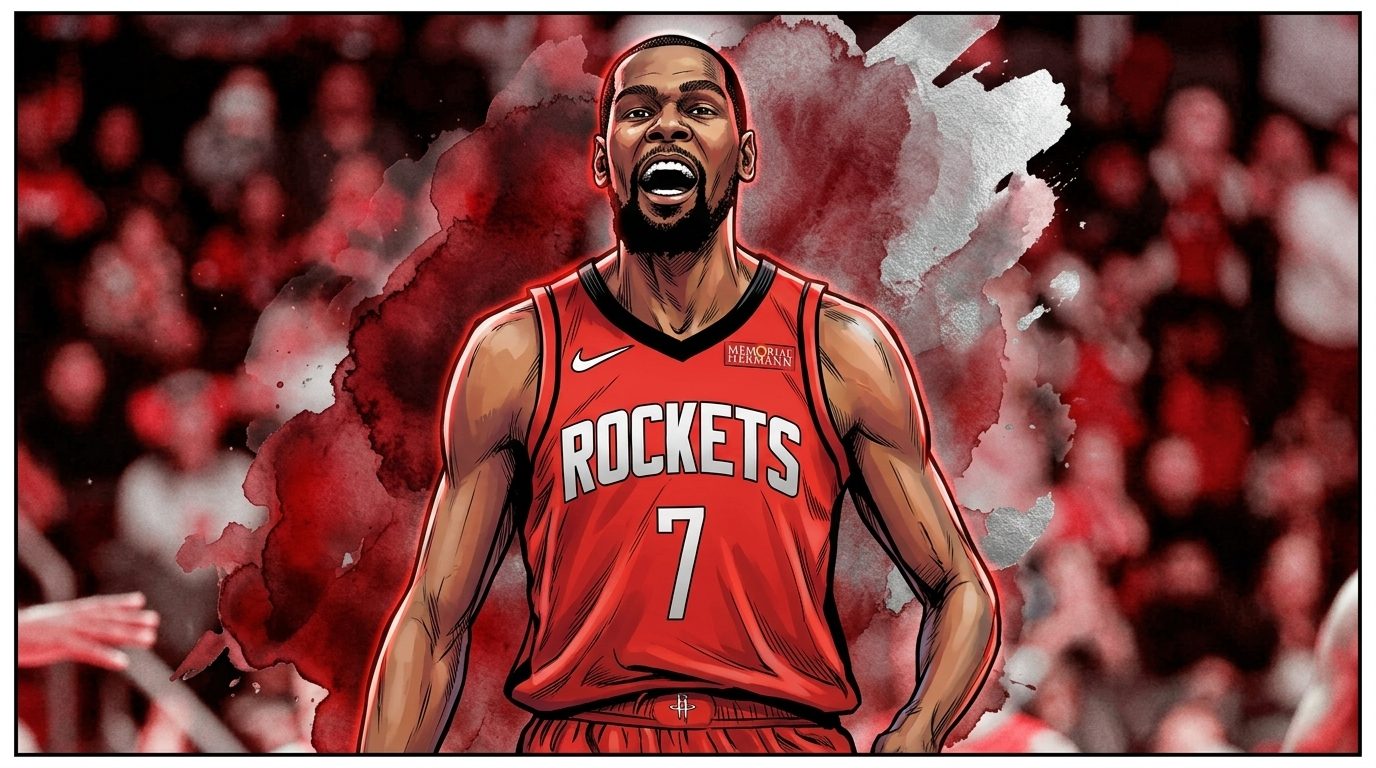
The Houston Rockets are the NBA franchise that started in San Diego, moved to Texas in 1971 and became one of the league’s most reliable winners. Through Nov. 16, 2026, the franchise had won 2,484 games and lost 2,301, with 36 playoff appearances, four Western Conference titles and back-to-back championships in 1994 and 1995. The team’s history runs through some of the biggest names in basketball: Elvin Hayes, Moses Malone, Hakeem Olajuwon, Yao Ming, James Harden and Kevin Durant. Two of the three Houston players named league MVP (Malone and Olajuwon) were centers. Along the way the club produced a nickname, “Clutch City,” and one of the most influential front offices of the analytics era.
| Vitals | |
|---|---|
| Founded | 1967, as the San Diego Rockets; moved to Houston in 1971 |
| League / conference / division | NBA / Western Conference / Southwest Division |
| Arena | Toyota Center (since 2003-04) |
| Owner | Tilman Fertitta (since October 2017) |
| Head coach (Nov. 13, 2026) | Ime Udoka |
| Titles | NBA champions 1994, 1995 |
San Diego origins (1967-1971)
An expansion start. The Rockets joined the NBA for the 1967-68 season as an expansion team owned by Robert Breitbard, who paid a $1.75 million entry fee. The first San Diego team went 15-67 under coach Jack McMahon. Only the 1982-83 team (14-68) finished with a worse record.
The Big E arrives. The franchise drafted Elvin Hayes, the University of Houston star, and the turnaround was immediate: San Diego went 37-45 in 1968-69 and reached the playoffs, where it lost in the Western Division semifinals. Alex Hannum replaced Jack McMahon during the 1969-70 season, which ended 27-55 (McMahon went 9-17 and Hannum 18-38), and the 1970-71 team finished 40-42. That team also included a rookie guard named Calvin Murphy.
The move. In June 1971, Breitbard sold the club. Texas Sports Investments bought the franchise for $5.6 million and moved it to Houston for the 1971-72 season. The San Diego years produced 119 wins in four seasons.
Houston’s first decade and Moses Malone (1971-1983)
Finding a footing. The first Houston teams were mediocre. They went 34-48 under Tex Winter in 1971-72, and the team moved into the Eastern Conference’s Central Division in 1972-73. Rudy Tomjanovich, a 1970 draftee, became an All-Star forward. Calvin Murphy, a 5-foot-9 guard, became one of the best shooters of his era, and he played 1,002 games for the franchise, second only to Olajuwon. The Summit opened as the team’s home in 1975-76 and remained the home arena for 28 seasons (1975-76 through 2002-03).
First real contender. Under Tom Nissalke, the 1976-77 Rockets went 49-33, won the Central Division and reached the Eastern Conference finals. That was the franchise’s deepest playoff run up to then. The team had added Moses Malone, a rebounding force, and he won league MVP in 1978-79 and again in 1981-82.
The 1981 run. The 1980-81 team moved to the Western Conference’s Midwest Division under Del Harris, finished 40-42, and then went on a playoff run nobody predicted. Houston beat the Los Angeles Lakers 2-1, the San Antonio Spurs 4-3 and the Kansas City Kings 4-1 before losing the NBA Finals to the Boston Celtics in six games. Houston became one of the few teams with a losing record to reach the Finals, after the 1957 Hawks and 1959 Lakers.
The bottom. Malone left for Philadelphia after the 1981-82 season. The 1982-83 Rockets went 14-68, and Tomjanovich and Murphy had both retired by 1983. That season set up the next era.
The Twin Towers (1983-1991)
Two No. 1 picks. Houston drafted Virginia center Ralph Sampson first overall in 1983. After a 29-53 season in 1983-84, the team took Hakeem Olajuwon from the University of Houston first overall in 1984. Bill Fitch paired the two 7-footers in the frontcourt, and they became known as the “Twin Towers.”
1986. The 1985-86 Rockets went 51-31 and won the Midwest Division. In the playoffs they swept Sacramento, beat Denver in six games and beat the defending-champion Lakers 4-1 in the Western Conference finals. Sampson ended that series with a last-second turnaround in Game 5. Boston beat Houston in the Finals for the second time in six years, again in six games.
The window closes. Injuries slowed Sampson, and the team traded him to Golden State in 1987. Olajuwon became the centerpiece. Houston made the playoffs four straight years from 1988 through 1991 (Fitch in 1988, Don Chaney 1989-91), losing in the first round each time, though the 1990-91 team won 52 games.
Hakeem and the two titles (1992-1996)
Rudy T takes over. Tomjanovich replaced Chaney midway through 1991-92. In 1992-93, his first full season, Houston went 55-27 and won the Midwest. The 1993-94 team went 58-24, and Olajuwon won the 1993-94 MVP. Kenny Smith, Otis Thorpe, Vernon Maxwell, Robert Horry, Mario Elie and rookie Sam Cassell played around him.
“Choke City” becomes “Clutch City.” In the 1994 Western Conference semifinals, Houston lost the first two games to Phoenix at home. Local headlines started calling the team “Choke City.” The Rockets came back to win the series 4-3, and the nickname flipped to “Clutch City.” Wikipedia’s franchise history documents the nickname’s origin. Houston then beat Utah 4-1 in the conference finals.
The 1994 Finals. Against the New York Knicks, Houston trailed 3-2 after a 91-84 loss in Game 5 on June 17. The Rockets won Game 6 86-84 and Game 7 90-84 at the Summit on June 22, 1994, for the city’s first major professional championship. Olajuwon was named Finals MVP.
The 1995 repeat. The 1994-95 team was less dominant in the regular season, at 47-35 and third in its division. In February 1995, Houston traded with Portland for Clyde Drexler, Olajuwon’s former teammate at the University of Houston. In the playoffs, the Rockets beat Utah 3-2, came back to beat Phoenix 4-3, beat San Antonio 4-2 and swept Orlando 4-0. Olajuwon was Finals MVP again, averaging 32.8 points and 11.5 rebounds against Shaquille O’Neal.
The aging-stars years (1996-2002)
Barkley joins. In 1996, Houston traded for Charles Barkley to play alongside Olajuwon and Drexler. The trio led a 57-25 season in 1996-97 and a trip to the Western Conference finals, where Utah won the series. It was the last conference finals for that core.
Decline. Drexler retired after 1997-98. Scottie Pippen played the lockout-shortened 1998-99 season in Houston, and Barkley’s tenure ended after 1999-2000. Olajuwon was traded to Toronto in 2001. He left as the franchise leader in points (26,511), rebounds (13,382), steals (2,088) and blocks (3,740). Steve Francis, the 1999-2000 co-Rookie of the Year, led teams that missed the playoffs four years in a row from 2000 through 2003.
Yao Ming and Tracy McGrady (2002-2011)
The No. 1 pick from Shanghai. Houston won the 2002 draft lottery and took Yao Ming first overall. The 7-foot-6 center made the Rockets a global brand, especially in China. Jeff Van Gundy became coach in 2003, and in 2003-04, the first season at Toyota Center, the team returned to the playoffs.
T-Mac. In 2004, Houston acquired scoring champion Tracy McGrady from Orlando in a seven-player trade built around Steve Francis. The Yao-McGrady teams won 51 games in 2004-05 and 52 in 2006-07, but each of those seasons ended in the first round. Injuries to both stars kept the pairing from reaching its peak.
Twenty-two straight. Under Rick Adelman, the 2007-08 Rockets won 22 consecutive games from Jan. 29 to March 16, 2008. Yao broke his left foot in late February, and nearly half of the wins came after his season-ending injury. Boston ended the streak in Houston on March 18. At the time it was the second-longest winning streak in NBA history.
The end of the era. In 2008-09, Houston went 53-29 and won its first playoff series since 1997 before losing to the eventual-champion Lakers in seven games in the West semifinals. McGrady was traded in 2010. Recurring foot injuries ended Yao’s career in 2011, and the franchise retired his No. 11 in 2017.
Harden and Morey (2012-2020)
The Morey method. Daryl Morey became general manager in May 2007. He became known for analytics-driven roster building and an emphasis on three-pointers, layups and free throws. His defining move came on Oct. 27, 2012, when Houston acquired James Harden from Oklahoma City for Kevin Martin, Jeremy Lamb and draft picks.
The McHale years. With Harden, and with Dwight Howard after he signed in 2013, Houston made the playoffs four straight years (2013-16), three of them fully under Kevin McHale; J.B. Bickerstaff coached most of the 2015-16 season. In 2015, the 56-26 Rockets came back from a 3-1 deficit to beat the Clippers in the West semifinals, then lost the conference finals to Golden State.
D’Antoni and the 2018 peak. Mike D’Antoni took over in 2016-17 and gave Harden the ball as the full-time point guard. Chris Paul arrived for 2017-18, and that team went 65-17, the best record in franchise history. Harden won the 2017-18 MVP. In the Western Conference finals, Houston led Golden State 3-2 after a 98-94 win in Game 5 on May 24, 2018. Paul played in only five of the series’ seven games. Golden State won Game 6 115-86 and Game 7 in Houston 101-92 on May 28.
The window closes. The Warriors also eliminated Houston in the 2019 West semifinals. After acquiring Russell Westbrook, the team lost to the Lakers in the 2020 semifinals in the Orlando bubble. Morey left in October 2020, and in January 2021 Harden was traded to Brooklyn in a four-team deal. He left as the franchise leader in assists (4,796) and three-pointers (2,029).
The rebuild (2020-2024)
Bottoming out. Under Stephen Silas, Houston went 17-55, 20-62 and 22-60 from 2020-21 through 2022-23, and the losing seasons brought high draft picks. General manager Rafael Stone drafted Jalen Green and Alperen Şengün in 2021, Jabari Smith Jr. and Tari Eason in 2022, Amen Thompson in 2023 and Reed Sheppard in 2024. Şengün, a Turkish center and skilled passer, became the hub of the offense.
Udoka’s culture shift. Ime Udoka was hired for the 2023-24 season, along with veteran signings Fred VanVleet and Dillon Brooks. Houston improved by 19 wins, to 41-41. In 2024-25 the Rockets went 52-30, won the Southwest Division and made the playoffs for the first time in five years. Şengün made his first All-Star team. Golden State won the first-round series 4-3.
The Durant era (2025-present)
The trade. On July 6, 2025, Houston acquired Kevin Durant from Phoenix in a seven-team trade, the largest by number of teams in NBA history. Jalen Green, Dillon Brooks and the draft rights to Khaman Maluach went to Phoenix, and Houston also got center Clint Capela back. On Oct. 19, 2025, Durant agreed to a two-year extension reported at $90 million that runs through 2027-28. The team announced the signing without disclosing terms.
2025-26. In his first season in Houston, Durant led the team at 26.0 points per game and made the All-Star and All-NBA Second teams. Şengün made another All-Star team. Houston went 52-30 again and finished fifth in the West. The Los Angeles Lakers won the first three games of their first-round series, Houston forced a Game 6, and the Lakers won the series 4-2.
2026-27. The season opened on Oct. 21, 2026, with a 128-110 home win over Dallas. Houston started 5-0, and a 125-118 win over Utah on Nov. 13, 2026, made the record 10-3. A loss at Miami on Nov. 16 left the team 11-4. On Nov. 17, 2026, the roster included Durant, Şengün, Thompson, Smith, Eason, Sheppard, VanVleet, Capela, Steven Adams, Bogdan Bogdanović, Marcus Smart and Jae’Sean Tate. Şengün led the team at 22.8 points per game, ahead of Durant at 21.3.
Retired numbers
The Rockets honor seven players with retired numbers, plus a “CD” banner for longtime assistant coach and general manager Carroll Dawson, raised on April 16, 2007, per the franchise’s Wikipedia retired-numbers table. Elvin Hayes’ No. 44, retired in November 2022, was the most recent addition as of Nov. 17, 2026. The NBA retired Bill Russell’s No. 6 for every franchise in August 2022. Ceremony dates are from the same Wikipedia table. Tenures are playing years; the table’s footnote adds that Tomjanovich was also head coach from 1991 to 2003.
Retired numbers
| No. | Player | Pos. | Team tenure | Retired |
|---|---|---|---|---|
| 11 | Yao Ming | C | 2002–2011 | Feb. 3, 2017 |
| 22 | Clyde Drexler | G | 1995–1998 | Feb. 3, 2000 |
| 23 | Calvin Murphy | G | 1970–1983 | Mar. 17, 1984 |
| 24 | Moses Malone | C | 1976–1982 | Apr. 19, 1998 |
| 34 | Hakeem Olajuwon | C | 1984–2001 | Nov. 9, 2002 |
| 44 | Elvin Hayes | F/C | 1968–1972, 1981–1984 | Nov. 18, 2022 |
| 45 | Rudy Tomjanovich | F | 1970–1981 | Jan. 28, 1982 |
| 6 | Bill Russell (league-wide) | C | — | Aug. 11, 2022 |
| CD | Carroll Dawson (assistant coach, GM) | — | 1980–2007 | Apr. 16, 2007 |
Season by season
Every season since 1967-68, newest decade first, per Basketball-Reference. Finish is division rank.
The 2020s 215–282 through Nov. 16, 2026 · 2 playoff berths
| Season | W–L | Finish | Playoffs |
|---|---|---|---|
| 2026-27 | 11-4 (through Nov. 16) | 2nd of 5 | In progress |
| 2025-26 | 52-30 | 2nd of 5 | Lost W. Conf. 1st Rd. (LAL 2-4) |
| 2024-25 | 52-30 | 1st of 5 | Lost W. Conf. 1st Rd. (GSW 3-4) |
| 2023-24 | 41-41 | 3rd of 5 | — |
| 2022-23 | 22-60 | 4th of 5 | — |
| 2021-22 | 20-62 | 5th of 5 | — |
| 2020-21 | 17-55 | 5th of 5 | — |
The 2010s 490–304 · 8 playoff berths · 2 conference finals
| Season | W–L | Finish | Playoffs |
|---|---|---|---|
| 2019-20 | 44-28 | 1st of 5 | Lost W. Conf. Semis |
| 2018-19 | 53-29 | 1st of 5 | Lost W. Conf. Semis |
| 2017-18 | 65-17 | 1st of 5 | Lost W. Conf. Finals (GSW 3-4) |
| 2016-17 | 55-27 | 2nd of 5 | Lost W. Conf. Semis |
| 2015-16 | 41-41 | 4th of 5 | Lost W. Conf. 1st Rd. |
| 2014-15 | 56-26 | 1st of 5 | Lost W. Conf. Finals |
| 2013-14 | 54-28 | 2nd of 5 | Lost W. Conf. 1st Rd. |
| 2012-13 | 45-37 | 3rd of 5 | Lost W. Conf. 1st Rd. |
| 2011-12 | 34-32 | 4th of 5 | — |
| 2010-11 | 43-39 | 5th of 5 | — |
The 2000s 448–372 · 5 playoff berths · 22-game win streak (2008)
| Season | W–L | Finish | Playoffs |
|---|---|---|---|
| 2009-10 | 42-40 | 3rd of 5 | — |
| 2008-09 | 53-29 | 2nd of 5 | Lost W. Conf. Semis |
| 2007-08 | 55-27 | 3rd of 5 | Lost W. Conf. 1st Rd. |
| 2006-07 | 52-30 | 3rd of 5 | Lost W. Conf. 1st Rd. |
| 2005-06 | 34-48 | 5th of 5 | — |
| 2004-05 | 51-31 | 3rd of 5 | Lost W. Conf. 1st Rd. |
| 2003-04 | 45-37 | 5th of 7 | Lost W. Conf. 1st Rd. |
| 2002-03 | 43-39 | 5th of 7 | — |
| 2001-02 | 28-54 | 5th of 7 | — |
| 2000-01 | 45-37 | 5th of 7 | — |
The 1990s 465–323 · 8 playoff berths · 2 NBA titles
| Season | W–L | Finish | Playoffs |
|---|---|---|---|
| 1999-00 | 34-48 | 6th of 7 | — |
| 1998-99 | 31-19 | 3rd of 7 | Lost W. Conf. 1st Rd. |
| 1997-98 | 41-41 | 4th of 7 | Lost W. Conf. 1st Rd. |
| 1996-97 | 57-25 | 2nd of 7 | Lost W. Conf. Finals |
| 1995-96 | 48-34 | 3rd of 7 | Lost W. Conf. Semis |
| 1994-95 | 47-35 | 3rd of 6 | Won NBA Finals (ORL 4-0) |
| 1993-94 | 58-24 | 1st of 6 | Won NBA Finals (NYK 4-3) |
| 1992-93 | 55-27 | 1st of 6 | Lost W. Conf. Semis |
| 1991-92 | 42-40 | 3rd of 6 | — |
| 1990-91 | 52-30 | 3rd of 7 | Lost W. Conf. 1st Rd. |
The 1980s 402–418 · 8 playoff berths · 2 Finals
| Season | W–L | Finish | Playoffs |
|---|---|---|---|
| 1989-90 | 41-41 | 5th of 7 | Lost W. Conf. 1st Rd. |
| 1988-89 | 45-37 | 2nd of 6 | Lost W. Conf. 1st Rd. |
| 1987-88 | 46-36 | 4th of 6 | Lost W. Conf. 1st Rd. |
| 1986-87 | 42-40 | 3rd of 6 | Lost W. Conf. Semis |
| 1985-86 | 51-31 | 1st of 6 | Lost NBA Finals (BOS 2-4) |
| 1984-85 | 48-34 | 2nd of 6 | Lost W. Conf. 1st Rd. |
| 1983-84 | 29-53 | 6th of 6 | — |
| 1982-83 | 14-68 | 6th of 6 | — |
| 1981-82 | 46-36 | 3rd of 6 | Lost W. Conf. 1st Rd. |
| 1980-81 | 40-42 | 3rd of 6 | Lost NBA Finals (BOS 2-4) |
The 1970s 385–435 · 4 playoff berths · 1 conference finals
| Season | W–L | Finish | Playoffs |
|---|---|---|---|
| 1979-80 | 41-41 | 2nd of 6 | Lost E. Conf. Semis |
| 1978-79 | 47-35 | 2nd of 6 | Lost E. Conf. 1st Rd. |
| 1977-78 | 28-54 | 6th of 6 | — |
| 1976-77 | 49-33 | 1st of 6 | Lost E. Conf. Finals |
| 1975-76 | 40-42 | 3rd of 5 | — |
| 1974-75 | 41-41 | 2nd of 5 | Lost E. Conf. Semis |
| 1973-74 | 32-50 | 3rd of 4 | — |
| 1972-73 | 33-49 | 3rd of 4 | — |
| 1971-72 | 34-48 | 4th of 5 | — |
| 1970-71 | 40-42 (San Diego) | 3rd of 5 | — |
The 1960s 79–167 · 1 playoff berth · San Diego years
| Season | W–L | Finish | Playoffs |
|---|---|---|---|
| 1969-70 | 27-55 | 7th of 7 | — |
| 1968-69 | 37-45 | 4th of 7 | Lost W. Div. Semis |
| 1967-68 | 15-67 | 6th of 6 | — |
By the numbers
Franchise marks
Per Basketball-Reference and NBA.com, through Nov. 16, 2026.
Ranks
- 1st Points, franchise history: Hakeem Olajuwon (26,511)
- 1st Rebounds, franchise history: Hakeem Olajuwon (13,382)
- 1st Blocks, franchise history: Hakeem Olajuwon (3,740)
- 1st Assists, franchise history: James Harden (4,796)
- 1st Three-pointers made, franchise history: James Harden (2,029)
- 2nd Points, franchise history: James Harden (18,365)
Per Basketball-Reference franchise leaders, through Nov. 16, 2026.
Honors
- 1994 NBA champion
- 1995 NBA champion
- 4 MVP seasons (Malone 1979, 1982; Olajuwon 1994; Harden 2018)
- 2× Finals MVP: Hakeem Olajuwon (1994, 1995)
- 4 Western Conference titles (1981, 1986, 1994, 1995)
- 65-17 franchise-best record (2017-18)
- 22-game winning streak (2008)
Per Basketball-Reference and its 1995 playoffs page, through Nov. 17, 2026.
The arguments
The asterisk debate. Critics of the 1994 and 1995 titles point out that both came while Michael Jordan was away from the Bulls or just back from retirement. Defenders answer that Houston beat the teams in front of it, including the 1995 path through Utah, Phoenix, David Robinson’s Spurs and O’Neal’s Magic as a 47-win team. They also note that Olajuwon outplayed the MVP and the league’s best young center in back-to-back series.
Morey’s legacy. Supporters credit the Morey front office with making the three-point-heavy offense standard across the league. They cite the 65-17 season and two conference finals trips as evidence. Skeptics point out that the Harden teams never reached the Finals and that the trades for Paul and Westbrook used up assets before the 2020-21 collapse.
Harden’s place. Harden ranks second in franchise scoring and first in assists and three-pointers. In Houston, arguments about his standing beside Olajuwon tend to weigh the 2018 MVP and the statistical peak against the zero titles and the way the 2021 exit happened.
The Durant bet. Supporters of the 2025 trade argue that a young core coming off a 52-win season needed a proven closer. Critics note that it sent away Jalen Green, a homegrown No. 2 pick, and tied the team’s timeline to a player who turned 38 shortly before the 2026-27 season.
Why it matters
The Rockets show that a franchise can rebuild itself around one idea after another and keep winning. They have had four MVP seasons, from three different stars. The two titles came from a player drafted out of the city’s own university, and the “Clutch City” nickname grew out of a 1994 comeback. Morey’s analytics front office changed how the league plays. Then the team rebuilt itself again, around Şengün, Thompson and Durant. From San Diego in 1967 to an 11-4 start on Nov. 16, 2026, the Rockets have been one of the NBA’s essential franchises, with 2,484 wins and a championship history few teams can match.