Oklahoma City Thunder
The Oklahoma City Thunder are a two-time NBA champion franchise, born as the 1967 Seattle SuperSonics and crowned in 2025 behind MVP Shai Gilgeous-Alexander.
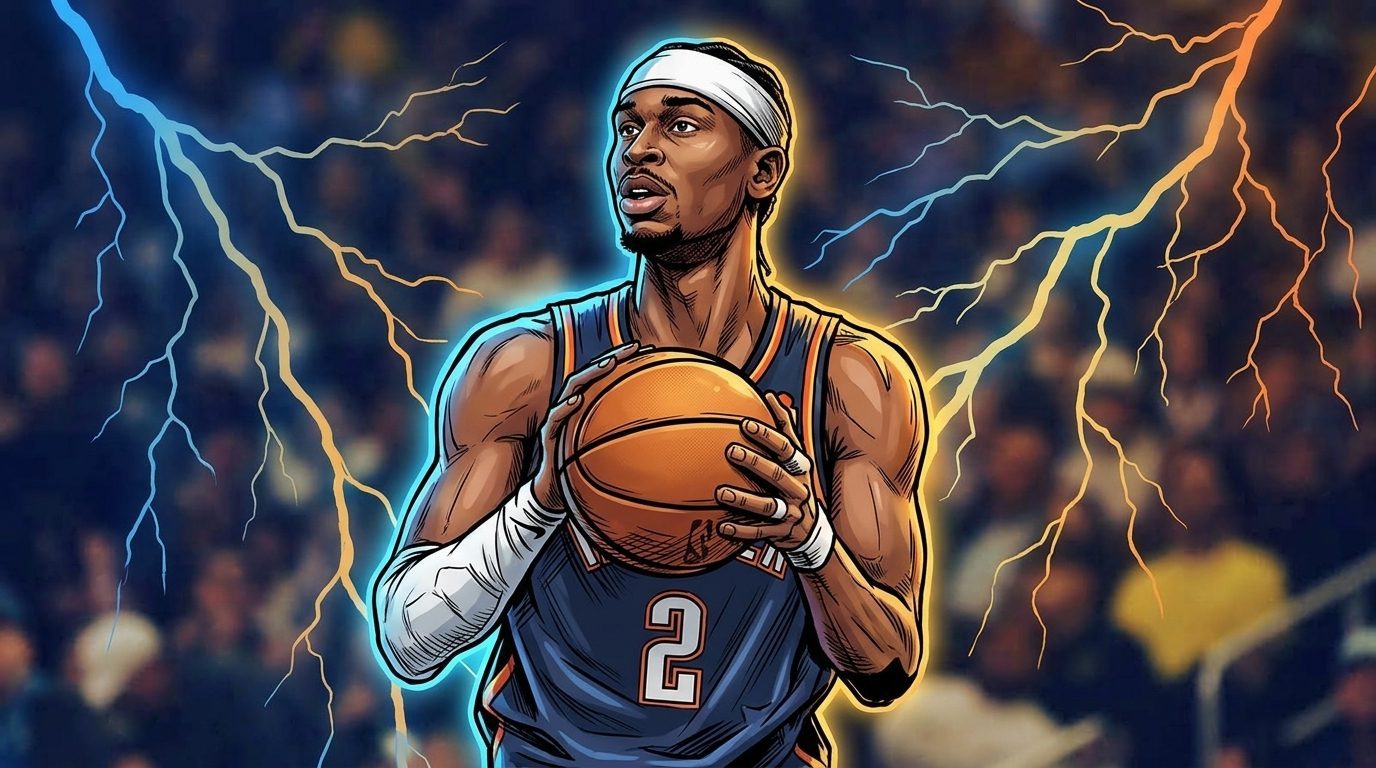
The Oklahoma City Thunder are a National Basketball Association franchise in the Western Conference’s Northwest Division, and one of the few in North American sports to have won titles under two different identities in two different cities. Founded in 1967 as the Seattle SuperSonics, the club captured the Pacific Northwest’s first major professional championship in 1979, moved to Oklahoma City in 2008 amid one of the most contested relocations in league history, and in 2025 delivered the state of Oklahoma its first major-sport title. Across 60 seasons the franchise has gone 2,602–2,168 in the regular season, built almost entirely through the draft and shrewd trades rather than free-agent splashes — a small-market blueprint that produced two separate eras of genuine contention.
| Vitals | |
|---|---|
| Founded | 1967 (Seattle SuperSonics); relocated to Oklahoma City, 2008 |
| League / conference / division | NBA — Western Conference, Northwest Division |
| Arena | Paycom Center, Oklahoma City (cap. 18,203) |
| Owner | Clay Bennett / Professional Basketball Club LLC |
| Head coach | Mark Daigneault (as of Oct. 11, 2026) |
| Titles | 2 — 1979, 2025 |
Expansion and the Spencer Haywood years (1967–1976)
Seattle entered the NBA as an expansion team in 1967, awarded alongside the San Diego Rockets and tipping off on Oct. 13, 1967. The “SuperSonics” name saluted the city’s aviation industry and the planned Boeing supersonic transport. The early teams lost — 23–59 in 1967-68 and 30–52 in 1968-69 — but the foundation arrived fast.
Lenny Wilkens joined in 1968 and became player-coach in 1969, steering Seattle to its first winning season, 47–35 in 1971-72. The franchise’s first true star was Spencer Haywood, who signed in 1970 at the center of a landmark legal fight: his challenge to the NBA’s ban on players whose college classes had not graduated reached the U.S. Supreme Court and opened the league to underclassmen. Haywood averaged better than 24 points and 12 rebounds a night as a four-time All-Star in Seattle.
Hall of Famer Bill Russell coached the club from 1973 to 1977, guiding Seattle to its first playoff berth in 1974-75 (43–39) and a return in 1975-76. Haywood was traded in 1975, closing the franchise’s first competitive chapter without a deep postseason run.
The 1979 championship (1977–1980)
The title team came together almost overnight. After a 5–17 start to 1977-78, Wilkens returned to the bench and transformed the roster of Gus Williams, Dennis Johnson, rookie center Jack Sikma, and sharpshooter “Downtown” Fred Brown into a juggernaut. Seattle reached the 1978 NBA Finals and pushed the Washington Bullets to seven games before losing.
The 1978-79 season ended with the franchise’s first championship. Seattle went 52–30, won the Pacific Division, and beat Washington in a Finals rematch, four games to one. Dennis Johnson was named Finals MVP, Gus Williams led the team in scoring, and Wilkens — later honored with a retired No. 19 — authored the defining season of the Seattle era. The Sonics followed with a franchise-best-to-date 56–26 in 1979-80 before falling in the conference finals.
Decline and the 1987 surprise run (1980–1989)
The title window shut quickly. Gus Williams sat out the entire 1980-81 season in a contract dispute and the team cratered to 34–48; Dennis Johnson had already been dealt to Phoenix. Sikma anchored respectable mid-1980s teams before his own trade in 1986.
A new core of scorers briefly caught fire. Behind Tom Chambers, Dale Ellis and Xavier “X-Man” McDaniel, coach Bernie Bickerstaff’s 1986-87 club finished just 39–43 but, seeded seventh, upset Dallas and Houston to reach the Western Conference finals, where the Showtime Lakers ended the run. It was the franchise’s lone deep playoff push of the decade.
The Payton–Kemp era (1989–1998)
The most beloved Seattle teams were built on a dunk and a pick-your-pocket. Shawn “Reign Man” Kemp arrived from high school in 1989 and Gary “The Glove” Payton was drafted second overall in 1990. Under George Karl, hired in January 1992, they became the NBA’s most electric young tandem, reaching the 1993 Western Conference finals.
Then came the heartbreak that still defines the era. Seattle posted the NBA’s best record at 63–19 in 1993-94 but, as the top seed, became the first No. 1 in league history to lose a first-round series to a No. 8, falling to Dikembe Mutombo’s Denver Nuggets. Redemption nearly came in 1995-96, a franchise-record 64–18: Payton won Defensive Player of the Year and Seattle reached the Finals, extending Michael Jordan’s 72-win Chicago Bulls to six games before losing. Kemp was traded in 1997 in a salary standoff, and Karl departed after 1998, ending the window.
Payton’s twilight and the move to Oklahoma City (1998–2008)
The franchise contended in fits before unraveling. Payton was traded in 2003; a Ray Allen and Rashard Lewis core won the Northwest Division at 52–30 in 2004-05 under coach Nate McMillan, before San Antonio ended the run four games to two in the conference semifinals, closing it out 98–96 in Game 6.
Ownership and geography then reshaped everything. Clay Bennett’s Oklahoma-based group bought the team in 2006. Seattle drafted Kevin Durant second overall in 2007 — he was Rookie of the Year on a 20–62 team — but after an arena-funding fight and a lawsuit from the city, the club relocated to Oklahoma City in 2008. Under the settlement, the SuperSonics name, colors and championship banners were left available to a future Seattle franchise even as the NBA recognized the Thunder as the continuous owner of the record, including the 1979 title.
Durant, Westbrook and Harden (2008–2016)
Oklahoma City’s first team won 23 games; its fourth reached the Finals. Russell Westbrook (drafted fourth in 2008) and James Harden (third in 2009) joined Durant under coach Scott Brooks, and the ascent was rapid: 50 wins in 2009-10, the Western Conference finals in 2011, and a trip to the 2011-12 NBA Finals, where LeBron James’s Miami Heat won in five.
The young core was broken up before it could grow. Harden was traded to Houston in October 2012 over a contract extension — a decision that remains the franchise’s great what-if. Oklahoma City stayed excellent, with Durant winning the 2014 MVP and reaching the conference finals again in 2014 and 2016. In 2016 the Thunder led the record-setting 73-win Golden State Warriors three games to one in the West finals and lost in seven. Durant signed with Golden State that July.
Westbrook’s MVP and the Paul George years (2016–2019)
Russell Westbrook answered Durant’s exit with history. In 2016-17 he averaged a triple-double for the season (31.6 points, 10.7 rebounds, 10.4 assists), broke Oscar Robertson’s single-season triple-double record, and won the 2017 MVP. Oklahoma City acquired Paul George and Carmelo Anthony that summer in a bid to stay in contention.
The star pairing never cleared the first round. The 2017-18 and 2018-19 teams won 48 and 49 games but exited early both times — the latter ended by Damian Lillard’s series-clinching buzzer-beater over George. By the summer of 2019, general manager Sam Presti chose to reset.
The teardown and the pick hoard (2019–2023)
The 2019 trades became the pivot of the modern franchise. Presti sent Paul George to the Clippers for Shai Gilgeous-Alexander, Danilo Gallinari and a record haul of future first-round picks and swaps, and shipped Westbrook to Houston for Chris Paul, two future first-round picks (2024 and 2026) and two pick swaps (2021 and 2025). A veteran-led 44–28 team pushed Houston to a Game 7 in the 2020 bubble.
Then the Thunder deliberately bottomed out to stockpile talent. Chris Paul was moved and the club won just 22 and 24 games in the next two seasons, converting its pick trove into Chet Holmgren (second overall) and Jalen Williams (12th) in the 2022 draft. Holmgren missed 2022-23 with a foot injury while Gilgeous-Alexander quietly became one of the league’s elite scorers.
The Gilgeous-Alexander contender and the 2025 title (2023–present)
The rebuild matured in a single leap. The 2023-24 Thunder went 57–25 as the Western Conference’s top seed before losing in the second round. The 2024-25 season was historic: a 68–14 record and a point differential of +12.9 that broke the 1971-72 Lakers’ NBA record.
On June 22, 2025, Oklahoma City won its first championship. Gilgeous-Alexander completed the rare triple crown — league scoring title at 32.7 points, regular-season MVP and NBA Finals MVP — joining Michael Jordan, Kareem Abdul-Jabbar and Shaquille O’Neal as the only players to sweep all three in one season. The Thunder swept Memphis, survived Denver in seven, dispatched Minnesota, and beat the Indiana Pacers four games to three, taking Game 7 by 103–91. At an average age of 25.6, they were the second-youngest champion in league history.
The repeat bid fell one series short. The 2025-26 Thunder went 64–18 and returned to the Western Conference finals, where Victor Wembanyama’s San Antonio Spurs won a seven-game series. As of Oct. 11, 2026, Mark Daigneault remains head coach and Gilgeous-Alexander the cornerstone, with Holmgren and All-Star Jalen Williams anchoring a young roster that still holds surplus draft capital.
Retired numbers
The franchise’s honored numbers split along its two cities. Seattle retired six player jerseys and a broadcaster’s banner; Oklahoma City has retired a single number, Nick Collison’s No. 4, for the forward who spent his entire career with the club. The league recognizes the Thunder as the continuous holder of this history, though the physical Seattle banners remain a disputed legacy.
| No. | Player | Pos. | Team tenure | Retired |
|---|---|---|---|---|
| 1 | Gus Williams | G | 1977–1984 | Mar. 26, 2004 |
| 4 | Nick Collison | PF | 2003–2018 | Mar. 20, 2019 |
| 10 | Nate McMillan | G | 1986–1998 | Mar. 24, 1999 |
| 19 | Lenny Wilkens | G | 1968–1972 | Oct. 19, 1979 |
| 24 | Spencer Haywood | F/C | 1971–1975 | Feb. 26, 2007 |
| 32 | Fred Brown | G | 1971–1984 | Nov. 6, 1986 |
| 43 | Jack Sikma | C | 1977–1986 | Nov. 21, 1992 |
| — | Bob Blackburn (broadcaster) | — | 1967–1992 | Apr. 17, 1993 |
Season by season
The full franchise record, folded by decade with the newest first.
The 2020s 275–207 · 3 playoff berths · 1 title (2025)
| Season | W–L | Finish | Playoffs |
|---|---|---|---|
| 2020-21 | 22-50 | 5th (NW) | Missed |
| 2021-22 | 24-58 | 5th (NW) | Missed |
| 2022-23 | 40-42 | 3rd (NW) | Missed |
| 2023-24 | 57-25 | 1st (NW) | Lost conf. semis |
| 2024-25 | 68-14 | 1st (NW) | NBA champion (def. IND 4–3) |
| 2025-26 | 64-18 | 1st (NW) | Lost conf. finals |
The 2010s 509–285 · 9 playoff berths · 1 Finals
| Season | W–L | Finish | Playoffs |
|---|---|---|---|
| 2010-11 | 55-27 | 1st (NW) | Lost conf. finals |
| 2011-12 | 47-19 | 1st (NW) | Lost NBA Finals (MIA 1–4) |
| 2012-13 | 60-22 | 1st (NW) | Lost conf. semis |
| 2013-14 | 59-23 | 1st (NW) | Lost conf. finals |
| 2014-15 | 45-37 | 2nd (NW) | Missed |
| 2015-16 | 55-27 | 1st (NW) | Lost conf. finals |
| 2016-17 | 47-35 | 2nd (NW) | Lost first round |
| 2017-18 | 48-34 | 2nd (NW) | Lost first round |
| 2018-19 | 49-33 | 4th (NW) | Lost first round |
| 2019-20 | 44-28 | 2nd (NW) | Lost first round |
The 2000s 377–443 · 3 playoff berths · relocation to OKC (2008)
| Season | W–L | Finish | Playoffs |
|---|---|---|---|
| 2000-01 | 44-38 | 5th (Pacific) | Missed |
| 2001-02 | 45-37 | 4th (Pacific) | Lost first round |
| 2002-03 | 40-42 | 5th (Pacific) | Missed |
| 2003-04 | 37-45 | 5th (Pacific) | Missed |
| 2004-05 | 52-30 | 1st (NW) | Lost conf. semis |
| 2005-06 | 35-47 | 3rd (NW) | Missed |
| 2006-07 | 31-51 | 5th (NW) | Missed |
| 2007-08 | 20-62 | 5th (NW) | Missed |
| 2008-09 | 23-59 | 5th (NW) | Missed |
| 2009-10 | 50-32 | 4th (NW) | Lost first round |
The 1990s 515–273 · 9 playoff berths · 1 Finals
| Season | W–L | Finish | Playoffs |
|---|---|---|---|
| 1990-91 | 41-41 | 5th (Pacific) | Lost first round |
| 1991-92 | 47-35 | 4th (Pacific) | Lost conf. semis |
| 1992-93 | 55-27 | 2nd (Pacific) | Lost conf. finals |
| 1993-94 | 63-19 | 1st (Pacific) | Lost first round |
| 1994-95 | 57-25 | 2nd (Pacific) | Lost first round |
| 1995-96 | 64-18 | 1st (Pacific) | Lost NBA Finals (CHI 2–4) |
| 1996-97 | 57-25 | 1st (Pacific) | Lost conf. semis |
| 1997-98 | 61-21 | 1st (Pacific) | Lost conf. semis |
| 1998-99 | 25-25 | 5th (Pacific) | Missed |
| 1999-00 | 45-37 | 4th (Pacific) | Lost first round |
The 1980s 409–411 · 6 playoff berths · 1 conference finals
| Season | W–L | Finish | Playoffs |
|---|---|---|---|
| 1980-81 | 34-48 | 6th (Pacific) | Missed |
| 1981-82 | 52-30 | 2nd (Pacific) | Lost conf. semis |
| 1982-83 | 48-34 | 3rd (Pacific) | Lost first round |
| 1983-84 | 42-40 | 3rd (Pacific) | Lost first round |
| 1984-85 | 31-51 | 4th (Pacific) | Missed |
| 1985-86 | 31-51 | 5th (Pacific) | Missed |
| 1986-87 | 39-43 | 4th (Pacific) | Lost conf. finals |
| 1987-88 | 44-38 | 3rd (Pacific) | Lost first round |
| 1988-89 | 47-35 | 3rd (Pacific) | Lost conf. semis |
| 1989-90 | 41-41 | 4th (Pacific) | Missed |
The 1970s 428–392 · 5 playoff berths · 2 Finals · 1 title (1979)
| Season | W–L | Finish | Playoffs |
|---|---|---|---|
| 1970-71 | 38-44 | 4th (Pacific) | Missed |
| 1971-72 | 47-35 | 3rd (Pacific) | Missed |
| 1972-73 | 26-56 | 4th (Pacific) | Missed |
| 1973-74 | 36-46 | 3rd (Pacific) | Missed |
| 1974-75 | 43-39 | 2nd (Pacific) | Lost conf. semis |
| 1975-76 | 43-39 | 2nd (Pacific) | Lost conf. semis |
| 1976-77 | 40-42 | 4th (Pacific) | Missed |
| 1977-78 | 47-35 | 3rd (Pacific) | Lost NBA Finals (WAS 3–4) |
| 1978-79 | 52-30 | 1st (Pacific) | NBA champion (def. WAS 4–1) |
| 1979-80 | 56-26 | 2nd (Pacific) | Lost conf. finals |
The 1960s 89–157 · 0 playoff berths · expansion era
| Season | W–L | Finish | Playoffs |
|---|---|---|---|
| 1967-68 | 23-59 | 5th (West) | Missed |
| 1968-69 | 30-52 | 6th (West) | Missed |
| 1969-70 | 36-46 | 5th (West) | Missed |
By the numbers
Franchise marks
Ranks
- 1st Scoring margin, single season in NBA history (+12.9, 2024-25)
- 1st NBA regular season, 2024-25 (68–14)
- 2nd Youngest NBA champion ever (avg. age 25.6, 2024-25)
Honors
- 2025 NBA champion
- 1979 NBA champion
- 5× conference champion (1978, 1979, 1996, 2012, 2025)
- 14× division champion (1979, 1994, 1996, 1997, 1998, 2005, 2011, 2012, 2013, 2014, 2016, 2024, 2025, 2026)
- 3 league MVPs: Durant (2014), Westbrook (2017), Gilgeous-Alexander (2025)
- Gilgeous-Alexander: 2025 MVP, Finals MVP & scoring title
Per Basketball-Reference and the 2024-25 season record, through Oct. 11, 2026.
The arguments
Whose history is it? The most charged debate surrounding the franchise is not on the court. When the team left Seattle in 2008, the relocation settlement allowed the SuperSonics name, colors and banners to be claimed by a future Seattle NBA team, yet the league recognizes the Thunder as the unbroken franchise that holds the 1979 title and all Seattle records. Many Seattle supporters argue the championship and the Payton–Kemp legacy belong to the city that lived them; the NBA’s record-keeping and the Thunder’s own history pages treat the line as continuous. Both positions are widely held and neither has been formally resolved.
Did trading James Harden cost a dynasty? Oklahoma City dealt Harden to Houston in October 2012 rather than pay a fourth maximum-level salary. One side holds that keeping the Durant–Westbrook–Harden trio would have won multiple titles; the other notes the franchise reached the Finals once and three conference finals afterward and that luxury-tax math left the front office little room. The counterfactual is unprovable and remains the most-litigated decision of the Oklahoma City era.
Was 2016 the one that got away? Leading Golden State 3–1 in the 2016 Western Conference finals and losing in seven, followed weeks later by Durant signing with that same Warriors team, is remembered by many as the franchise’s deepest heartbreak. Others frame the collapse as the product of an all-time opponent rather than a Thunder failure.
Why it matters
The Oklahoma City Thunder are the rare small-market club to have built two distinct contenders a generation apart — Payton and Kemp in Seattle, Durant and Westbrook and now Gilgeous-Alexander in Oklahoma City — each assembled through the draft rather than purchased in free agency. The 2019 decision to convert a departing star into a record stockpile of draft picks, and the patience to let that capital mature into a 68-win champion, has become a template studied across the league. For a franchise that carried a city’s grievance in one direction and delivered a state its first championship in the other, the throughline is the same: Oklahoma City won by valuing assets and time more ruthlessly than almost anyone else.