Shohei Ohtani
Shohei Ohtani is the two-way Angels and Dodgers superstar whose record 50-50 season, back-to-back World Series titles and $700M deal redefined baseball.
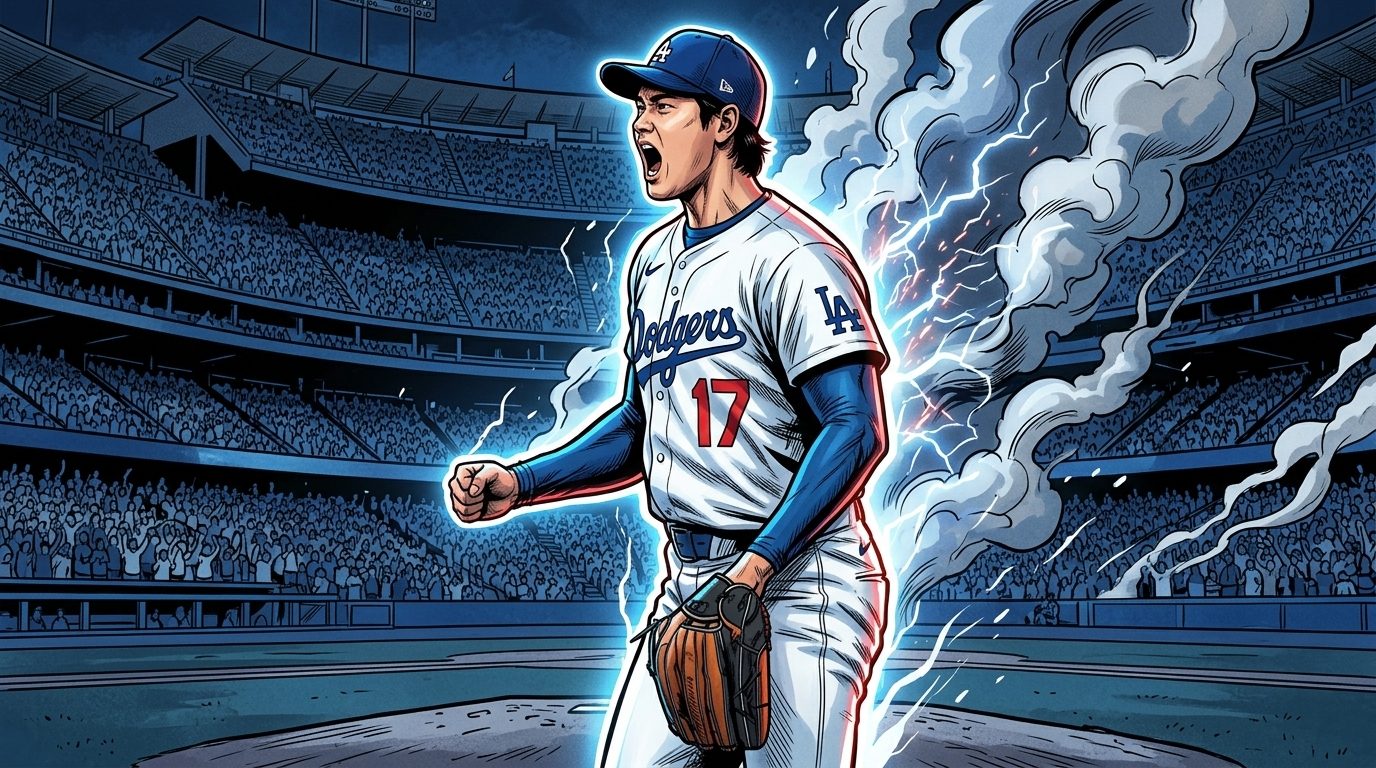
Shohei Ohtani is the Japanese two-way phenomenon who collapsed a century-old assumption — that no modern player could both hit and pitch at the top of the sport — and then kept raising the ceiling. A starting pitcher who throws past 100 mph and a left-handed slugger with 310 career home runs through the 2026 season, he won two unanimous MVP awards in the American League, two more in the National League, the first 50-home-run/50-stolen-base season in Major League history, and back-to-back World Series titles with the Los Angeles Dodgers. His December 2023 contract — ten years and $700 million, with $680 million deferred — remains the largest in North American team-sports history.
| Vitals | |
|---|---|
| Born | July 5, 1994, Oshu, Japan |
| Position | Designated hitter / starting pitcher (bats left, throws right) |
| Teams | Los Angeles Angels (2018–2023); Los Angeles Dodgers (from 2024) |
| Draft / signing | No MLB draft; arrived from Japan’s Nippon Professional Baseball and signed with the Angels as an international free agent ahead of the 2018 season |
| Contract | 10 years, $700M with the Dodgers (signed December 2023); $680M deferred across 2034–2043. Under contract through 2033 as of October 8, 2026 |
| Number | 17 |
Before the majors
The import. Ohtani reached the majors already a national figure in Japan, where he had played professionally in Nippon Professional Baseball as both a pitcher and a hitter. Rather than enter through the amateur draft, he came to the United States as an international free agent and signed with the Los Angeles Angels ahead of the 2018 season, choosing the franchise in part for its willingness to let him keep pitching and hitting. The experiment that followed had almost no modern precedent: the last player to carry a comparable two-way workload across a full career was Babe Ruth, roughly a century earlier.
Angels years (2018–2023)
The arrival. Ohtani announced himself immediately, winning the 2018 American League Rookie of the Year award while hitting 22 home runs and holding down a spot in the rotation. An elbow injury that first autumn required a Tommy John procedure and cost him his 2019 pitching, a preview of the arm trouble that would shadow his career even as his bat kept producing.
The two-way proof. The role stopped being a novelty in 2021, when Ohtani hit 46 home runs, stole 26 bases and threw 130-plus innings on the mound, a season so singular it earned him a unanimous AL MVP. He answered it in 2023 with an even louder bat — a league-leading 44 home runs and a 1.066 OPS — and a second unanimous MVP, becoming the rare player to win the award by acclamation twice. Across six Angels seasons he carried a mid-market franchise that, for all his output, never reached the postseason while he wore its uniform.
The elbow. A second major elbow injury in 2023 ended his pitching that year and required surgery, removing him from the mound entirely for what would become his first Dodgers season. He reached free agency that winter as the most coveted player the sport had seen in a generation, a hitter who could anchor a lineup immediately and a pitcher expected to return.
Dodgers years (from 2024)
The megadeal. In December 2023, Ohtani signed with the Los Angeles Dodgers for ten years and $700 million, the richest contract in North American sports. Its defining feature was structural: $680 million of the total is deferred, paid out from 2034 through 2043, which lowered the deal’s present-day value and gave the Dodgers room under the competitive-balance tax to build around him. The mechanism was reported as fully legal and, by the player’s own framing, designed to help the team win.
The 50-50 season. Limited to designated hitter in 2024 while his elbow healed, Ohtani produced the most prolific individual season of the era. He finished with 54 home runs and 59 stolen bases, becoming the first player in Major League history to reach 50 of each in a single year — a threshold he cleared on September 19, 2024, during a 6-for-6 game with three homers and two steals. He led the National League in home runs, drove in 130 runs and was named NL MVP unanimously. The season ended with a championship: the Dodgers beat the New York Yankees in five games, closing it out with the largest comeback to clinch a title in World Series history.
Back-to-back. In 2025 Ohtani set the Dodgers single-season home-run record with 55 and broke the modern-era franchise record for runs scored, crossing the plate 146 times — past Babe Herman’s modern-era mark of 143 from 1930 and his own Los Angeles-era record of 134 set in 2024. That 146 still trails the all-time franchise record of 148, set by Hub Collins in Brooklyn’s 1890 season, and ties Darby O’Brien’s 146 from 1889 for second on the list. He won a second straight NL MVP and was named NLCS MVP after a Game 4 against the Milwaukee Brewers in which he hit three home runs and threw six scoreless innings with ten strikeouts. The Dodgers then became baseball’s first repeat champions since the 1998–2000 Yankees, defeating the Toronto Blue Jays 5–4 in an eleven-inning Game 7 on November 1, 2025; Ohtani started that game on the mound before the Dodgers’ comeback in the late innings.
The return to the mound. Ohtani’s pitching came back by degrees. He took the mound again in 2025 for the first time since his 2023 surgery, working a cautious 47 innings across 14 starts with a 2.87 ERA and 62 strikeouts. The 2026 season was his first full-strength pitching campaign in Dodger blue: he went 8–2 with a 1.79 ERA and 95 strikeouts over 85.2 innings in 14 starts, making his final start of the year on July 3 before a left knee injury — later compounded by a biceps issue — sidelined his pitching. By early September 2026 his pitching was effectively finished for the season, though manager Dave Roberts stopped short of making it official: “Not officially. But obviously, if you’re looking at the calendar, how much he’s thrown in the last week, I think we can all do the math.” With little time left in the schedule to rebuild his arm strength, the expectation was that he would focus on hitting the rest of the way. As a hitter in 2026 he appeared in 135 games with 30 home runs.
By the numbers
| Season | Team | GP | HR | RBI | SB | AVG | OPS |
|---|---|---|---|---|---|---|---|
| 2018 | LAA | 104 | 22 | 61 | 10 | .285 | .925 |
| 2019 | LAA | 106 | 18 | 62 | 12 | .286 | .848 |
| 2020 | LAA | 44 | 7 | 24 | 7 | .190 | .657 |
| 2021 | LAA | 155 | 46 | 100 | 26 | .257 | .965 |
| 2022 | LAA | 157 | 34 | 95 | 11 | .273 | .875 |
| 2023 | LAA | 135 | 44 | 95 | 20 | .304 | 1.066 |
| 2024 | LAD | 159 | 54 | 130 | 59 | .310 | 1.036 |
| 2025 | LAD | 158 | 55 | 102 | 20 | .282 | 1.014 |
| 2026 | LAD | 135 | 30 | 81 | 11 | .275 | .889 |
Batting figures per Baseball-Reference. As a pitcher he threw 166 innings in 2022 and returned for 47 (2025) and 85.2 (2026) innings with the Dodgers.
Career totals
Ranks
- 1st Only 50-HR / 50-SB season in MLB history (54 HR, 59 SB, 2024)
- 1st National League home runs, 2024 season (54)
- 1st Dodgers single-season home runs (55, 2025)
- 1st Modern-era (post-1900) Dodgers single-season runs scored (146, 2025) — tied-2nd all-time behind Hub Collins (148, 1890)
Honors
- 4× Most Valuable Player (2021, 2023, 2024, 2025)
- 2× World Series champion (2024, 2025)
- First 50-50 season in MLB history (2024)
- 2018 AL Rookie of the Year
- 6× All-Star (2021–2026)
- 2025 NLCS MVP
- 4× Silver Slugger (2021, 2023, 2024, 2025)
Per Baseball-Reference, Wikipedia, Baseball Almanac and True Blue LA, through the 2026 season.
The arguments
Is the two-way role worth the risk? Ohtani’s value as a hitter alone would make him a franchise cornerstone, which is why some analysts have argued the Dodgers should curb his pitching to protect a bat that produces MVP seasons on its own; the counterview, voiced by Ohtani and his managers, is that the two-way identity is the point — the thing that makes him unique and, by his telling, the role he intends to keep. His 2024 season as a designated hitter and the Dodgers’ early-September 2026 move to keep him off the mound for the rest of the season sit on one side of that ledger; his 1.79-ERA mound work before it sits on the other.
Does the deferred contract distort the sport? The structure of the $700 million deal — with $680 million pushed into the 2030s and 2040s — drew debate across the industry. Critics, reported to include rival executives, framed the heavy deferrals as a way to suppress a contract’s luxury-tax hit and tilt competitive balance toward the wealthiest clubs. Defenders noted the arrangement is permitted under the collective bargaining agreement, that it carries real cost to the player in present-day value, and that Ohtani himself requested the terms to let the Dodgers spend elsewhere.
Ruth, or something beyond? The comparison to Babe Ruth is unavoidable and contested. Supporters argue Ohtani has already surpassed Ruth as a two-way player, pointing to a 50-50 season and sustained elite pitching that Ruth never combined in the same years. Skeptics counter that Ruth’s offensive dominance relative to his era, and the gap between the leagues then and now, make any direct ranking more rhetorical than settled. The debate is framed, by both sides, as a measure of how far outside the normal distribution Ohtani sits.
Why it matters
Ohtani matters because he moved the boundary of what a single baseball player is understood to be able to do, and then did it inside winning teams rather than as a curiosity on losing ones. The Angels years proved the two-way role could survive a full major-league season and win MVPs; the Dodgers years added the championships, the records and the contract that reset the market. Whatever the final shape of his career, the 50-50 season, the two unanimous MVPs in each league and the back-to-back titles are already the kind of facts that end an argument rather than start one.