LSU Tigers football
LSU Tigers football has won four national titles (1958, 2003, 2007, 2019), produced three Heisman winners, and plays in Death Valley under Lane Kiffin.
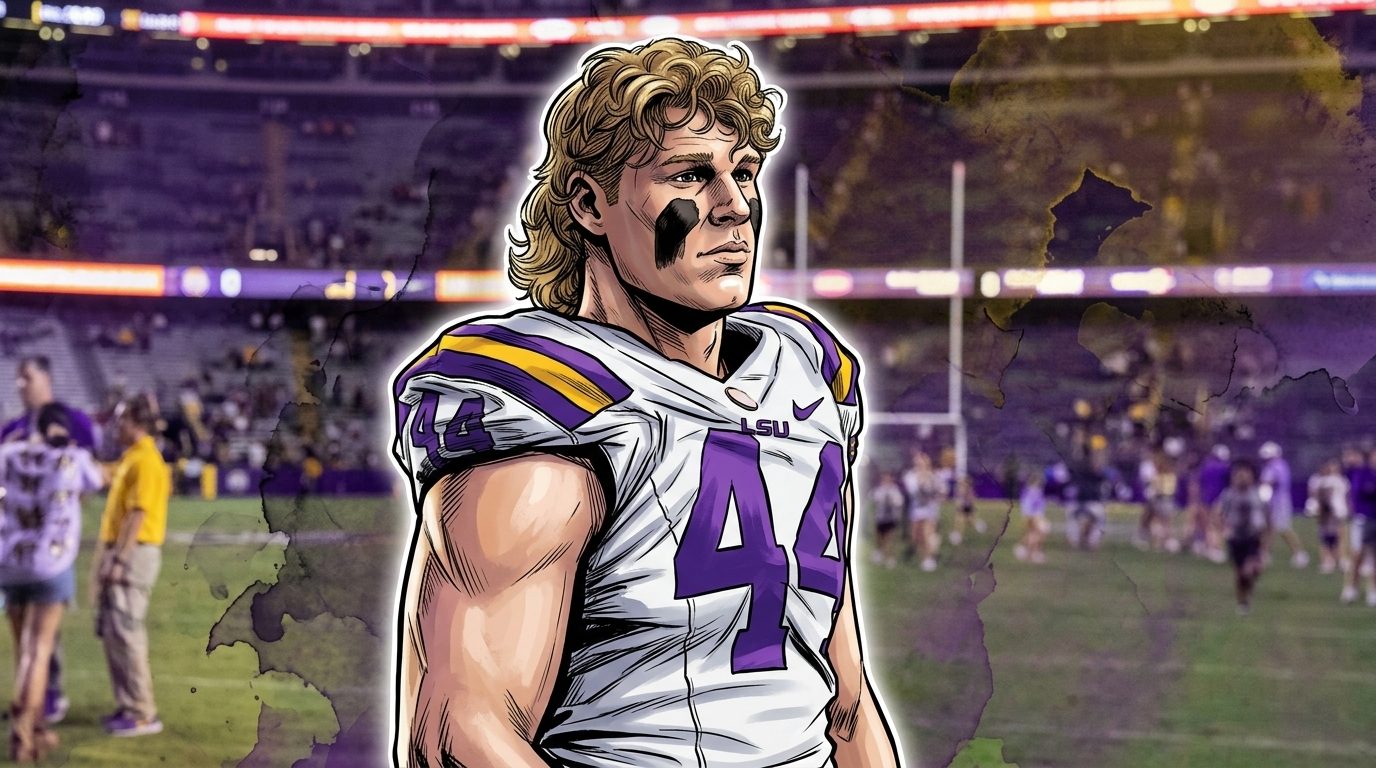
The LSU Tigers are the football program of Louisiana State University in Baton Rouge, and for the better part of a century they have been the beating heart of football in Louisiana. The Tigers are a charter member of the Southeastern Conference, own four claimed national championships (1958, 2003, 2007 and 2019), have produced three Heisman Trophy winners, and carry an all-time record of 834–446–47 (.646), the 15th-best winning percentage in major-college history. More than the numbers, LSU is defined by a place: Tiger Stadium, “Death Valley,” where Saturday night football became a sensory experience that visiting teams dread and NFL scouts treat as a finishing school.
| Vitals | |
|---|---|
| First season | 1893 |
| Conference | Southeastern Conference (charter member, 1933) |
| Stadium | Tiger Stadium (“Death Valley”), 102,321, Baton Rouge |
| Institution | Louisiana State University (public) |
| Head coach | Lane Kiffin (37th in program history; hired Nov. 30, 2025), as of Oct. 14, 2026 |
| National titles | 1958, 2003, 2007, 2019 |
Origins and the Southern rise (1893–1954)
LSU first fielded a team in 1893, and the nickname “Fighting Tigers” was borrowed from a Confederate infantry battalion of Louisiana “Tigers,” a lineage that gave the program its purple-and-gold identity and its live Bengal mascot, Mike the Tiger, first installed in 1936. The Tigers were a founding member of the Southeastern Conference when it formed in 1933.
The venue arrived before the dynasties did. Tiger Stadium opened on Nov. 25, 1924 with a capacity of 12,000, and LSU began the tradition that would define it in 1931, playing under the lights against Spring Hill to dodge the daytime heat. Night football became the program’s signature and, eventually, its mythology.
Bernie Moore delivered the first conference glory. Under Moore, LSU won SEC titles in 1935 and 1936 behind All-American end Gaynell Tinsley, establishing the Tigers as a regional power even as national recognition stayed out of reach through the war years and after.
The Dietzel era and the first national title (1955–1961)
Paul Dietzel built LSU’s first champion. The 1958 Tigers went 11–0 and won the AP and Coaches national championship, capping the season with a 7–0 Sugar Bowl win over Clemson. Dietzel’s innovation was a three-platoon system whose fearsome third unit, the “Chinese Bandits,” became folk heroes in Baton Rouge.
Billy Cannon turned that team into legend. The halfback was the engine of the 1958 title run and then, on Halloween night 1959, produced the single most famous play in school history: an 89-yard punt return for the only touchdown in a 7–3 win over No. 3 Ole Miss, breaking seven tackles down the east sideline. Cannon won LSU’s first Heisman Trophy that season. His No. 20 remains the only number the program has ever permanently retired. Dietzel added another SEC title in 1961 before departing.
The McClendon era: two decades of Cholly Mac (1962–1979)
Charles “Cholly Mac” McClendon gave LSU its longest run of stability. Across 18 seasons he became the winningest coach in program history with 137 victories, fielding bowl team after bowl team and repeatedly challenging Bear Bryant’s Alabama in the SEC’s defining rivalry of the era. LSU won the conference outright in 1970.
The era produced enduring stars. Defensive back Tommy Casanova (No. 37) and quarterback Bert Jones (No. 7) both played for McClendon and both would later have their jerseys honored. McClendon’s Tigers rarely reached the mountaintop, but they made Tiger Stadium a nightmare for ranked visitors and kept LSU permanently relevant.
The wilderness and the DiNardo revival (1980–1999)
Bill Arnsparger briefly restored the Tigers to the top of the SEC, winning an outright conference championship in 1986 with a defense-first identity drawn from his NFL pedigree. But the two decades after McClendon were mostly lean, marked by coaching churn and a slide into the conference’s second tier.
Gerry DiNardo pulled the program out of the ditch in the mid-1990s, stacking consecutive winning seasons and bowl wins and briefly convincing fans the sleeping giant had woken. The revival did not last; a collapse at the end of the decade left LSU searching for a coach who could match the stadium’s ambition. Athletic director Joe Dean found one in a little-known Michigan State coach named Nick Saban.
The Saban era: the program reborn (2000–2004)
Nick Saban turned LSU into a machine. Over five seasons he went 48–16, won the SEC in 2001, and in 2003 delivered the title the program had chased for 45 years. That team finished 13–1 and won the BCS National Championship Game 21–14 over Oklahoma in the Superdome, splitting the national championship with USC in a season that would help doom the BCS format.
Saban’s defining imprint was defense and recruiting. He locked down the talent-rich state and built a championship standard that LSU has measured every coach against since. His departure for the Miami Dolphins after the 2004 season set up a hire that, improbably, kept the dynasty rolling.
The Les Miles era: the Mad Hatter (2005–2016)
Les Miles won early and kept LSU in the national conversation for a decade. The coach nicknamed the “Mad Hatter” for his clock-defying gambles compiled a 114–34 record and claimed the 2007 BCS championship, a 12–2 season that ended with a 38–24 win over Ohio State and gave LSU its second title in five years.
The 2011 team was arguably the best not to finish as champion. LSU went 12–0 in the regular season, including a 9–6 overtime win over No. 2 Alabama on Nov. 5, 2011, then beat Georgia in the SEC Championship Game to reach 13–0 before losing the all-SEC rematch for the title 21–0 — the first shutout in BCS history and a result that fueled the push toward a playoff. That roster, featuring Tyrann Mathieu, Odell Beckham Jr. and Jarvis Landry, is still argued over in Louisiana. Miles was fired four games into the 2016 season after a narrow loss to Auburn.
The Orgeron era and the perfect season (2016–2021)
Ed Orgeron, a Louisiana native, took over as interim and earned the job, then built toward the greatest season in school history. The 2019 Tigers went 15–0 and won the College Football Playoff, overwhelming Clemson 42–25 in the title game.
Joe Burrow authored the finest individual year a quarterback has ever had. The transfer threw for 5,671 yards and a then-FBS-record 60 touchdowns, won LSU’s first Heisman since Billy Cannon by the largest margin in the award’s history, and carried an offense that is widely regarded as the best in modern college football. The afterglow faded fast: LSU went 5–5 in the pandemic-shortened 2020 season and 6–7 in 2021, and Orgeron and the school parted ways after that year.
The Brian Kelly era (2022–2025)
Brian Kelly arrived from Notre Dame as a proven winner and started strong, going 10–4 and winning the SEC West in his first season. In 2023 quarterback Jayden Daniels won the program’s third Heisman Trophy in a 10–3 campaign, and 2024 produced another nine-win year.
The marriage ended in acrimony. With the 2025 team at 5–3 following a lopsided home loss to Texas A&M, LSU fired Kelly on Oct. 26, 2025, leaving behind a 34–14 record. The split triggered a legal fight over his contract that ended with the school agreeing to pay a buyout of roughly $54 million, the largest of the 2025 coaching carousel. The Tigers finished 7–6 under interim leadership.
The Lane Kiffin era (2026–present)
LSU made the splash hire of the cycle. On Nov. 30, 2025, Lane Kiffin left Ole Miss to become LSU’s 37th head coach, the offensive architect who had turned the Rebels into a national contender over six seasons in Oxford. The deal reflected the sport’s new economics, with Kiffin’s program commanding roster spending far beyond any previous LSU regime.
The debut was emphatic. On Sept. 5, 2026, LSU smothered Clemson 51–10 in Tiger Stadium behind quarterback Sam Leavitt, piling up 644 yards. SEC play proved harder: through Oct. 11, 2026 the Tigers stood at 4–2 (1–2 SEC), ranked No. 22 in the AP poll, with losses at Ole Miss (a charged 32–24 Magnolia Bowl return to Oxford for Kiffin) and a 35–34 overtime defeat at Kentucky sandwiched around a 35–6 dismantling of Texas A&M.
Rivalries frame every LSU season. The blood feuds run deepest with Alabama — the series that produced Saban’s split allegiances and the 2011 title rematch — and with Ole Miss, whose annual Magnolia Bowl traces back to Cannon’s Halloween run. LSU also plays Auburn for the “Tiger Bowl,” Arkansas for the Golden Boot trophy, Texas A&M on the season’s final weekend, and Tulane in one of the oldest series in the South.
Retired numbers
LSU is famously stingy with its numbers, drawing a sharp line between a jersey that is “retired” from circulation and one that is merely honored. Only Billy Cannon’s No. 20 has been removed from the program forever; the others remain eligible to be worn again. The figures LSU has set apart, per the LSU Football Report:
| No. | Player | Pos. | Team tenure | Honored |
|---|---|---|---|---|
| 20 | Billy Cannon | HB | 1957–1959 | Dec. 12, 1959 (permanently retired) |
| 37 | Tommy Casanova | DB | 1969–1971 | Oct. 10, 2009 |
| 21 | Jerry Stovall | HB/DB | 1960–1962 | Oct. 13, 2018 |
| 4 | Charles Alexander | RB | 1975–1978 | Sept. 13, 2025 |
| 7 | Bert Jones | QB | 1970–1972 | scheduled Nov. 14, 2026 |
Season by season
The folded record below is complete for LSU’s modern era (2000 onward); the program’s championship and landmark seasons anchor the earlier decades. Newest decade first.
The 2020s 51–31 (through Oct. 2026) · 1 SEC West title · 1 Heisman (Daniels, 2023)
| Season | W–L | Result |
|---|---|---|
| 2026 | 4–2 | In progress (through Oct. 11) — Kiffin era opens |
| 2025 | 7–6 | Kelly dismissed Oct. 26 at 5–3; interim finish |
| 2024 | 9–4 | Bowl season |
| 2023 | 10–3 | Jayden Daniels wins the Heisman |
| 2022 | 10–4 | SEC West champion |
| 2021 | 6–7 | Orgeron era ends |
| 2020 | 5–5 | Pandemic-shortened; opted out of bowl |
The 2010s 103–28 · 1 national title (2019) · 1 Heisman (Burrow, 2019)
| Season | W–L | Result |
|---|---|---|
| 2019 | 15–0 | CFP national champion; SEC champion |
| 2018 | 10–3 | Fiesta Bowl season |
| 2017 | 9–4 | Bowl season |
| 2016 | 8–4 | Miles fired; Orgeron interim |
| 2015 | 9–3 | Bowl season |
| 2014 | 8–5 | Bowl season |
| 2013 | 10–3 | Bowl season |
| 2012 | 10–3 | Bowl season |
| 2011 | 13–1 | Lost BCS title game 21–0 to Alabama |
| 2010 | 11–2 | Cotton Bowl season |
The 2000s 99–31 · 2 national titles (2003, 2007) · 3 SEC titles
| Season | W–L | Result |
|---|---|---|
| 2009 | 9–4 | Bowl season |
| 2008 | 8–5 | Bowl season |
| 2007 | 12–2 | BCS national champion; SEC champion |
| 2006 | 11–2 | Sugar Bowl season |
| 2005 | 11–2 | Miles’ first season |
| 2004 | 9–3 | Saban’s final season |
| 2003 | 13–1 | BCS national champion; SEC champion |
| 2002 | 8–5 | Bowl season |
| 2001 | 10–3 | SEC champion |
| 2000 | 8–4 | Saban’s first season |
Before 2000 Charter SEC member (1933) · landmark seasons below
| Season | W–L | Result |
|---|---|---|
| 1986 | 9–3 | Outright SEC champion (Arnsparger) |
| 1970 | 9–3 | SEC champion (McClendon) |
| 1961 | 10–1 | SEC champion (Dietzel) |
| 1958 | 11–0 | National champion (Dietzel) |
| 1936 | 9–1–1 | SEC champion (Moore) |
| 1935 | 9–2 | SEC champion (Moore) |
By the numbers
Franchise marks
Ranks
- 15th All-time FBS winning percentage (.646)
- 12th All-time FBS wins (834)
- 3–1 All-time in BCS bowl games
- Top 10 Most wins among FBS programs since the 2000 season
Honors
- 4× national champion (1958, 2003, 2007, 2019)
- 3× Heisman winner (1959, 2019, 2023)
- 12× SEC champion
- 2019: 15–0, CFP national champion
- 2003 & 2007 BCS national champion
- 3–1 all-time in BCS bowl games
Per Winsipedia, program records and Sports Reference, through Oct. 11, 2026.
The arguments
Is LSU a “title-or-bust” job that eats good coaches? Supporters of the Brian Kelly firing argue that a program with four national titles and the nation’s richest recruiting state should never settle for nine wins, and that a 34–14 record without a playoff run justified eating a $54 million buyout. Critics counter that LSU’s impatience — three coaches pushed out mid-contract since 2016 — breeds instability and that few programs have cycled through more talent for fewer titles in the same span.
Does the 2003 championship count the same as the others? LSU claims 2003 as a full national title, having won the BCS game, but the AP poll awarded its championship to USC that year, making it a split title. Rivals use the asterisk; LSU points to the trophy from the game designated to decide the champion.
Was the 2011 team robbed, or exposed? One camp holds that a 13–0 LSU side that had already beaten Alabama on the road was the best team in the country and that a rematch should never have decided the title. The other notes that LSU was shut out 21–0 on the night that counted, a result that both ended the BCS era and left the question permanently unsettled.
Why it matters
LSU football is where Louisiana gathers on Saturday nights, and Death Valley at full voice remains one of the sport’s genuine home-field advantages. The program has won titles under four different coaches across seven decades, sent a conveyor belt of stars to the NFL — from Billy Cannon to Joe Burrow, Odell Beckham Jr. and Ja’Marr Chase — and set the standard for how much a fan base, a state and a recruiting pipeline can demand of a football team. Through every coaching change and every argument, the expectation never wavers: at LSU, the only acceptable ceiling is a championship.