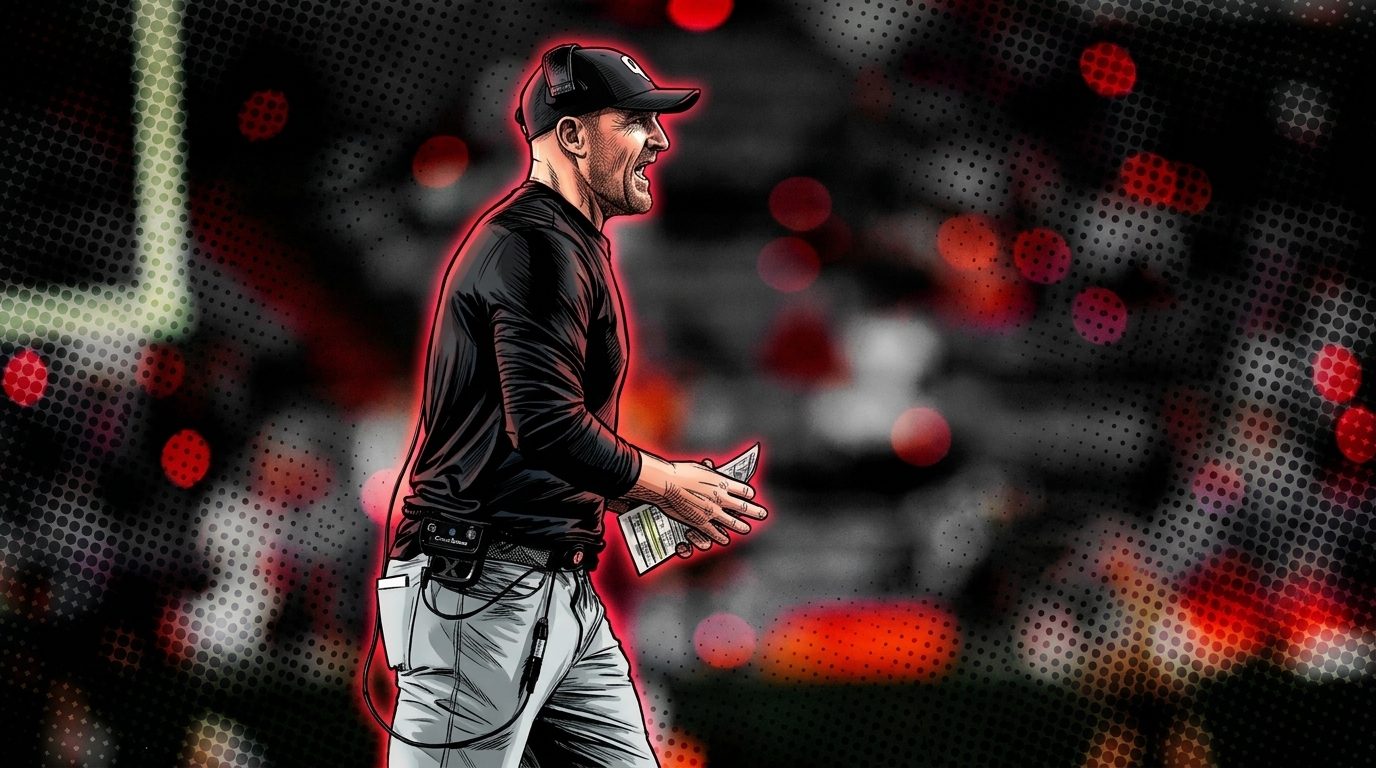

Twenty plays. 89 yards. Twelve minutes and 45 seconds off the clock, with five third-down conversions along the way. That one drive is how Oklahoma closed out Florida in Gainesville, and it is the cleanest summary of what Jason Witten’s first game as interim play-caller looked like.
I’m calling my yardstick the clock-and-conversion test. Did the offense control time, and did it finish when the down and distance got ugly? Clock is the first half: how much of the game does your offense keep away from the other sideline? Conversion is the second: when it is third down and the play call has to work, does it? Oklahoma passed both on Saturday, 23-7 over a ranked Florida team that had not lost to a visitor at home in 48 games.
https://x.com/NEWS9/status/2119279672492228916
The arithmetic of that drive is worth a pause. Eighty-nine yards over 20 plays is a hair under four and a half yards a snap. Nothing about it was explosive. It was a drive that ate more than twelve minutes, most of a quarter’s worth of game time while Florida’s defense stayed on the field.
What did Witten actually change?
He changed how Oklahoma gained yards. The Sooners rushed 39 times, kept John Mateer turnover-free, and piled up 351 total yards to Florida’s 203 by accumulating gains. Only one play went over 20 yards, a 41-yard Mateer pass to Rocky Beers. The offense stopped hunting chunks and started earning first downs.
The run-pass split backs that up. Oklahoma carried the ball 39 times against 33 Mateer attempts, so the ground game set the pace and the passing game cashed in on it.
Mateer finished 21-of-33 with two touchdown passes, one to Hayden Hansen from three yards out and the one that capped the long drive to Isaiah Sategna III. He added 56 rushing yards. Eight different Sooners caught passes, which is the plain-language version of balance: a defense cannot lean on one receiver when the ball keeps finding new hands.
Context matters here. Witten, a former Cowboys tight end who coached high school ball in Texas last season, took over five days before kickoff after Ben Arbuckle was fired following a loss to South Carolina. This is an offense that earlier this season put up three straight games of 14 points or fewer. Twenty-three points and no turnovers is a different animal, and a fan can fairly ask whether the same players were simply put in better spots.
Does one drive prove anything?
It proves Oklahoma can finish what it starts, which matters for an offense that had just lost its coordinator. It cannot prove repeatability. A 20-play march depends on staying ahead of the sticks, and five third-down conversions inside one possession is a number most offenses will not hit twice in a row.
Florida also helped. Tramell Jones Jr. went 10-of-22 for 133 yards with two interceptions, and the Gators were scoreless in the second half. Brent Venables called it a “Really complete performance” and “Just really clean football game, with complementary football,” adding, “Thought we really dominated the line of scrimmage.”
When the defense tilts the field like that, a patient offense looks smarter than it might against a team that keeps pace. A lead makes every run-heavy call look like a plan. A trailing offense has to speed up, and that is when clock-and-conversion football gets stress-tested. Saturday never gave us that test, because Florida was scoreless after halftime. Venables was praising the whole afternoon, and the clock-and-conversion clinic was one part of a game where several things broke Oklahoma’s way.
Is this a cure or a sugar high?
My lean is a mild sugar high with a real caveat. One game is a small sample, Witten is an interim play-caller, and Oklahoma still sits at 5-4 overall and 3-3 in the SEC. Still, ball security and third-down conversions tend to travel, so I’d call this a promising start and keep the verdict open.
Here is the case for the cure. Ball security does not depend on the opponent’s mood. Conversions on third down come from play calls that match the situation, and Witten’s first call sheet produced five on one drive. A coordinator who gets that from a quarterback, a line and eight different receivers has found something repeatable, at least in outline.
Here is the case for the sugar high. Every new voice gets a honeymoon, and a ranked opponent that gave the ball away twice is a generous first exam. Florida finished with 203 total yards and could not score after halftime, so the Sooners were never forced to answer anything. We have one game of evidence and an interim title, and that deserves patience in both directions.
The human side was loud, too. Witten said, “In all the years I’ve been around football (that) may be the greatest moment I’ve had.” Venables backed him by bragging on his ambition and excitement for the opportunity: “you can’t fabricate that.” Enthusiasm is real, but it does not call third-and-seven.
The number I’d watch next is the count of 20-yard plays. If it stays near one and the points keep coming, the cure case gets strong. If the scoring dries up the moment Oklahoma falls behind, Saturday was a very good sugar high.