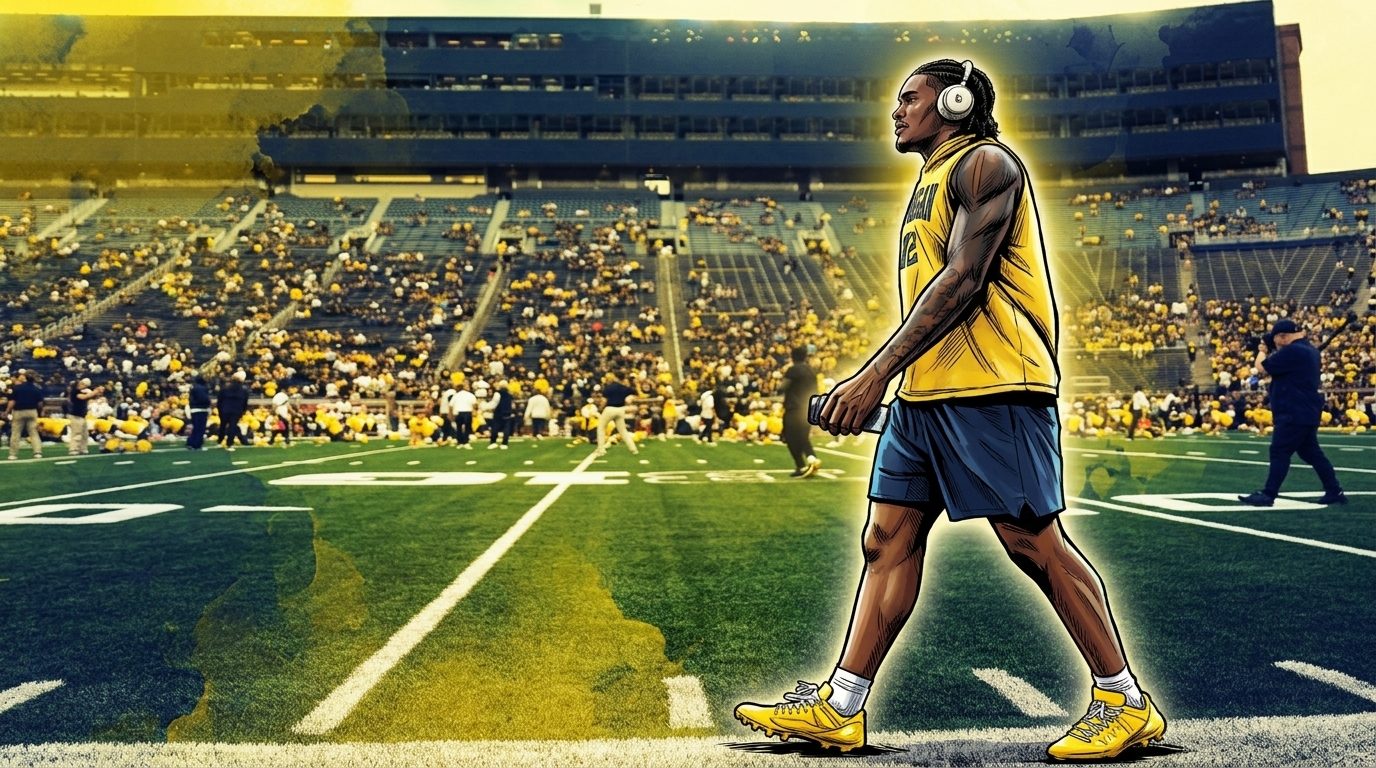

A Washtenaw County Circuit Court judge granted a court order this week that did something the NCAA’s own compliance process had refused to do since June: decide, in writing, that Alex Bauman and Jeremiah Earby get to play college football this fall. The order overrides the NCAA’s five-for-five rule, which never bothered to grandfather in players who graduated high school in 2022 and didn’t redshirt. Bauman, a tight end, and Earby, a cornerback, transferred to the Michigan Wolverines within days. The NCAA didn’t make this call; a county courthouse in Ann Arbor did, and Michigan happened to be standing in exactly the right spot when the gavel came down. Michigan didn’t recruit Alex Bauman and Jeremiah Earby. It litigated them.
It’s worth sitting with how small that courthouse is. Washtenaw County Circuit Court handles divorces, zoning fights, and the occasional landlord dispute; it was not built to set national eligibility policy for a 130-team sport. And yet here we are, because the NCAA wrote a rule with a hole in it wide enough to drive a transfer portal through, and the only body willing to say so with any actual authority wasn’t the NCAA’s own appeals office. It was a judge with a Tuesday docket.
I’ve spent most of my adult life rooting against this program, which makes it extra irritating to admit that none of what’s wrong here is Michigan’s doing.
Bauman’s case is mostly made of film. At Tulane from 2022 to 2024, he caught 63 passes for 610 yards and 13 touchdowns, including the six-yard, nine-seconds-left score that beat USC 46-45 in the Cotton Bowl. He moved to the Miami Hurricanes for 2025, caught 18 passes for 166 yards, and watched Miami lose the College Football Playoff National Championship to Indiana, 27-21 — a game in which, per Hoodline’s reporting, he missed a blocking assignment on Indiana defensive end Mikail Kamara that turned into a blocked punt returned for a touchdown. He had also, separately, already enrolled at the University of Michigan’s School of Social Work — the detail that made the rest of this possible, since he was already on campus when the order came down.
Earby’s résumé is shorter and just as sharp: a career-high four interceptions, 13 passes defended, and 60 tackles at Boise State, good for second-team All-Mountain West honors and fifth on the team in stops, according to SI’s coverage of the ruling.
The players’ motion argued the NCAA was “attempting to arbitrarily and capriciously exclude all college student-athletes…who graduated from high school in 2022 and have not redshirted or received a waiver,” and the judge agreed, reasoning that denying eligibility would cause harm that is “irreparable and severe” to the players, while the harm to the NCAA from granting it would be “negligible.” I’ve read that sentence four times now, and it gets funnier each pass: an entire governing body’s capacity for harm, downgraded to negligible by a judge a short drive from the Big House.
The NCAA, asked for comment on the ruling, had nothing to say as of Wednesday. Its current operating mode is simple: object loudly to interference it can’t control; do nothing about interference it can. NCAA President Charlie Baker spent part of this fall criticizing an Ohio governor’s executive order in an unrelated eligibility dispute, saying an official “cannot legislate NCAA eligibility rules” and calling it “a terrible way to run athletic competitions.” Fine. Sure. But a governor and a county circuit court judge both outrank a position paper, and the NCAA still hasn’t found the lever that makes either one listen.
This isn’t even the first time this fall a judge has done the NCAA’s job for it. Boise State defensive tackle Braxton Fely got a similar order in September and landed at Oklahoma, meaning the Broncos have lost two starters to the identical legal maneuver in two months. Factor in the wave of NFL players suing their way back into college football, and the pattern writes itself: the waiver request is dead. The lawsuit is the waiver request now.
Michigan fans, who’ve spent a decade being told to find joy in “program building,” reacted to the sudden arrival of a tight end who once broke USC’s heart and a cornerback who broke up 13 passes in Boise about how you’d expect:
https://twitter.com/BarstoolUofM/status/2110389470117937540
It’s the appropriate response, even though none of this is Michigan’s doing. The program made a phone call after the gavel had already come down, which, in this sport in October 2026, counts as roster management.
The real headline is buried under two transfer names: the NCAA’s five-for-five rule just lost to a county courthouse, and the NCAA no longer gets a meaningful vote on who plays football this fall. It can release statements. It can send Charlie Baker out to scold a governor. It cannot stop a circuit court judge from ruling that denying a kid a season is irreparable harm and letting the NCAA absorb the cost of being wrong. Every program with a roster hole and a lawyer on retainer just learned the lesson Michigan backed into by accident: the fix isn’t a waiver request anymore. It’s a docket number. There’s more from the transfer portal era landing there by the week, and it’s only going to look more like this.