
Six Wins, Ten Touchdowns, One Historical Comp
Minnesota is 6-0. The Vikings have scored 10 touchdowns through those six wins, the fewest touchdowns by a 6-0 team since the 1933 Chicago Bears, back when the forward pass still needed training wheels. A perfect record is supposed to convert the doubters. This one is building their case for them.
Nobody actually believes in this undefeated team. Not the oddsmakers, who keep pricing Minnesota like a .500 club riding a hot streak. Not the league, which has spent six weeks waiting for the other shoe. Probably not even Vikings fans, judging by the mailbag line making the rounds on vikings.com this week: “Our offense continues to be better at FGs than TDs, which remains concerning.” That’s the fan base’s own diagnosis of a 6-0 team, delivered with the warmth of a performance review.
Start with the raw numbers, because they’re doing most of the work here. Minnesota has scored 125 points and those 10 touchdowns through six games, fewest touchdowns by a 6-0 team since 1933 and the second-fewest points by a 6-0 team since 1940. The Vikings have scored fewer than 20 points in three of their six wins. They’ve topped 23 points exactly once, a 39-22 win over Green Bay in Week 1 that now looks like an outlier instead of a baseline.
Translate that into something you can feel: an NFL offense averaging around 20.8 points a game is middle-of-the-pack on a normal Sunday. Doing it while going 6-0 means the other half of the equation is carrying weight offenses are supposed to share. That kind of imbalance usually shows up in the loss column before the schedule gets this far. Minnesota’s offensive struggles haven’t cost them a single game yet. That’s the entire riddle of this season in one sentence.
How Are the Vikings 6-0 With This Little Scoring?
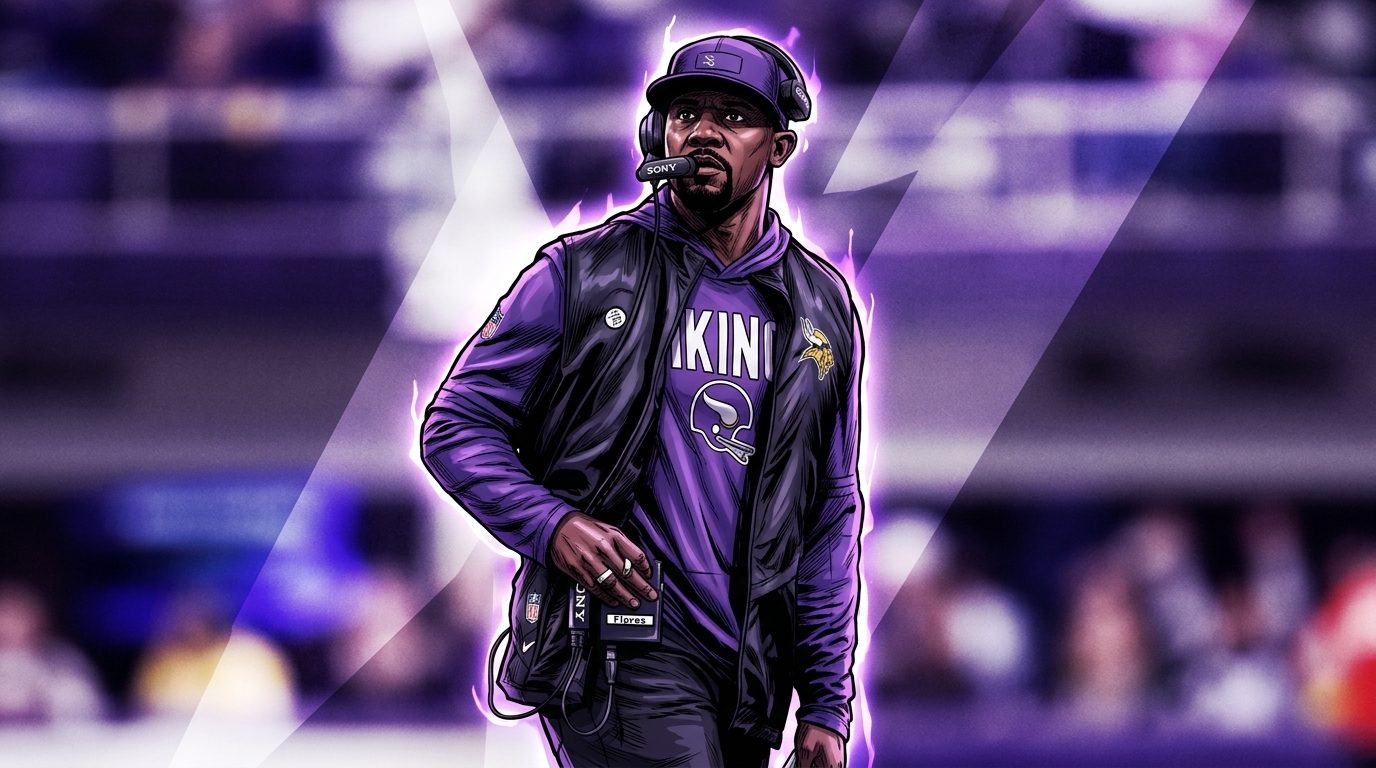
Minnesota is 6-0 despite scoring only 10 touchdowns and 125 points through six games, the fewest touchdowns by a 6-0 team since the 1933 Chicago Bears, because Brian Flores’ defense is allowing a league-best 12.3 points per game. The math works because one side of the ball is historically great and the other is historically quiet.
That equation is rare for a reason. A defense can carry a team for a quarter, a half, even a four-game stretch while an offense finds its footing. Carrying a team for six straight weeks, against six different game plans built specifically to slow it down, is a different kind of achievement, and historically it hasn’t come cheap. The price for leaning this hard on one side of the ball tends to come due the moment the schedule stops cooperating, which is exactly the tension sitting underneath this record.
Brian Flores Is Doing Something Nobody Else Will Try
Flores’ defense has held opponents to 16 points or fewer in every game except Week 1, and it has never allowed more than 22 points in a single outing. A defense allowing 12.3 points a game is operating in rarefied territory, the kind of number that reads differently once you watch it hold for six straight weeks instead of one summer preview. Minnesota’s blitz-heavy scheme is the engine behind it, pressure package after pressure package daring opposing quarterbacks to get the ball out before they’re hit. Offenses built around getting rid of the ball fast and avoiding negative plays are exactly the kind that eventually solve pressure. Whether Minnesota faces one of those offenses before the postseason is the real swing variable in this season, not the record.
What Harrison Smith’s Milestone Says About This Defense
The defense’s signature moment of the season came with 1:15 left on Sunday, when Harrison Smith intercepted Daniel Jones to seal a 16-10 win over the Colts and keep Minnesota perfect. It was Smith’s 40th career interception, and paired with his sack total, it makes him the third player since sacks became an official stat in 1982 (fourth all-time, counting Larry Wilson’s pre-1982 career) to reach 40 interceptions and 20 sacks. The only other names in that 1982-forward group are Ronde Barber and Charles Woodson. That’s the company Smith is keeping on a one-year deal he signed back in September to play his 15th season.
The Vikings marked the milestone themselves:
https://twitter.com/Vikings/status/2114446038463648120
A two-time All-Pro and six-time Pro Bowler doesn’t need one interception to build a Hall of Fame case. But the 40/20 club is the kind of round-number milestone voters remember, and it arrived in the same month Minnesota became the last unbeaten team left in football after San Francisco slipped to 6-1 and Kansas City dropped to 5-1 in Week 7. Smith’s defense is doing more than winning games. It’s building the Canton case one takeaway at a time.
The Schedule That Decides Whether This Is Real
TheBigLead’s own read on this start is blunt: a mirage, the kind of thing elite defense and minimal offense tend to produce right up until the schedule gets harder. The remaining slate makes that framing hard to dismiss. Detroit, Buffalo, Green Bay again, and San Francisco are all still on the calendar, three of those on the road, and none of them are offenses that panic after one sack.
I ran the era-adjusted version of this comparison three different ways this week, looking for a 6-0 start that scored this little and still finished the job. All three searches kept landing in the same place: before the modern passing game existed. Minnesota’s defense is legitimately one of the best units in football right now. The offense is the live question. It has to produce one competent half against a team capable of forcing the issue, or the record stops mattering.
Give me Flores’ defense to keep holding up. The bigger bet is whether Minnesota’s offense finds one real half of football before the rest of this season forces the issue instead of just daring it to. My money says they find it against Detroit, not a week sooner. A 6-0 team built like no 6-0 team in 93 years doesn’t get to stay a mystery forever.