Minnesota Vikings
The Minnesota Vikings' full history: the 1969 NFL title, four Super Bowl losses, Moss, Peterson, the Minneapolis Miracle and the O'Connell era.
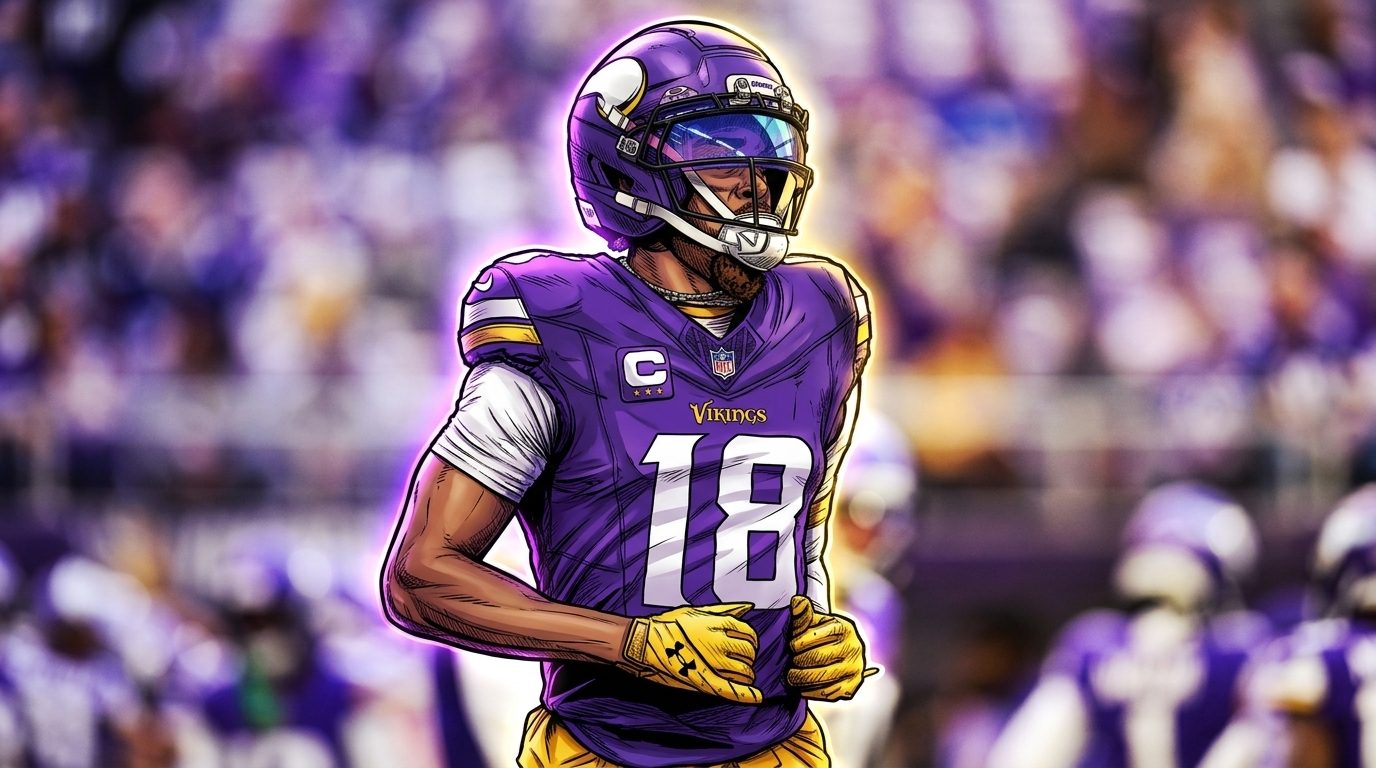
The Minnesota Vikings joined the NFL as an expansion franchise in 1961 and became one of the league’s most consistent winners without ever winning the Lombardi Trophy. They won the last NFL Championship Game before the AFL-NFL merger, then lost four Super Bowls in eight seasons under Bud Grant. Through the 2025 season the Vikings had a 546–446–11 regular-season record, with 32 playoff appearances and 21 division titles. That sustained winning, with no Super Bowl to show for it, defines the club.
| Vitals | |
|---|---|
| Founded | Franchise awarded Jan. 28, 1960; first season 1961 |
| League / conference / division | NFL / NFC / North |
| Stadium | U.S. Bank Stadium, Minneapolis (opened 2016) |
| Owner | Wilf family (Zygi Wilf, owner since 2005) |
| Head coach (Nov. 13, 2026) | Kevin O’Connell (hired Feb. 16, 2022) |
| General manager (Nov. 13, 2026) | Nolan Teasley (named June 1, 2026) |
| Titles | 1969 NFL Championship; NFC champions 1973, 1974, 1976; 0–4 in Super Bowls (IV, VIII, IX, XI) |
Origins: Van Brocklin and Tarkenton (1961–1966)
The NFL awarded the franchise on Jan. 28, 1960. Home games were played at Metropolitan Stadium in suburban Bloomington. Norm Van Brocklin, the Hall of Fame quarterback, was hired as the first head coach. The Vikings beat the Chicago Bears 37–13 in their first regular-season game. Rookie Fran Tarkenton came off the bench to throw four touchdown passes and ran for a fifth score, per the franchise history. The 1961 team still finished 3–11. In 1964 the Vikings went 8–5–1, their first winning record. The relationship between the coach and the quarterback soured, however. Van Brocklin resigned on Feb. 11, 1967, and Tarkenton was traded to the New York Giants in 1967.
The Bud Grant era (1967–1985)
Grant and the Purple People Eaters. Bud Grant came to Minnesota from the Canadian Football League in 1967. Over 18 seasons he went 158–96–5 in the regular season and 10–12 in the playoffs and won 11 division titles. He was inducted into the Pro Football Hall of Fame in 1994. The defensive front of Alan Page, Carl Eller, Gary Larsen and Jim Marshall became one of the most famous units in NFL history. Page won the 1971 league MVP award as a defensive tackle.
Krause patrols the deep middle. The Vikings acquired safety Paul Krause from Washington in 1968. He went on to set the NFL career record of 81 interceptions. Through Nov. 13, 2026, he still held the record, per StatMuse. He broke the previous record of 79, held by Emlen Tunnell, in his final season, 1979.
1969: champions of the NFL. Behind quarterback Joe Kapp, the 1969 Vikings went 12–2. They beat the Los Angeles Rams 23–20 in the Western Conference playoff. On Jan. 4, 1970, they beat the Cleveland Browns 27–7 in the last NFL Championship Game before the merger. On Jan. 11, 1970, the AFL’s Kansas City Chiefs beat the heavily favored Vikings 23–7 in Super Bowl IV.
Tarkenton and three more Super Bowls. The Vikings reacquired Tarkenton from the Giants in 1972. In his two stints with Minnesota he threw for 33,098 yards and 239 touchdowns, and he was the league MVP in 1975. Three Vikings teams reached the Super Bowl with him and lost:
- The 1973 team (12–2) lost Super Bowl VIII to Miami, 24–7.
- The 1974 team (10–4) lost Super Bowl IX to Pittsburgh, 16–6.
- The 1976 team (11–2–1) lost Super Bowl XI to Oakland, 32–14.
Counting Super Bowl IV, the Vikings scored a combined 34 points in four Super Bowls. In 1975 the team went 12–2 and lost a 17–14 divisional game to Dallas. Roger Staubach’s late long touchdown pass to Drew Pearson decided it.
The end of an era. In 1982 the team moved indoors to the Hubert H. Humphrey Metrodome. Grant retired after the 1983 season. Under Les Steckel the 1984 team went 3–13. Grant returned to coach the 1985 season, then retired for good.
Burns, Walker and Green (1986–2001)
The 1987 surprise and the Walker trade. Under Jerry Burns, the strike-shortened 1987 team went 8–7. It won playoff games at New Orleans and San Francisco, then lost the NFC Championship Game at Washington, 17–10. On Oct. 12, 1989, the Vikings acquired running back Herschel Walker from Dallas. They gave up five players and a series of draft picks; two of those picks became Emmitt Smith and Darren Woodson. The trade is still regularly cited as one of the most lopsided in league history.
Moss and the 15–1 juggernaut. Dennis Green coached the Vikings from 1992 to 2001 and made the playoffs in eight of his ten seasons. Cris Carter was his top receiver. In the 1998 draft, Minnesota took Randy Moss with the 21st pick. As a rookie he had 69 catches, 1,313 yards and 17 touchdowns. Through 2025, 17 was still the most receiving touchdowns ever by a rookie, per StatMuse. With Randall Cunningham at quarterback, the 1998 Vikings went 15–1 and scored 556 points, an NFL record at the time. Kicker Gary Anderson made every field goal and extra point he tried in the regular season. Late in the NFC Championship Game at the Metrodome, he missed a field goal. Atlanta tied the game on its next drive and won 30–27 in overtime. The 2000 team reached the NFC Championship Game again and lost 41–0 at the Giants.
Culpepper, Favre and Peterson (2002–2013)
New faces. Under Mike Tice, Daunte Culpepper threw a club-record 39 touchdown passes in 2004. In 2005 the Vikings traded Moss to Oakland, and Red McCombs sold the team to Zygi Wilf. Brad Childress took over in 2006. In 2007 the Vikings drafted Adrian Peterson seventh overall.
2009: one kick from Miami. Brett Favre joined the Vikings in 2009, and the team went 12–4. It beat Dallas 34–3 in the divisional round, then lost the NFC Championship Game 31–28 in overtime at New Orleans. Late in regulation, a 12-men-in-the-huddle penalty and a Favre interception ended a drive that might have set up a winning field goal. In December 2010 the Metrodome’s roof collapsed under snow.
Peterson’s MVP comeback. On Dec. 24, 2011, Peterson tore the ACL and MCL in his left knee against Washington. He then played the full 2012 season and ran for 2,097 yards and 12 touchdowns. That was eight yards short of Eric Dickerson’s single-season record of 2,105. He was named NFL MVP and Offensive Player of the Year and passed Robert Smith as the franchise’s career rushing leader. His time in Minnesota ended after the 2016 season. On Feb. 28, 2017, the Vikings declined his 2017 contract option, and he became a free agent when the new league year opened on March 9, 2017.
Zimmer and the Minneapolis Miracle (2014–2021)
Mike Zimmer was hired in 2014 and built a top defense around Harrison Smith, Everson Griffen and Xavier Rhodes. In 2017 starter Sam Bradford was hurt early. Backup Case Keenum led the Vikings to a 13–3 record.
On Jan. 14, 2018, the Vikings played New Orleans in the divisional round and trailed 24–23 with under 10 seconds left. Keenum threw to Stefon Diggs near the sideline. Safety Marcus Williams missed the tackle, and Diggs ran the rest of the way for a 29–24 win. It was the first game in NFL playoff history to end in regulation on a game-winning touchdown as time expired. The Vikings then lost the NFC Championship Game at Philadelphia, 38–7. Kirk Cousins signed as a free agent in 2018. Zimmer and general manager Rick Spielman were fired after the 2021 season.
The O’Connell era (2022–2026)
A new regime. Kevin O’Connell was hired on Feb. 16, 2022, with Kwesi Adofo-Mensah as general manager. The 2022 team went 13–4, won the North and lost to the Giants in the wild-card round. Minnesota drafted J.J. McCarthy with the 10th pick in 2024, but a knee injury kept him out for the 2024 season. Sam Darnold threw for 4,319 yards and 35 touchdowns. The Vikings went 14–3 and lost a wild-card game to the Rams. O’Connell was named 2024 AP Coach of the Year.
McCarthy’s turn. McCarthy started 10 games in 2025 and threw for 1,632 yards, 11 touchdowns and 12 interceptions. The team finished 9–8 and missed the playoffs. On Jan. 30, 2026, ownership fired Adofo-Mensah after four seasons. On June 1, 2026, the team named Nolan Teasley, an assistant general manager in Seattle, as general manager. The Vikings signed Kyler Murray and re-signed Carson Wentz in March 2026. On Sept. 28, 2026, they traded McCarthy to the Giants for a 2027 fifth-round pick.
The 2026 season through Nov. 13. Minnesota started 6–0. It then lost 19–15 at Detroit and 23–6 to Buffalo on Nov. 9, which left it 6–2 and third in the NFC North, behind Chicago (7–2) and Detroit (6–2). Murray had strained a hamstring at Detroit, so Wentz started against the Bills. At the trade deadline the Vikings brought back Cousins from the Raiders for a 2027 third-round pick.
U.S. Bank Stadium
The Vikings played at Metropolitan Stadium from 1961 to 1981 and at the Metrodome from 1982 to 2013. They spent 2014 and 2015 outdoors at TCF Bank Stadium. U.S. Bank Stadium was built on the Metrodome site for $1.061 billion and opened on July 22, 2016. It hosted Super Bowl LII on Feb. 4, 2018, and the 2019 men’s Final Four.
Retired numbers
The Vikings have retired six numbers, per the Pro Football Hall of Fame. Korey Stringer, a Pro Bowl tackle, died of heatstroke at training camp in 2001. Randy Moss’s No. 84 has not been retired. Retirement years are from the NFL retired numbers list.
| No. | Player | Pos. | Team tenure | Retired |
|---|---|---|---|---|
| 10 | Fran Tarkenton | QB | 1961–1966, 1972–1978 | 1979 |
| 53 | Mick Tingelhoff | C | 1962–1978 | 2001 |
| 70 | Jim Marshall | DE | 1961–1979 | 1999 |
| 77 | Korey Stringer | T | 1995–2000 | 2001 |
| 80 | Cris Carter | WR | 1990–2001 | 2003 |
| 88 | Alan Page | DT | 1967–1978 | 1988 |
Season by season
Every regular-season record, division finish and playoff result from 1961 through Nov. 13, 2026, per the list of Minnesota Vikings seasons, checked against the division titles in the Pro Football Hall of Fame team facts.
The 2020s 58–43 (2020–2025) · 2 playoff berths · 2026 in progress
| Season | W–L | Finish | Playoffs |
|---|---|---|---|
| 2026 | 6–2 (through Nov. 13) | 3rd (North) | Season in progress |
| 2025 | 9–8 | 3rd (North) | Missed playoffs |
| 2024 | 14–3 | 2nd (North) | Lost Wild Card at Rams, 27–9 |
| 2023 | 7–10 | 3rd (North) | Missed playoffs |
| 2022 | 13–4 | 1st (North) | Lost Wild Card vs. Giants, 31–24 |
| 2021 | 8–9 | 2nd (North) | Missed playoffs |
| 2020 | 7–9 | 3rd (North) | Missed playoffs |
The 2010s 81–77–2 · 4 playoff berths · 1 NFC Championship Game
| Season | W–L | Finish | Playoffs |
|---|---|---|---|
| 2019 | 10–6 | 2nd (North) | Won Wild Card at Saints, 26–20 (OT); lost Divisional at 49ers, 27–10 |
| 2018 | 8–7–1 | 2nd (North) | Missed playoffs |
| 2017 | 13–3 | 1st (North) | Won Divisional vs. Saints, 29–24; lost NFC Championship at Eagles, 38–7 |
| 2016 | 8–8 | 3rd (North) | Missed playoffs |
| 2015 | 11–5 | 1st (North) | Lost Wild Card vs. Seahawks, 10–9 |
| 2014 | 7–9 | 3rd (North) | Missed playoffs |
| 2013 | 5–10–1 | 4th (North) | Missed playoffs |
| 2012 | 10–6 | 2nd (North) | Lost Wild Card at Packers, 24–10 |
| 2011 | 3–13 | 4th (North) | Missed playoffs |
| 2010 | 6–10 | 4th (North) | Missed playoffs |
The 2000s 84–76 · 4 playoff berths · 2 NFC Championship Games
| Season | W–L | Finish | Playoffs |
|---|---|---|---|
| 2009 | 12–4 | 1st (North) | Won Divisional vs. Cowboys, 34–3; lost NFC Championship at Saints, 31–28 (OT) |
| 2008 | 10–6 | 1st (North) | Lost Wild Card vs. Eagles, 26–14 |
| 2007 | 8–8 | 2nd (North) | Missed playoffs |
| 2006 | 6–10 | 3rd (North) | Missed playoffs |
| 2005 | 9–7 | 2nd (North) | Missed playoffs |
| 2004 | 8–8 | 2nd (North) | Won Wild Card at Packers, 31–17; lost Divisional at Eagles, 27–14 |
| 2003 | 9–7 | 2nd (North) | Missed playoffs |
| 2002 | 6–10 | 2nd (North) | Missed playoffs |
| 2001 | 5–11 | 4th (Central) | Missed playoffs |
| 2000 | 11–5 | 1st (Central) | Won Divisional vs. Saints, 34–16; lost NFC Championship at Giants, 41–0 |
The 1990s 95–65 · 7 playoff berths · 1 NFC Championship Game
| Season | W–L | Finish | Playoffs |
|---|---|---|---|
| 1999 | 10–6 | 2nd (Central) | Won Wild Card vs. Cowboys, 27–10; lost Divisional at Rams, 49–37 |
| 1998 | 15–1 | 1st (Central) | Won Divisional vs. Cardinals, 41–21; lost NFC Championship vs. Falcons, 30–27 (OT) |
| 1997 | 9–7 | 4th (Central) | Won Wild Card at Giants, 23–22; lost Divisional at 49ers, 38–22 |
| 1996 | 9–7 | 2nd (Central) | Lost Wild Card at Cowboys, 40–15 |
| 1995 | 8–8 | 4th (Central) | Missed playoffs |
| 1994 | 10–6 | 1st (Central) | Lost Wild Card vs. Bears, 35–18 |
| 1993 | 9–7 | 2nd (Central) | Lost Wild Card at Giants, 17–10 |
| 1992 | 11–5 | 1st (Central) | Lost Wild Card vs. Redskins, 24–7 |
| 1991 | 8–8 | 3rd (Central) | Missed playoffs |
| 1990 | 6–10 | 5th (Central) | Missed playoffs |
The 1980s 77–75 · 5 playoff berths · 1 NFC Championship Game
| Season | W–L | Finish | Playoffs |
|---|---|---|---|
| 1989 | 10–6 | 1st (Central) | Lost Divisional at 49ers, 41–13 |
| 1988 | 11–5 | 2nd (Central) | Won Wild Card vs. Rams, 28–17; lost Divisional at 49ers, 34–9 |
| 1987 | 8–7 | 2nd (Central) | Won Wild Card at Saints, 44–10; won Divisional at 49ers, 36–24; lost NFC Championship at Redskins, 17–10 |
| 1986 | 9–7 | 2nd (Central) | Missed playoffs |
| 1985 | 7–9 | 3rd (Central) | Missed playoffs |
| 1984 | 3–13 | 5th (Central) | Missed playoffs |
| 1983 | 8–8 | 4th (Central) | Missed playoffs |
| 1982 | 5–4 | 4th (NFC) | Won First Round vs. Falcons, 30–24; lost Second Round at Redskins, 21–7 |
| 1981 | 7–9 | 4th (Central) | Missed playoffs |
| 1980 | 9–7 | 1st (Central) | Lost Divisional at Eagles, 31–16 |
The 1970s 99–43–2 · 8 playoff berths · 3 Super Bowls
| Season | W–L | Finish | Playoffs |
|---|---|---|---|
| 1979 | 7–9 | 3rd (Central) | Missed playoffs |
| 1978 | 8–7–1 | 1st (Central) | Lost Divisional at Rams, 34–10 |
| 1977 | 9–5 | 1st (Central) | Won Divisional at Rams, 14–7; lost NFC Championship at Cowboys, 23–6 |
| 1976 | 11–2–1 | 1st (Central) | Won Divisional vs. Redskins, 35–20; won NFC Championship vs. Rams, 24–13; lost Super Bowl XI to Raiders, 32–14 |
| 1975 | 12–2 | 1st (Central) | Lost Divisional vs. Cowboys, 17–14 |
| 1974 | 10–4 | 1st (Central) | Won Divisional vs. Cardinals, 30–14; won NFC Championship vs. Rams, 14–10; lost Super Bowl IX to Steelers, 16–6 |
| 1973 | 12–2 | 1st (Central) | Won Divisional vs. Redskins, 27–20; won NFC Championship at Cowboys, 27–10; lost Super Bowl VIII to Dolphins, 24–7 |
| 1972 | 7–7 | 3rd (Central) | Missed playoffs |
| 1971 | 11–3 | 1st (Central) | Lost Divisional vs. Cowboys, 20–12 |
| 1970 | 12–2 | 1st (Central) | Lost Divisional vs. 49ers, 17–14 |
The 1960s 52–67–7 · 2 playoff berths · 1969 NFL champions
| Season | W–L | Finish | Playoffs |
|---|---|---|---|
| 1969 | 12–2 | 1st (Central) | Won Western Conference vs. Rams, 23–20; won NFL Championship vs. Browns, 27–7; lost Super Bowl IV to Chiefs, 23–7 |
| 1968 | 8–6 | 1st (Central) | Lost Western Conference at Colts, 24–14 |
| 1967 | 3–8–3 | 4th (Central) | Missed playoffs |
| 1966 | 4–9–1 | T-6th (Western) | Missed playoffs |
| 1965 | 7–7 | 5th (Western) | Missed playoffs |
| 1964 | 8–5–1 | T-2nd (Western) | Missed playoffs |
| 1963 | 5–8–1 | T-4th (Western) | Missed playoffs |
| 1962 | 2–11–1 | 6th (Western) | Missed playoffs |
| 1961 | 3–11 | 7th (Western) | Missed playoffs |
By the numbers
Franchise marks
Ranks
- 1st Career interceptions, NFL history: Paul Krause (81)
- 1st Rookie receiving touchdowns, NFL history: Randy Moss (17, 1998)
- T-1st Super Bowl appearances without a win (4, tied with Buffalo)
- 2nd Single-season rushing yards, NFL history: Adrian Peterson (2,097, 2012)
Honors
- 1969 NFL champion
- 3× NFC champion (1973, 1974, 1976)
- 21 division titles
- Alan Page, 1971 NFL MVP
- Fran Tarkenton, 1975 NFL MVP
- Adrian Peterson, 2012 NFL MVP
- Kevin O'Connell, 2024 AP Coach of the Year
Per the Pro Football Hall of Fame, the Vikings seasons list, StatMuse (interceptions, rookie receiving touchdowns, single-season rushing) and Fox Sports, through Nov. 13, 2026.
The arguments
Was the Grant era a dynasty? One side points to 11 division titles and four Super Bowl trips in eight seasons. The other notes that the Vikings scored 34 points across four Super Bowls and lost each one by at least 10.
The quarterback carousel. Critics cite four moves: the fully guaranteed Cousins contract in 2018, McCarthy’s selection in 2024, McCarthy’s trade in September 2026 and Cousins’s return at the November 2026 deadline. Defenders note that injuries limited McCarthy to 10 starts in Minnesota, so the team never fully evaluated him.
Why it matters
The Vikings are the NFL’s clearest example of sustained excellence without a Super Bowl title. They have reached the playoffs 32 times, won 21 division titles and played in four Super Bowls. Their only championship came in the final season before the merger. As of Nov. 13, 2026, the franchise was chasing its first Lombardi Trophy under general manager Nolan Teasley and coach Kevin O’Connell.