Chicago Bears
The Chicago Bears are a charter NFL franchise with nine league championships, including Super Bowl XX, now rebuilt around quarterback Caleb Williams.
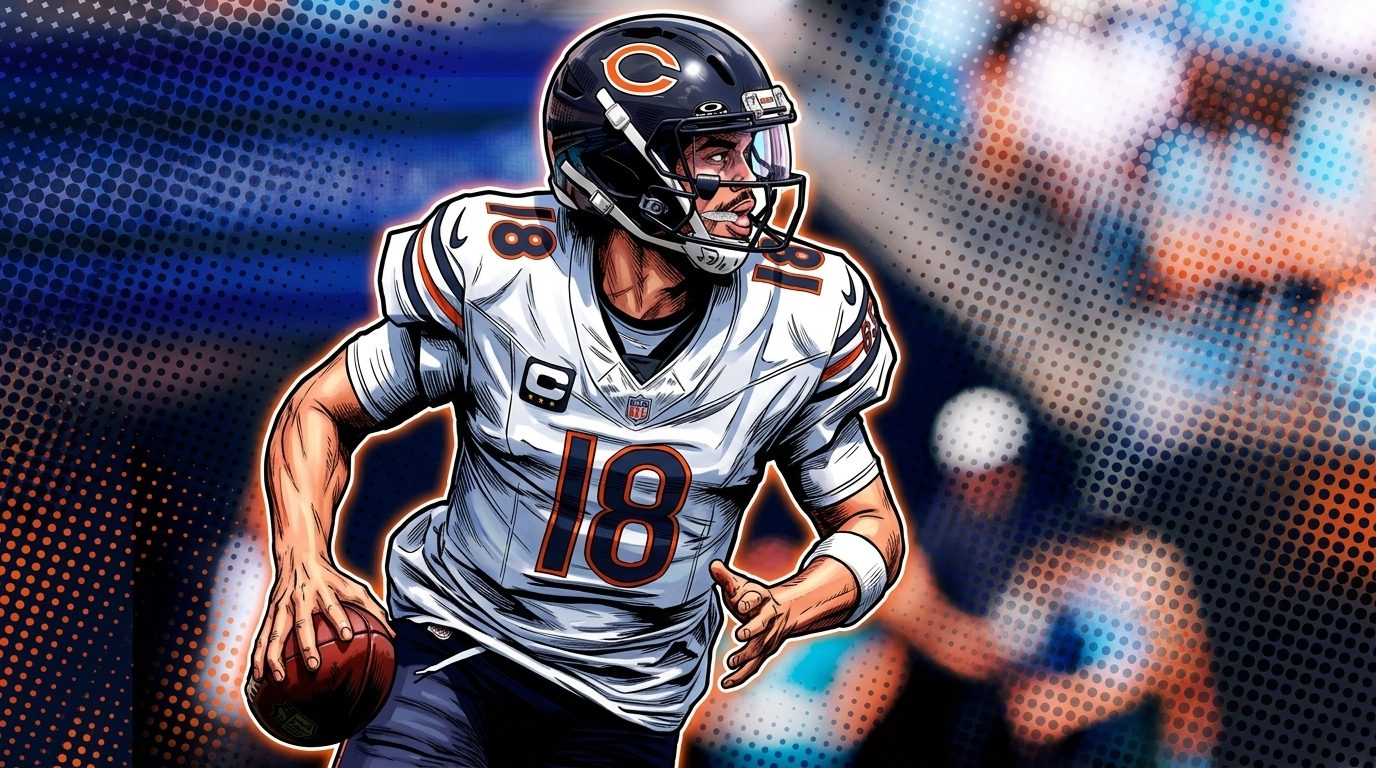
The Chicago Bears are one of the two oldest franchises in the National Football League, a charter member founded in 1920 and the winner of nine league championships — eight pre–Super Bowl NFL titles and the 1985 team that won Super Bowl XX. No franchise has sent more men to the Pro Football Hall of Fame or retired more jersey numbers. Built by George Halas and defined for a century by snarling defense and a short-passing, ground-first identity, the Bears remain, through the 2025 season, among the sport’s foundational institutions.
| Vitals | |
|---|---|
| Founded | 1920 (as the Decatur Staleys) |
| League / conference / division | NFL — NFC North |
| Stadium | Soldier Field, Chicago (since 1971) |
| Owner | McCaskey family — George McCaskey, chairman |
| Head coach (Oct. 27, 2026) | Ben Johnson (hired Jan. 2025) |
| Titles | 9 — NFL 1921, 1932, 1933, 1940, 1941, 1943, 1946, 1963; Super Bowl XX (1985) |
Origins: the Decatur Staleys and George Halas (1920–1929)
The franchise began as a company team. In 1920 the A. E. Staley starch company of Decatur, Illinois, hired George Halas to run its football club, and that fall the Decatur Staleys became a charter member of the American Professional Football Association, the league that would be renamed the NFL. The team went 10–1–2 in its first season.
Halas moved the team to Chicago in 1921 and, under the agreement with owner Gene Staley, kept the name one more year; the Chicago Staleys promptly finished 9–1–1 and won the 1921 league championship. When the deal lapsed in 1922, Halas renamed the club the Bears.
The signing that put pro football on the map came in 1925. Halas inked University of Illinois sensation Red Grange, “the Galloping Ghost,” and sent the Bears on a 17-game coast-to-coast barnstorming tour that drew record crowds and lent the young league legitimacy. Halas — owner, coach, and former player — would shape the team for the next six decades.
Monsters of the Midway: the T-formation dynasty (1932–1946)
The 1930s and 1940s produced the first great Bears dynasty. Powered by bruising fullback Bronko Nagurski, Chicago won an indoor playoff 9–0 over Portsmouth for the 1932 title, then beat the New York Giants 23–21 in the first scheduled NFL Championship Game in 1933. Twice the Bears went unbeaten in the regular season — 13–0 in 1934 and 11–0 in 1942 — only to lose the title game both times.
The 1940 championship remains the most lopsided game in NFL history. Running Clark Shaughnessy’s modern T-formation with quarterback Sid Luckman at the controls, the Bears demolished Washington 73–0 for the crown, a record margin that still stands.
Chicago won four titles in seven seasons. The 1941 club repeated, routing the Giants 37–9 after a 33–14 division playoff over Green Bay; the 1943 team beat Washington 41–21; and in 1946 the Bears downed the Giants 24–14. Luckman, Nagurski, and the swaggering defenses of the era earned the nickname that still defines the franchise: the Monsters of the Midway.
Drought and a last title under Halas (1947–1963)
The 1950s were the first decade the Bears finished without a championship. The post-dynasty years brought good teams but no crown — a 70–48–2 decade capped by a one-sided 47–7 loss to the Giants in the 1956 title game. Middle guard Bill George, a Hall of Famer credited with pioneering the modern middle-linebacker position, anchored the defense.
Halas got one more. In 1963, with a defense that intercepted Giants quarterback Y. A. Tittle five times, the 11–1–2 Bears beat New York 14–10 at Wrigley Field for the franchise’s eighth NFL championship — its last before the Super Bowl era, and the final title of Halas’s coaching life. Rookie tight end Mike Ditka, the 1961 Rookie of the Year, was by then a fixture.
Sayers, Butkus, and Brian’s Song (1965–1973)
The 1965 draft delivered two of the greatest players in team history. Running back Gale Sayers and middle linebacker Dick Butkus arrived together. Sayers won Rookie of the Year and set a team record with 22 touchdowns; on December 12, 1965, he scored six touchdowns against the San Francisco 49ers at Wrigley Field, a feat matched only twice in league history. Butkus became the sport’s defining symbol of linebacker menace.
Tragedy shadowed the era. Sayers blew out his knee in 1968 and was never fully the same. His friend and backfield mate Brian Piccolo was diagnosed with cancer and died on June 16, 1970, at age 26; their bond became the 1971 film Brian’s Song. Halas coached his final game in 1967, closing a tenure that spanned 40 seasons on the sideline.
Finks, Soldier Field, and the arrival of Walter Payton (1970s)
The Bears left Wrigley Field and bottomed out before rebuilding. After beating Green Bay 35–17 in their Wrigley finale on December 13, 1970, the team moved to Soldier Field, opening there in 1971. The early decade was grim — a 60–83–1 run — until general manager Jim Finks, hired in 1974, began the reconstruction.
His first great pick was his best. In 1975 Finks drafted Walter Payton, “Sweetness,” out of Jackson State. Payton ran for a then-team-record 1,852 yards and won MVP honors in 1977, and would retire in 1987 as the NFL’s all-time leading rusher with 16,726 yards — a record he held until 2002. Finks also added the defensive talent and the coordinator, Buddy Ryan, whose 46 defense would soon terrorize the league.
The Ditka era and the 1985 champions (1982–1992)
Halas’s final major act was hiring Mike Ditka as head coach in 1982. The former Bears tight end built a hard-nosed winner, and in 1984 the team reached the NFC Championship Game before a historic breakthrough in 1985.
The 1985 Bears are among the most dominant teams the sport has produced. They went 15–1, losing only a Monday night game at Miami on December 2, and allowed just 198 points all year behind Ryan’s 46 defense. Mike Singletary, Richard Dent, Dan Hampton, Steve McMichael, Otis Wilson, and Wilber Marshall formed the core; Jim McMahon quarterbacked a Payton-led offense; rookie lineman William “Refrigerator” Perry became a national novelty. The defense pitched back-to-back shutouts in the playoffs — 21–0 over the Giants, 24–0 over the Rams — then routed the New England Patriots 46–10 in Super Bowl XX on January 26, 1986, with Dent named MVP. Their “Super Bowl Shuffle” video, recorded the day after their lone loss, became a cultural landmark.
The dynasty that didn’t repeat. Chicago kept winning the NFC Central — 14–2 in 1986, the “Fog Bowl” divisional win over Philadelphia in 1988 — but never returned to the Super Bowl under Ditka, who was dismissed after the 1992 season.
The Urlacher defense and Super Bowl XLI (1993–2008)
A decade of flux gave way to a new defensive golden age. After the Dave Wannstedt and Dick Jauron years and a surprise 13–3 run in 2001, the Bears drafted middle linebacker Brian Urlacher ninth overall in 2000. A five-time All-Pro and the 2005 Defensive Player of the Year, Urlacher became the face of the franchise and entered the Hall of Fame in 2018.
Lovie Smith’s 2006 team came within a title of greatness. The 13–3 Bears won the NFC Championship and reached Super Bowl XLI on February 4, 2007, where Devin Hester opened the game with a 92-yard kickoff-return touchdown — the only one in Super Bowl history — before Chicago fell 29–17 to the Indianapolis Colts. Hester, the most prolific return man ever with 20 career return touchdowns, was enshrined in Canton in 2024.
The quarterback wilderness (2009–2024)
The long search for a franchise passer defined the next fifteen years. Chicago traded for Jay Cutler in 2009 and reached the 2010 NFC Championship Game, losing 21–14 at home to Green Bay. In 2018, bolstered by the blockbuster Khalil Mack trade, Matt Nagy’s Bears went 12–4 and won the NFC North — a season that ended on the “Double Doink,” Cody Parkey’s 43-yard field goal clanging off upright and crossbar in a 16–15 wild-card loss to Philadelphia on January 6, 2019.
The bottom fell out under Matt Eberflus. His teams lost a franchise-record stretch of games, and on November 29, 2024, he became the first head coach fired in-season in Bears history, with offensive coordinator Thomas Brown finishing the year. The era had its own landmark passing: Virginia Halas McCaskey, Halas’s daughter and the team’s matriarch, died on February 6, 2025, after more than four decades as principal owner.
The Caleb Williams era (2024–present)
The Bears used the first pick on a quarterback and then hired a coach to match. Caleb Williams, the 2022 Heisman winner at USC, went No. 1 overall in the 2024 draft and threw for 3,541 yards as a rookie on a 5–12 team. In January 2025, Chicago hired Ben Johnson, the architect of Detroit’s record-setting offense, as its 18th head coach.
The partnership paid off immediately. The 2025 Bears went 11–6 and won the NFC North, with Williams breaking Erik Kramer’s single-season franchise passing record at 3,942 yards. In the wild-card round on January 12, 2026, they erased a 21–3 halftime deficit to beat Green Bay 31–27 — their largest playoff comeback since 1933 and first postseason win since the 2010 season — before losing 20–17 in overtime to the Los Angeles Rams in the divisional round, Williams throwing an interception in the extra period after tying the game with 18 seconds left in regulation.
The Packers rivalry
Chicago’s series with Green Bay is the oldest and most-played in the NFL. The teams first met on November 27, 1921, and have faced each other more than 210 times. Through the 2025 season the Packers lead the all-time series 110–98–6 including the playoffs (109–96–6 in the regular season), but the Bears hold the postseason edge 2–1: a 33–14 division-playoff win in 1941, a 21–14 Packers win in the January 2011 NFC Championship Game, and Chicago’s 31–27 wild-card comeback after the 2025 season. The rivalry has outlasted both founders, Halas and Curly Lambeau, and remains the sport’s defining grudge.
Retired numbers
The Bears have retired 14 jersey numbers — more than any franchise in the NFL. Twelve belong to Pro Football Hall of Famers; the numbers of Willie Galimore and Brian Piccolo were retired as memorials after both died young. Ditka’s No. 89, honored in 2013, was the most recent.
| No. | Player | Pos. | Team tenure | Hall of Fame |
|---|---|---|---|---|
| 3 | Bronko Nagurski | FB | 1930–1937, 1943 | 1963 |
| 5 | George McAfee | HB | 1940–1941, 1945–1950 | 1966 |
| 7 | George Halas | E / founder-coach | 1920–1983 | 1963 |
| 28 | Willie Galimore | RB | 1957–1963 | — |
| 34 | Walter Payton | RB | 1975–1987 | 1993 |
| 40 | Gale Sayers | RB | 1965–1971 | 1977 |
| 41 | Brian Piccolo | RB | 1965–1969 | — |
| 42 | Sid Luckman | QB | 1939–1950 | 1965 |
| 51 | Dick Butkus | MLB | 1965–1973 | 1979 |
| 56 | Bill Hewitt | E | 1932–1936 | 1971 |
| 61 | Bill George | MG / MLB | 1952–1965 | 1974 |
| 66 | Clyde “Bulldog” Turner | C / LB | 1940–1952 | 1966 |
| 77 | Red Grange | HB | 1925, 1929–1934 | 1963 |
| 89 | Mike Ditka | TE | 1961–1966 | 1988 |
Season by season
Every season in franchise history, folded by decade, newest first.
The 2020s 40–61 · 2 playoff berths · 2025 Divisional Round
| Season | W–L–T | Finish | Playoffs |
|---|---|---|---|
| 2025 | 11–6 | 1st, NFC North | Won Wild Card (GB 31–27); Lost Divisional (LAR 17–20 OT) |
| 2024 | 5–12 | 4th, NFC North | Missed |
| 2023 | 7–10 | 4th, NFC North | Missed |
| 2022 | 3–14 | 4th, NFC North | Missed |
| 2021 | 6–11 | 3rd, NFC North | Missed |
| 2020 | 8–8 | 2nd, NFC North | Lost Wild Card (NO 9–21) |
The 2010s 76–84 · 2 playoff berths · 1 NFC title game
| Season | W–L–T | Finish | Playoffs |
|---|---|---|---|
| 2019 | 8–8 | 3rd, NFC North | Missed |
| 2018 | 12–4 | 1st, NFC North | Lost Wild Card (PHI 15–16) |
| 2017 | 5–11 | 4th, NFC North | Missed |
| 2016 | 3–13 | 4th, NFC North | Missed |
| 2015 | 6–10 | 4th, NFC North | Missed |
| 2014 | 5–11 | 4th, NFC North | Missed |
| 2013 | 8–8 | 2nd, NFC North | Missed |
| 2012 | 10–6 | 3rd, NFC North | Missed |
| 2011 | 8–8 | 3rd, NFC North | Missed |
| 2010 | 11–5 | 1st, NFC North | Won Divisional; Lost NFC Championship (GB 14–21) |
The 2000s 81–79 · 3 playoff berths · 1 NFC title (Super Bowl XLI)
| Season | W–L–T | Finish | Playoffs |
|---|---|---|---|
| 2009 | 7–9 | 3rd, NFC North | Missed |
| 2008 | 9–7 | 2nd, NFC North | Missed |
| 2007 | 7–9 | 4th, NFC North | Missed |
| 2006 | 13–3 | 1st, NFC North | Won NFC; Lost Super Bowl XLI (IND 17–29) |
| 2005 | 11–5 | 1st, NFC North | Lost Divisional (CAR 21–29) |
| 2004 | 5–11 | 4th, NFC North | Missed |
| 2003 | 7–9 | 3rd, NFC North | Missed |
| 2002 | 4–12 | 3rd, NFC North | Missed |
| 2001 | 13–3 | 1st, NFC Central | Lost Divisional (PHI 19–33) |
| 2000 | 5–11 | 5th, NFC Central | Missed |
The 1990s 73–87 · 3 playoff berths
| Season | W–L–T | Finish | Playoffs |
|---|---|---|---|
| 1999 | 6–10 | 5th, NFC Central | Missed |
| 1998 | 4–12 | 5th, NFC Central | Missed |
| 1997 | 4–12 | 5th, NFC Central | Missed |
| 1996 | 7–9 | 3rd, NFC Central | Missed |
| 1995 | 9–7 | 3rd, NFC Central | Missed |
| 1994 | 9–7 | 4th, NFC Central | Won Wild Card; Lost Divisional (SF 15–44) |
| 1993 | 7–9 | 4th, NFC Central | Missed |
| 1992 | 5–11 | 4th, NFC Central | Missed |
| 1991 | 11–5 | 2nd, NFC Central | Lost Wild Card (DAL 13–17) |
| 1990 | 11–5 | 1st, NFC Central | Won Wild Card; Lost Divisional (NYG 3–31) |
The 1980s 92–60 · 5 playoff berths · Super Bowl XX
| Season | W–L–T | Finish | Playoffs |
|---|---|---|---|
| 1989 | 6–10 | 4th, NFC Central | Missed |
| 1988 | 12–4 | 1st, NFC Central | Won Divisional (Fog Bowl); Lost NFC Championship (SF 3–28) |
| 1987 | 11–4 | 1st, NFC Central | Lost Divisional (WAS 17–21) |
| 1986 | 14–2 | 1st, NFC Central | Lost Divisional (WAS 13–27) |
| 1985 | 15–1 | 1st, NFC Central | Won Super Bowl XX (NE 46–10) |
| 1984 | 10–6 | 1st, NFC Central | Won Divisional; Lost NFC Championship (SF 0–23) |
| 1983 | 8–8 | 3rd, NFC Central | Missed |
| 1982 | 3–6 | — (strike) | Missed |
| 1981 | 6–10 | 5th, NFC Central | Missed |
| 1980 | 7–9 | 3rd, NFC Central | Missed |
The 1970s 60–83–1 · 2 playoff berths
| Season | W–L–T | Finish | Playoffs |
|---|---|---|---|
| 1979 | 10–6 | 2nd, NFC Central | Lost Wild Card (PHI 17–27) |
| 1978 | 7–9 | 4th, NFC Central | Missed |
| 1977 | 9–5 | 2nd, NFC Central | Lost Divisional (DAL 7–37) |
| 1976 | 7–7 | 2nd, NFC Central | Missed |
| 1975 | 4–10 | 3rd, NFC Central | Missed |
| 1974 | 4–10 | 4th, NFC Central | Missed |
| 1973 | 3–11 | 4th, NFC Central | Missed |
| 1972 | 4–9–1 | 4th, NFC Central | Missed |
| 1971 | 6–8 | 3rd, NFC Central | Missed |
| 1970 | 6–8 | 4th, NFC Central | Missed |
The 1960s 67–65–6 · 1 NFL title (1963)
| Season | W–L–T | Finish | Playoffs |
|---|---|---|---|
| 1969 | 1–13 | 4th, Central | Missed |
| 1968 | 7–7 | 2nd, Central | Missed |
| 1967 | 7–6–1 | 2nd, Central | Missed |
| 1966 | 5–7–2 | 5th, Western | Missed |
| 1965 | 9–5 | 3rd, Western | Missed |
| 1964 | 5–9 | 6th, Western | Missed |
| 1963 | 11–1–2 | 1st, Western | Won NFL Championship (NYG 14–10) |
| 1962 | 9–5 | 3rd, Western | Missed |
| 1961 | 8–6 | T-3rd, Western | Missed |
| 1960 | 5–6–1 | 5th, Western | Missed |
The 1950s 70–48–2 · 2 postseason trips · 0 titles
| Season | W–L–T | Finish | Playoffs |
|---|---|---|---|
| 1959 | 8–4 | 2nd, Western | Missed |
| 1958 | 8–4 | T-2nd, Western | Missed |
| 1957 | 5–7 | 5th, Western | Missed |
| 1956 | 9–2–1 | 1st, Western | Lost NFL Championship (NYG 7–47) |
| 1955 | 8–4 | 2nd, Western | Missed |
| 1954 | 8–4 | 2nd, Western | Missed |
| 1953 | 3–8–1 | 4th, Western | Missed |
| 1952 | 5–7 | 5th, National | Missed |
| 1951 | 7–5 | 4th, National | Missed |
| 1950 | 9–3 | T-1st, National | Lost Conference Playoff (LAR 14–24) |
The 1940s 81–26–3 · 5 title games · 4 NFL titles
| Season | W–L–T | Finish | Playoffs |
|---|---|---|---|
| 1949 | 9–3 | 2nd, Western | Missed |
| 1948 | 10–2 | 2nd, Western | Missed |
| 1947 | 8–4 | 2nd, Western | Missed |
| 1946 | 8–2–1 | 1st, Western | Won NFL Championship (NYG 24–14) |
| 1945 | 3–7 | 4th, Western | Missed |
| 1944 | 6–3–1 | T-2nd, Western | Missed |
| 1943 | 8–1–1 | 1st, Western | Won NFL Championship (WAS 41–21) |
| 1942 | 11–0 | 1st, Western | Lost NFL Championship (WAS 6–14) |
| 1941 | 10–1 | 1st, Western | Won NFL Championship (NYG 37–9) |
| 1940 | 8–3 | 1st, Western | Won NFL Championship (WAS 73–0) |
The 1930s 85–28–11 · 3 title games · 2 NFL titles
| Season | W–L–T | Finish | Playoffs |
|---|---|---|---|
| 1939 | 8–3 | 2nd, Western | Missed |
| 1938 | 6–5 | 3rd, Western | Missed |
| 1937 | 9–1–1 | 1st, Western | Lost NFL Championship (WAS 21–28) |
| 1936 | 9–3 | 2nd, Western | Missed |
| 1935 | 6–4–2 | T-3rd, Western | Missed |
| 1934 | 13–0 | 1st, Western | Lost NFL Championship (NYG 13–30) |
| 1933 | 10–2–1 | 1st, Western | Won NFL Championship (NYG 23–21) |
| 1932 | 7–1–6 | 1st | Won NFL Championship (playoff vs. POR 9–0) |
| 1931 | 8–5 | 3rd | Missed |
| 1930 | 9–4–1 | 3rd | Missed |
The 1920s 84–31–19 · 1 league title (1921)
| Season | W–L–T | Finish | Playoffs |
|---|---|---|---|
| 1929 | 4–9–2 | 9th | Missed |
| 1928 | 7–5–1 | 5th | Missed |
| 1927 | 9–3–2 | 3rd | Missed |
| 1926 | 12–1–3 | 2nd | Missed |
| 1925 | 9–5–3 | 7th | Missed |
| 1924 | 6–1–4 | 2nd | Missed |
| 1923 | 9–2–1 | 2nd | Missed |
| 1922 | 9–3 | 2nd | Missed |
| 1921 | 9–1–1 | 1st | APFA Champions (as Chicago Staleys) |
| 1920 | 10–1–2 | 2nd | — (as Decatur Staleys) |
By the numbers
Franchise marks
Per Pro-Football-Reference and Wikipedia, through the 2025 season (regular-season record 809–652–42).
Ranks
- 1st Pro Football Hall of Fame enshrinees (32)
- 1st Retired jersey numbers, all NFL franchises (14)
- 2nd All-time regular-season wins, NFL (behind Green Bay)
Per the Pro Football Hall of Fame and Pro-Football-Reference, through the 2025 season.
Honors
- Super Bowl XX champions (1985 season)
- 9× league champions (8 NFL titles + Super Bowl XX)
- 2× NFC champions (1985, 2006)
- 22 division titles
- Walter Payton — Pro Football HOF, 16,726 career rushing yards
- NFL-record 32 Pro Football Hall of Famers
Per Wikipedia and the Pro Football Hall of Fame, through the 2025 season.
The arguments
The quarterback question hangs over everything. Critics have long argued that an organization built on defense never learned to develop passers, pointing to the stretch between Sid Luckman and the modern day in which no Bear threw for the kind of production routine elsewhere; defenders counter that the franchise’s identity — defense, special teams, the running game — was a deliberate philosophy that won nine titles, and that Williams’ arrival finally answers the complaint. Both sides agree the position has been the franchise’s defining frustration.
Ownership is the second recurring debate. Observers have questioned whether the McCaskey family’s long stewardship, often run without a traditional top-heavy front office, cost the team competitiveness relative to free-spending rivals; supporters note the stability of a single family across a century and the hiring of a dedicated football operation in recent years. Neither view is settled, and the 2025 division title has given each camp fresh evidence.
Why it matters
The Bears are a load-bearing wall of professional football — a charter franchise whose founder helped invent the modern league, whose 1940 rout and 1985 defense set standards still invoked decades later, and whose rivalry with Green Bay is the oldest the sport has. They have produced more Hall of Famers than anyone and retired more numbers than anyone. For a fan, the ledger is both a source of pride and a long argument about what might have been — and, with Caleb Williams and Ben Johnson, a fresh case that the next chapter could rival the oldest ones.