The Tush Push, Explained
The tush push is the Eagles' short-yardage QB sneak in which teammates shove the ball carrier forward; here is how it works and why the NFL nearly banned it.
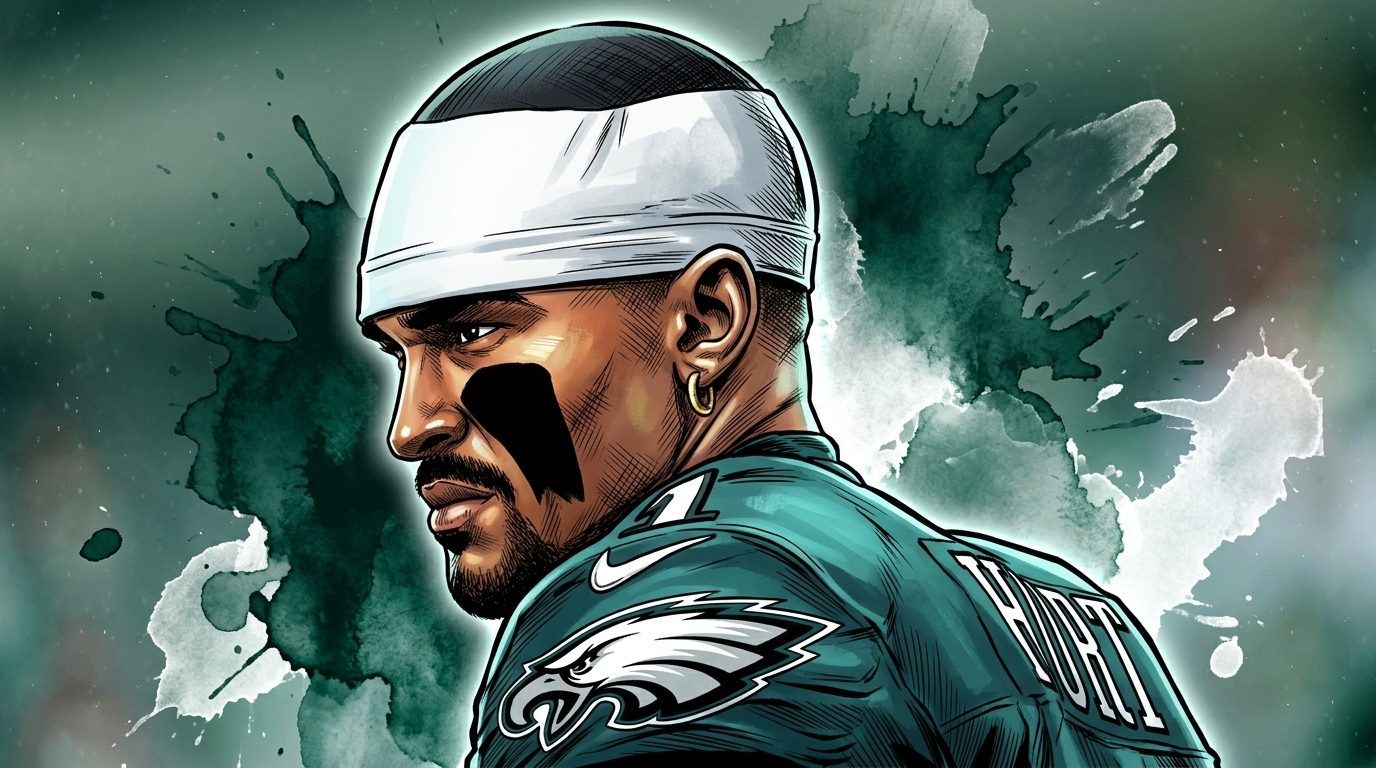
The tush push is a short-yardage play in American football, most associated with the Philadelphia Eagles, in which one or more offensive teammates line up directly behind the quarterback and shove him forward the instant the ball is snapped, turning a routine quarterback sneak into a coordinated group push. It is deployed almost exclusively when an offense needs a yard or less: third- or fourth-and-short, or at the goal line. Widely nicknamed the “Brotherly Shove” for its Philadelphia roots, the play is legal in the NFL because the rulebook prohibits pulling or carrying a ball carrier but permits pushing him — a distinction that has existed since 2005.
How it works
The mechanics are simple by design. The quarterback — for the Eagles, Jalen Hurts — crouches into a low, wide stance immediately behind the center, takes the snap, and drives forward behind a double-team on the interior of the offensive line. At the same time, one or two players stationed behind him (typically a running back and a tight end or fullback) push against his hips and back, adding mass and momentum to the surge. Low pad level, leverage, and lower-body strength matter more than open-field speed; the entire play is decided in roughly a yard of space.
Its legality rests on the “assisting the runner” provision. Pushing a teammate who is carrying the ball is permitted, while pulling him forward or lifting and carrying him is a foul. The NFL’s executive vice president of football operations, Troy Vincent, publicly reinforced this reading in December 2023, saying reports that the league wanted to ban the play were false and that there was no plan to change the rule as written, per Bleacher Report.
| Action on the ball carrier | Legal in the NFL? |
|---|---|
| Pushing the runner forward | Yes |
| Pulling the runner forward | No |
| Lifting or carrying the runner | No |
Per Wikipedia's Tush Push and Helping the runner entries, PFF, and NFL.com, 2005–2025.
Where it came from
The foul the play sidesteps is nearly as old as football itself; a penalty for assisting the runner has existed since the early 1900s, when interlocking mass plays such as the flying wedge were driven from the game over safety concerns. The modern exception dates to 2005, when the NFL narrowed the penalty to cover only pulling and carrying, dropping the sanction for pushing because officials found it nearly impossible to determine who was pushing whom in a pile. The NCAA did not follow suit until 2013.
The Eagles turned that dormant allowance into a signature under head coach Nick Sirianni and quarterback Jalen Hurts. Philadelphia first ran versions of it in 2021 and leaned into it during the 2022 season, notably in a Oct. 9, 2022, 20–17 win over the Arizona Cardinals, after which it became the team’s default short-yardage call. Over that 2022 season the Eagles converted their sneaks at an 88.1 percent success rate, per PFF. The nickname itself is a small piece of etymology: “tush” descends from the Yiddish tukhes, meaning backside — a nod to the shoving that defines the play.
Why it matters
The tush push matters because it distorts one of football’s oldest math problems: converting a yard. Philadelphia has leaned on it more than anyone, running 163 sneaks from 2022 through 2025 — the most in the NFL, with the Buffalo Bills second at 109, per PFF. The Eagles converted 88.1 percent of their sneaks in 2022, and even as more teams adopted the play and its edge narrowed — the league-wide sneak success rate reached 75.8 percent in 2025, per PFF — a short-yardage call that reliable reshapes strategy: coaches grow bolder on fourth-and-short, defenses can do little to stop a well-executed rep, and the goal line becomes a near-certainty rather than a coin flip.
Its highest-profile stage came in the 2024–25 postseason, which ended with the Eagles beating the Kansas City Chiefs 40–22 in Super Bowl LIX on Feb. 9, 2025, a title run built in part on Philadelphia’s command of short-yardage situations. Just as telling is what happened when other teams copied it: results across the league were mixed, feeding a widespread belief that the play depends on a specific combination — Hurts’s squat strength and an elite interior line — that most rosters cannot replicate. That gap between Philadelphia’s success and everyone else’s helped turn a niche short-yardage call into a leaguewide argument.
The arguments
The case for banning the play rests mainly on safety and tradition. The Green Bay Packers submitted a ban proposal in February 2025 and resubmitted a broader version before the spring meetings; the NFL’s competition committee, along with the player and owner health-and-safety committees, unanimously supported it, with committee chair Rich McKay framing it as restoring a rule “on the books forever” that had only been dropped for officiating reasons. Proponents drew comparisons to the banned mass-momentum plays of the early 1900s and noted that some quarterbacks, including Daniel Jones and Kyler Murray, had asked their teams to avoid it; critics also called it an aesthetically dull, non-competitive rugby scrum rather than football.
The case against a ban was led by the Eagles, with owner Jeffrey Lurie and former center Jason Kelce lobbying in person at the owners’ meetings. Opponents argued the play is legal, available to every team, and a product of skill and execution rather than an exploit, and they pointed to the absence of injury data tying the tush push to harm. When the owners voted on May 21, 2025, the proposal drew 22 votes in favor to 10 against — two short of the 24 required for a rule change — leaving the play legal.
Per NFL.com and CNN, May 21, 2025.
The bottom line
The tush push survives as a legal, near-automatic short-yardage weapon, protected by a two-decade-old rulebook quirk and, as of the May 21, 2025 vote, by the owners themselves — but only barely, and only for the moment. As long as one franchise converts it at a rate no one else can match, the debate over whether it belongs in the game will keep returning to the league’s meeting rooms.