Philadelphia Eagles
The Philadelphia Eagles are the NFL franchise founded in 1933 and a five-time world champion, most recently winning Super Bowl LIX in February 2025.
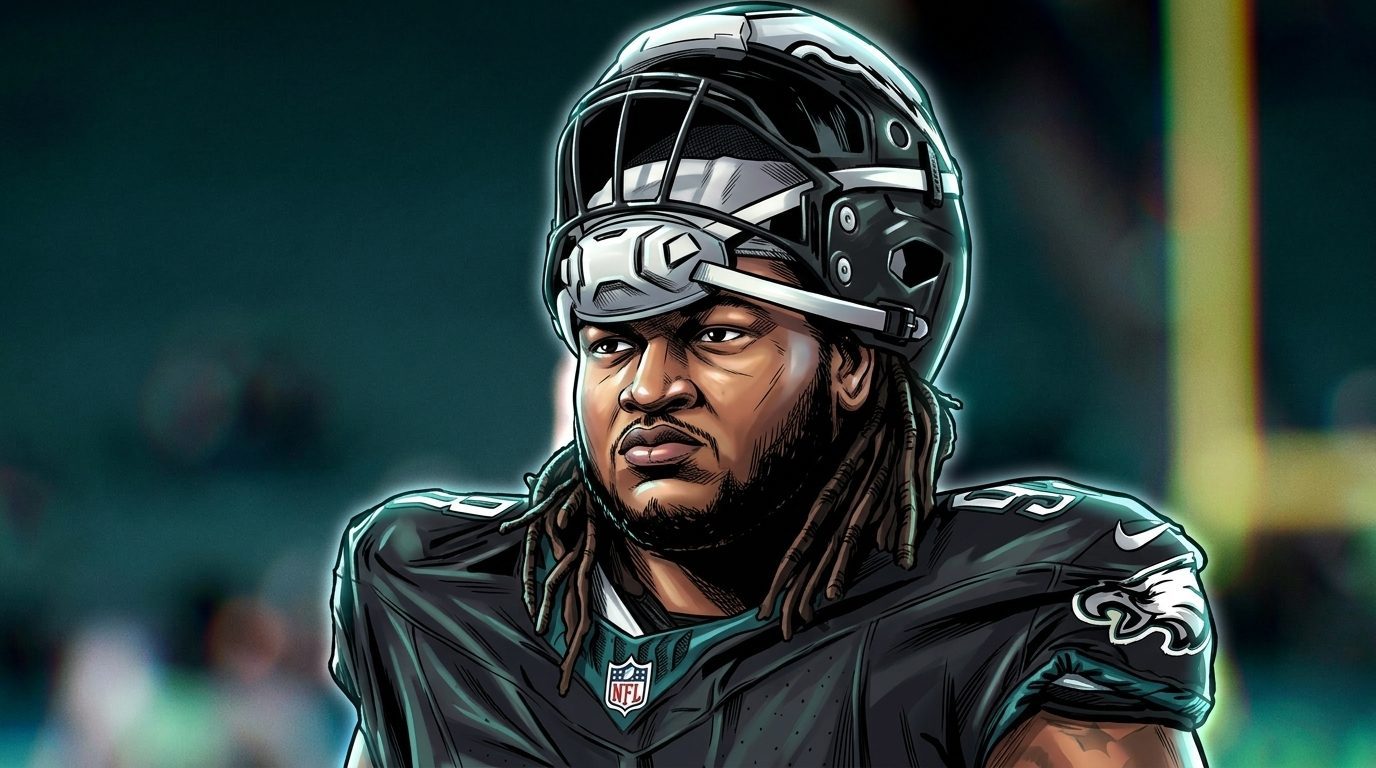
The Philadelphia Eagles are a National Football League franchise founded in 1933 and based in Philadelphia, Pennsylvania, where they have become one of the most intensely supported clubs in American sports. For most of their history the Eagles were a middle-of-the-pack franchise with a near-.500 all-time record and a famously impatient fan base, but they also hold five world championships — NFL titles in 1948, 1949 and 1960, and Super Bowls LII and LIX. The second of those Super Bowls, a 40–22 rout of the Kansas City Chiefs in February 2025, confirmed the Eagles as the defining NFC power of the 2020s.
| Vitals | |
|---|---|
| Founded | July 8, 1933 — Philadelphia, Pa. |
| League / conf. / div. | NFL — NFC East |
| Stadium | Lincoln Financial Field (2003–present), Philadelphia |
| Owner | Jeffrey Lurie (since 1994) |
| Head coach | Nick Sirianni (as of Oct. 11, 2026) |
| Titles | 5 — NFL 1948, 1949, 1960; Super Bowls LII (2017 season), LIX (2024 season) |
Founding and the early wilderness (1933–1942)
The franchise was born out of a bankruptcy and a New Deal slogan. Former University of Pennsylvania teammates Bert Bell and Lud Wray paid a $2,500 entry fee to join the NFL in 1933, taking over the territory of the defunct Frankford Yellow Jackets. They named the club the Eagles after the Blue Eagle, the emblem of Franklin Roosevelt’s National Industrial Recovery Act, and the team could play on Sundays only because Pennsylvania had just relaxed its blue laws.
The on-field results were dismal for a decade. Under Wray the Eagles went 3–5–1 in 1933, opening with a 56–0 loss to the New York Giants at the Polo Grounds on October 15, 1933. As the team’s history records, the club never won more than four games in its first ten seasons, stocking its rosters largely with local Penn, Temple and Villanova players and bouncing between the Baker Bowl and Municipal Stadium.
One early bright spot pointed to the future. In 1939 the Eagles signed record-setting TCU passer Davey O’Brien and appeared in the first televised professional football game, a 23–14 loss to the Brooklyn Dodgers at Ebbets Field — a footnote at the time, a milestone in hindsight.
Greasy Neale’s champions (1943–1950)
World War II forced the strangest season in franchise history. With rosters gutted by military service, the Eagles merged with the Pittsburgh Steelers for 1943 as the “Phil-Pitt Combine,” universally known as the “Steagles.” Co-coached by Philadelphia’s Earle “Greasy” Neale and Pittsburgh’s Walt Kiesling — who reportedly could not stand each other — the hybrid went 5–4–1, the first winning record in Eagles lineage.
Neale then built the franchise’s first dynasty around Steve Van Buren. The Eagles drafted the Hall of Fame halfback in 1944, reached the 1947 NFL Championship Game and lost 28–21 to the Chicago Cardinals on an icy field in Comiskey Park. They would not be denied again. In the 1948 title game at Shibe Park, played in a blizzard, Van Buren’s 5-yard fourth-quarter touchdown provided the only points in a 7–0 win over the same Cardinals.
The 1949 team repeated in the mud. At the Los Angeles Memorial Coliseum, Van Buren ran for 196 yards on 31 carries and the defense pitched a second straight shutout in a 14–0 win over the Rams, Pete Pihos catching a touchdown from Tommy Thompson. Back-to-back championship shutouts remain unique in league history. Philadelphia also used the 1949 draft to take center-linebacker Chuck Bednarik first overall, seeding the next title team.
Buck Shaw, Van Brocklin and the 1960 championship (1951–1960)
The 1950s were long and mostly joyless. After Neale’s departure the Eagles went a combined 51–64–5 across the decade, cycling through coaches and finishing in the division’s second tier nearly every year. The turn came in 1958, when Philadelphia hired coach Buck Shaw and acquired veteran quarterback Norm Van Brocklin from the Rams.
Bednarik became the face of a throwback champion. The last of the NFL’s 60-minute men, Bednarik played center on offense and linebacker on defense, and his November 20, 1960 clothesline of the Giants’ Frank Gifford — a hit that concussed Gifford and sidelined him for roughly 18 months — became one of the most famous tackles ever photographed.
Then came the title. In the 1960 NFL Championship Game at Franklin Field on December 26, 1960, the Eagles beat the Green Bay Packers 17–13, with Van Brocklin named MVP. Bednarik ended it by tackling fullback Jim Taylor short of the goal line and lying on top of him until the clock expired — the lone postseason defeat of Vince Lombardi’s career.
The long decline (1961–1975)
The hangover lasted 15 years. Philadelphia went 10–4 in 1961 but soon collapsed, and ownership churned: Jerry Wolman bought the club for $5.5 million in 1963, then went bankrupt and sold to trucking magnate Leonard Tose in 1969. In between, coach Joe Kuharich — handed a rare 15-year contract in 1964 — traded popular quarterback Sonny Jurgensen and inspired “Joe Must Go” banners from an increasingly hostile crowd.
Two moments from the era endure for the wrong reasons. On December 15, 1968, frustrated fans pelted a halftime Santa Claus with snowballs, a story Philadelphia has never been allowed to live down. In 1971 the team left Franklin Field for the concrete bowl of Veterans Stadium, which would house the franchise for 32 seasons. Winning records, however, remained scarce: the Eagles reached the playoffs just once between 1961 and 1977.
Dick Vermeil and the first Super Bowl (1976–1982)
Dick Vermeil dragged the franchise back to relevance. Hired in 1976, the famously intense coach acquired quarterback Ron Jaworski from the Rams in 1977 and leaned on running back Wilbert Montgomery. The 1978 club made the playoffs for the first time since 1960, aided by the “Miracle at the Meadowlands,” Herman Edwards’s fumble-return touchdown against the Giants; Montgomery then ran for 1,512 yards in 1979.
The 1980 team reached the mountaintop’s edge. In the NFC Championship Game on January 11, 1981, Montgomery’s 42-yard touchdown run on the second play from scrimmage set the tone for a 20–7 win over the hated Dallas Cowboys and the first Super Bowl berth in franchise history.
The Super Bowl itself was a letdown. In Super Bowl XV at the Louisiana Superdome on January 25, 1981, the Oakland Raiders beat Philadelphia 27–10, intercepting Jaworski three times behind MVP Jim Plunkett. A strike-shortened 1982 followed, after which Vermeil resigned, citing burnout — a term he helped popularize.
Buddy Ryan’s defense and Randall Cunningham (1983–1994)
Buddy Ryan built one of the NFL’s most feared defenses and most quotable teams. Hired in 1986 after Norman Braman purchased the club, Ryan handed the offense to the improvisational Randall Cunningham and unleashed a front seven led by Reggie White, Jerome Brown, Seth Joyner and Clyde Simmons. The teams were thrilling, nasty and chronically snakebitten in January.
Two games define the era. In the Fog Bowl at Soldier Field on December 31, 1988, visibility collapsed to roughly 15 yards and the Eagles lost 20–12 to Chicago despite Cunningham throwing for 407 yards. Two seasons later came the Body Bag Game on November 12, 1990, a 28–14 win in which so many Washington players were injured that a running back finished at quarterback.
Ryan never solved the postseason. He went winless in three playoff trips and was fired after the 1990 season. Rich Kotite’s teams kept the window cracked — an 11–5 record and a 1992 wild-card win over New Orleans — but were gutted by free agency and by the June 25, 1992 death of Jerome Brown in a car crash. Ray Rhodes squeezed out playoff berths in 1995 and 1996 before the decade ended in a 3–13 crater.
Andy Reid and Donovan McNabb (1999–2012)
Andy Reid’s hire in 1999 launched the most sustained success in team history. Reid drafted Donovan McNabb second overall that spring and, over 14 seasons, went 130–93–1 with nine playoff appearances. His signature stretch was four straight NFC Championship Games after the 2001 through 2004 seasons — a run that produced three agonizing losses before a breakthrough.
The road to the Super Bowl ran through heartbreak and one miracle. In the January 11, 2004 divisional round, McNabb converted an impossible 4th-and-26 to Freddie Mitchell to stun Green Bay in overtime. In the 2004 season, with Terrell Owens added to the offense, the Eagles beat Atlanta to reach Super Bowl XXXIX on February 6, 2005, losing 24–21 to the New England Patriots despite McNabb’s 357 passing yards.
The era had other folk heroes. Safety Brian Dawkins became the emotional heart of the defense, and in the Miracle at the New Meadowlands on December 19, 2010, DeSean Jackson returned a punt for a walk-off touchdown to cap a 38–31 comeback over the Giants. Reid was dismissed after a 4–12 finish in 2012.
Chip Kelly’s experiment (2013–2015)
Chip Kelly brought college tempo to the NFL, briefly to great effect. The former Oregon coach went 10–6 and won the NFC East in his 2013 debut, then 10–6 again in 2014, his up-tempo offense a genuine novelty. Granted personnel control, he tore the roster down — moving stars and reshaping the locker room — and the gamble failed. Kelly was fired with one game left in 2015 at 6–9, leaving at 26–21 overall.
Doug Pederson and Super Bowl LII (2016–2020)
Doug Pederson delivered the title the city had waited 57 years for. Hired in 2016, Pederson watched presumptive MVP Carson Wentz tear his ACL on December 10, 2017, then rode backup Nick Foles through the playoffs as the Eagles embraced their underdog billing, players wearing dog masks after being seeded as home underdogs.
The Super Bowl was an instant classic. In Super Bowl LII at Minneapolis on February 4, 2018, Philadelphia beat the Patriots 41–33 for its first Super Bowl and first NFL title since 1960. Foles was named MVP and, on the “Philly Special,” caught a touchdown pass on a fourth-down trick play — the signature moment of the franchise’s history.
The follow-up could not match it. Injuries and a Wentz-Foles quarterback question dragged the next three seasons sideways, and Pederson was fired in January 2021 after a 4–11–1 collapse.
Nick Sirianni, Jalen Hurts and Super Bowl LIX (2021–present)
Nick Sirianni and Jalen Hurts built the NFC’s dominant team of the 2020s. Hired in 2021, Sirianni developed Hurts into an MVP contender, and the 2022 Eagles went 14–3 and routed San Francisco 31–7 for the conference title. In Super Bowl LVII on February 12, 2023, they lost a 38–35 thriller to Kansas City despite three Hurts rushing touchdowns, and Hurts signed a five-year, $255 million extension that offseason.
The rematch two years later was a demolition. After adding Saquon Barkley — who ran for an NFL-leading 2,005 yards in 2024 and a record 2,504 including the playoffs — the Eagles reached Super Bowl LIX in New Orleans on February 9, 2025 and beat the Chiefs 40–22. Hurts was MVP, going 17-of-22 for 221 yards and two touchdowns with 72 rushing yards and a score, while Vic Fangio’s defense harassed Patrick Mahomes without blitzing; rookie Cooper DeJean returned an interception for a touchdown on his 22nd birthday.
The franchise entered the following seasons as a measuring stick. Philadelphia went 11–6 in 2025 and won the NFC East before losing a wild-card game to San Francisco. As of October 11, 2026, Sirianni remained head coach, Howie Roseman the general manager and Jeffrey Lurie the owner, with the team 2–2 early in the 2026 season.
Retired numbers
The Eagles have retired nine jersey numbers spanning every championship era — Steve Van Buren and Al Wistert from the 1940s titles, Chuck Bednarik from 1960, the 1960s-era standouts Pete Retzlaff and Tom Brookshier, Buddy Ryan-era defenders Reggie White and Jerome Brown (the latter honored after his death at 27 in 1992), and modern franchise cornerstones Donovan McNabb and Brian Dawkins. All tenures below are per the Eagles and team records; retirement years are per the list of NFL retired numbers.
| No. | Player | Pos. | Eagles tenure | Retired |
|---|---|---|---|---|
| 5 | Donovan McNabb | QB | 1999–2009 | 2013 |
| 15 | Steve Van Buren | HB | 1944–1951 | 1951 |
| 20 | Brian Dawkins | S | 1996–2008 | 2012 |
| 40 | Tom Brookshier | DB | 1953, 1956–1961 | 1962 |
| 44 | Pete Retzlaff | E/TE | 1956–1966 | 1965 |
| 60 | Chuck Bednarik | C/LB | 1949–1962 | 1987 |
| 70 | Al Wistert | T | 1943–1951 | 1952 |
| 92 | Reggie White | DE | 1985–1992 | 2005 |
| 99 | Jerome Brown | DT | 1987–1991 | 1992 |
Season by season
Every Eagles season since 1933, folded by decade (newest first). Records and finishes are per the list of Philadelphia Eagles seasons.
The 2020s 63–37–1 · 5 playoff berths · 2 Super Bowls (1 title)
| Season | W–L–T | Finish | Result |
|---|---|---|---|
| 2025 | 11-6 | 1st, NFC East | Lost Wild Card |
| 2024 | 14-3 | 1st, NFC East | Won Super Bowl LIX |
| 2023 | 11-6 | 2nd, NFC East | Lost Wild Card |
| 2022 | 14-3 | 1st, NFC East | Lost Super Bowl LVII |
| 2021 | 9-8 | 2nd, NFC East | Lost Wild Card |
| 2020 | 4-11-1 | 4th, NFC East | — |
The 2010s 87–73 · 5 playoff berths · 1 Super Bowl title (LII)
| Season | W–L–T | Finish | Result |
|---|---|---|---|
| 2019 | 9-7 | 1st, NFC East | Lost Wild Card |
| 2018 | 9-7 | 2nd, NFC East | Lost Divisional |
| 2017 | 13-3 | 1st, NFC East | Won Super Bowl LII |
| 2016 | 7-9 | 4th, NFC East | — |
| 2015 | 7-9 | 2nd, NFC East | — |
| 2014 | 10-6 | 2nd, NFC East | — |
| 2013 | 10-6 | 1st, NFC East | Lost Wild Card |
| 2012 | 4-12 | 4th, NFC East | — |
| 2011 | 8-8 | 2nd, NFC East | — |
| 2010 | 10-6 | 1st, NFC East | Lost Wild Card |
The 2000s 103–56–1 · 8 playoff berths · 1 Super Bowl (XXXIX)
| Season | W–L–T | Finish | Result |
|---|---|---|---|
| 2009 | 11-5 | 2nd, NFC East | Lost Wild Card |
| 2008 | 9-6-1 | 2nd, NFC East | Lost NFC Championship |
| 2007 | 8-8 | 4th, NFC East | — |
| 2006 | 10-6 | 1st, NFC East | Lost Divisional |
| 2005 | 6-10 | 4th, NFC East | — |
| 2004 | 13-3 | 1st, NFC East | Lost Super Bowl XXXIX |
| 2003 | 12-4 | 1st, NFC East | Lost NFC Championship |
| 2002 | 12-4 | 1st, NFC East | Lost NFC Championship |
| 2001 | 11-5 | 1st, NFC East | Lost NFC Championship |
| 2000 | 11-5 | 2nd, NFC East | Lost Divisional |
The 1990s 80–79–1 · 4 playoff berths · 0 titles
| Season | W–L–T | Finish | Result |
|---|---|---|---|
| 1999 | 5-11 | 5th, NFC East | — |
| 1998 | 3-13 | 5th, NFC East | — |
| 1997 | 6-9-1 | 3rd, NFC East | — |
| 1996 | 10-6 | 2nd, NFC East | Lost Wild Card |
| 1995 | 10-6 | 2nd, NFC East | Lost Divisional |
| 1994 | 7-9 | 4th, NFC East | — |
| 1993 | 8-8 | 3rd, NFC East | — |
| 1992 | 11-5 | 2nd, NFC East | Lost Divisional |
| 1991 | 10-6 | 3rd, NFC East | — |
| 1990 | 10-6 | 2nd, NFC East | Lost Wild Card |
The 1980s 76–74–2 · 4 playoff berths · 1 Super Bowl (XV)
| Season | W–L–T | Finish | Result |
|---|---|---|---|
| 1989 | 11-5 | 2nd, NFC East | Lost Wild Card |
| 1988 | 10-6 | 1st, NFC East | Lost Divisional |
| 1987 | 7-8 | 4th, NFC East | — (strike) |
| 1986 | 5-10-1 | 4th, NFC East | — |
| 1985 | 7-9 | 4th, NFC East | — |
| 1984 | 6-9-1 | 5th, NFC East | — |
| 1983 | 5-11 | 4th, NFC East | — |
| 1982 | 3-6 | 13th, NFC | — (strike) |
| 1981 | 10-6 | 2nd, NFC East | Lost Wild Card |
| 1980 | 12-4 | 1st, NFC East | Lost Super Bowl XV |
The 1970s 56–84–4 · 2 playoff berths · 0 titles
| Season | W–L–T | Finish | Result |
|---|---|---|---|
| 1979 | 11-5 | 2nd, NFC East | Lost Divisional |
| 1978 | 9-7 | 2nd, NFC East | Lost Wild Card |
| 1977 | 5-9 | 4th, NFC East | — |
| 1976 | 4-10 | 4th, NFC East | — |
| 1975 | 4-10 | 5th, NFC East | — |
| 1974 | 7-7 | 4th, NFC East | — |
| 1973 | 5-8-1 | 3rd, NFC East | — |
| 1972 | 2-11-1 | 5th, NFC East | — |
| 1971 | 6-7-1 | 3rd, NFC East | — |
| 1970 | 3-10-1 | 5th, NFC East | — |
The 1960s 57–76–5 · 1 playoff berth · 1 NFL title (1960)
| Season | W–L–T | Finish | Result |
|---|---|---|---|
| 1969 | 4-9-1 | 4th, Capitol | — |
| 1968 | 2-12 | 4th, Capitol | — |
| 1967 | 6-7-1 | 2nd, Capitol | — |
| 1966 | 9-5 | 2nd, Eastern | — |
| 1965 | 5-9 | 5th, Eastern | — |
| 1964 | 6-8 | 3rd, Eastern | — |
| 1963 | 2-10-2 | 7th, Eastern | — |
| 1962 | 3-10-1 | 7th, Eastern | — |
| 1961 | 10-4 | 2nd, Eastern | — |
| 1960 | 10-2 | 1st, Eastern | Won NFL Championship |
The 1950s 51–64–5 · 0 playoff berths · 0 titles
| Season | W–L–T | Finish | Result |
|---|---|---|---|
| 1959 | 7-5 | 2nd, Eastern | — |
| 1958 | 2-9-1 | 5th, Eastern | — |
| 1957 | 4-8 | 5th, Eastern | — |
| 1956 | 3-8-1 | 6th, Eastern | — |
| 1955 | 4-7-1 | 4th, Eastern | — |
| 1954 | 7-4-1 | 2nd, Eastern | — |
| 1953 | 7-4-1 | 2nd, Eastern | — |
| 1952 | 7-5 | 2nd, American | — |
| 1951 | 4-8 | 5th, American | — |
| 1950 | 6-6 | 3rd, American | — |
The 1940s 58–47–5 · 3 playoff berths · 2 NFL titles (1948, 1949)
| Season | W–L–T | Finish | Result |
|---|---|---|---|
| 1949 | 11-1 | 1st, Eastern | Won NFL Championship |
| 1948 | 9-2-1 | 1st, Eastern | Won NFL Championship |
| 1947 | 8-4 | 1st, Eastern | Lost NFL Championship |
| 1946 | 6-5 | 2nd, Eastern | — |
| 1945 | 7-3 | 2nd, Eastern | — |
| 1944 | 7-1-2 | 2nd, Eastern | — |
| 1943 | 5-4-1 | 3rd, Eastern | — (Steagles) |
| 1942 | 2-9 | 5th, Eastern | — |
| 1941 | 2-8-1 | 4th, Eastern | — |
| 1940 | 1-10 | 5th, Eastern | — |
The 1930s 18–55–3 · 0 playoff berths · 0 titles
| Season | W–L–T | Finish | Result |
|---|---|---|---|
| 1939 | 1-9-1 | 4th, Eastern | — |
| 1938 | 5-6 | 4th, Eastern | — |
| 1937 | 2-8-1 | 5th, Eastern | — |
| 1936 | 1-11 | 5th, Eastern | — |
| 1935 | 2-9 | 5th, Eastern | — |
| 1934 | 4-7 | 3rd, Eastern | — |
| 1933 | 3-5-1 | 4th, Eastern | — |
By the numbers
Franchise marks
Per the list of Philadelphia Eagles seasons, through the 2025 season.
Ranks
- 5th Regular-season wins, NFL history
- 7th All-time playoff games played (56)
- 9th NFL franchise valuation ($10.25B)
Per StatMuse and Forbes, valuation as of Sept. 2026.
Honors
- Super Bowl LIX champion (2024 season)
- Super Bowl LII champion (2017 season)
- 3× NFL champion (1948, 1949, 1960)
- 5 Super Bowl appearances (XV, XXXIX, LII, LVII, LIX)
- Jalen Hurts — Super Bowl LIX MVP
- Nick Foles — Super Bowl LII MVP
- Saquon Barkley — 2024 NFL rushing champion (2,005 yds)
Per the Pro Football Hall of Fame and NFL.com.
The arguments
Was Donovan McNabb underappreciated or overrated? McNabb is the franchise’s all-time leader in passing yards (32,873) and led the Eagles to five NFC Championship Games, yet he was booed by a segment of fans on his 1999 draft day and never won a title. Supporters argue he was the best quarterback in team history and a victim of thin receiving help before Owens; critics counter that his record in conference title games — one win in five tries — is the defining line.
Whose dynasty was greater, Reid’s or Sirianni’s? Reid’s tenure produced the longer sustained run and the most regular-season success, but ended without a Lombardi Trophy in Philadelphia; Sirianni’s Eagles reached two Super Bowls in three seasons and won one convincingly. Reid’s defenders note he later won titles in Kansas City; Sirianni’s point to the hardware already in the case.
Is the “tush push” a skill play or a loophole? The Eagles’ quarterback-sneak push behind their offensive line has been nearly unstoppable, and rival coaches and members of the competition committee have publicly pushed to restrict it on safety and aesthetic grounds. Philadelphia’s side argues the play is legal, well-coached and a product of its linemen; opponents argue it is closer to a rugby scrum than football.
Why it matters
The Eagles are the rare franchise whose identity was forged as much in losing as in winning: 57 years without a championship, a fan base defined by its impatience, and a city that treated each near-miss as civic drama. That history is exactly what made the two Super Bowl titles land the way they did — Foles’s trick-play catch in 2018 and Hurts’s coronation in 2025 were release valves for decades of frustration. Measured by wins, the Eagles sit fifth all-time; measured by intensity of attachment, few clubs in American sports can match the hold Philadelphia’s team has on its city.