Stephen Curry
Stephen Curry is the Golden State Warriors guard who won four NBA titles, two MVPs, and rewrote basketball as the league's all-time three-point king.
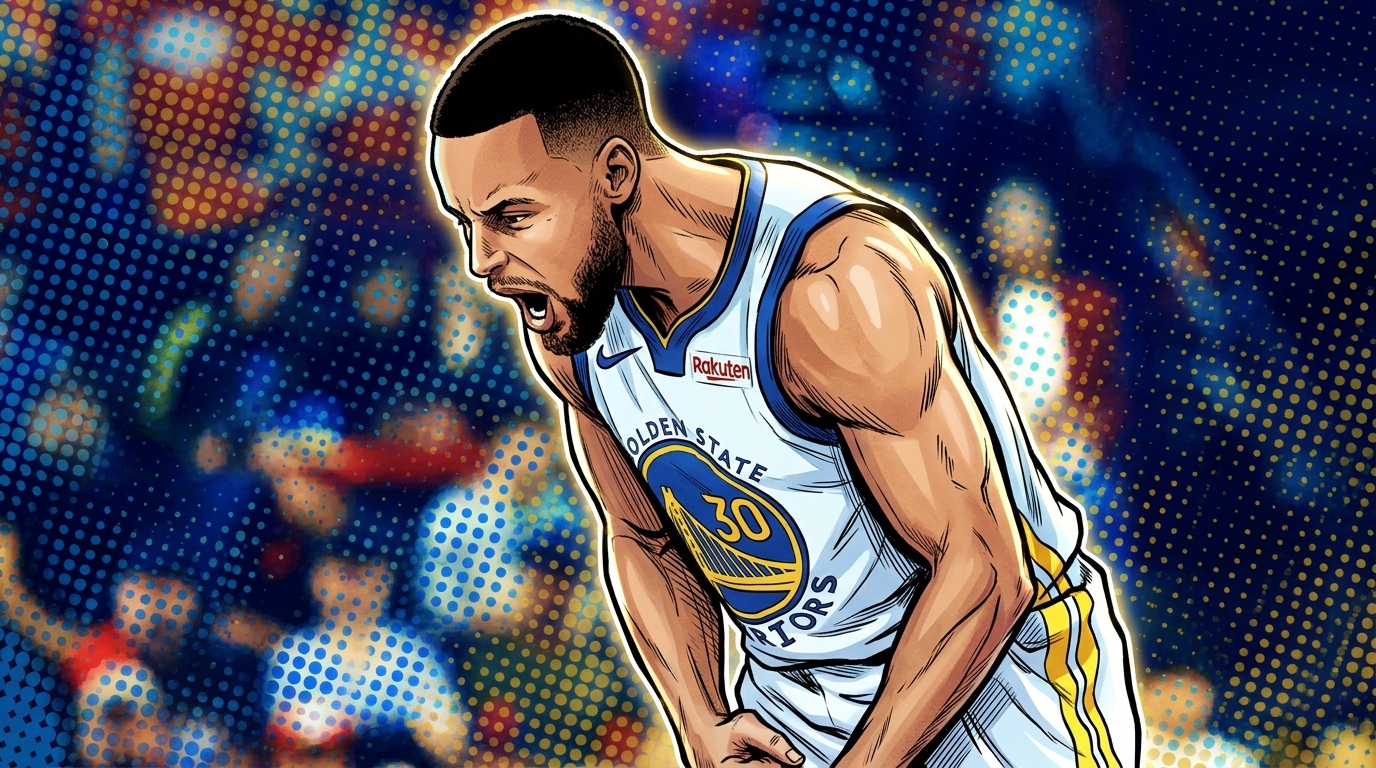
Stephen Curry is the Golden State Warriors point guard whose shooting reorganized how basketball is played. Across a career spent entirely in the Bay Area, he won four championships, earned two Most Valuable Player awards — one of them the first unanimous selection in league history — and became the most prolific three-point shooter the sport has ever produced, passing 4,248 made threes and standing alone atop the all-time list. Where earlier stars were measured by how high they rose or how hard they drove, Curry was measured by range, and the range redrew the floor for everyone who came after him.
| Vitals | |
|---|---|
| Born | March 14, 1988, Akron, Ohio |
| Position | Point guard |
| Teams | Golden State Warriors (2009–, active as of Oct. 6, 2026) |
| Draft | 2009, 1st round, 7th overall (Golden State) |
| Contract status | Signed through 2027-28 (two-year, $116M extension), 2028-29 player option, as of Oct. 6, 2026 |
| Number | 30 |
Davidson
Overlooked. Lightly recruited out of Charlotte Christian in North Carolina, Curry landed at Davidson, a small college that major programs had passed over. He answered the slight immediately, and by his sophomore year he was a national story.
The 2008 run. Curry carried Davidson to the 2008 NCAA Tournament’s Elite Eight, scoring in volume against far larger programs and turning a mid-major into appointment viewing. He led all of Division I in scoring the following season before declaring for the draft. Golden State selected him seventh overall in the 2009 NBA Draft, a pick made partly on faith in a slight guard whose game did not yet translate obviously to the professional level.
Arrival and the lean years (2009–2013)
A quiet start. Curry averaged 17.5 points as a rookie in 2009-10 on a losing team, flashing the touch but not yet the terror. Ankle injuries nearly derailed everything that followed: he played just 26 games in 2011-12 before surgery.
The breakout. Healthy again in 2012-13, Curry averaged 22.9 points and set a then-single-season record with 272 made three-pointers, announcing that the shooting was not a novelty but a foundation. The Warriors, long irrelevant, had the start of something.
The first dynasty (2014–2019)
The leap. In 2014-15 Curry won his first MVP and led Golden State to a title, the franchise’s first since 1975. The following season was the one that detached him from precedent: a unanimous MVP in 2015-16, a 73-win regular season that broke the all-time record, 30.1 points a game, and 402 threes — a single-season mark that still stands.
The reckoning and the reinforcement. That dominant 2015-16 team blew a 3-1 Finals lead to Cleveland, a collapse that trailed Curry for years. Golden State answered by adding Kevin Durant, and the retooled roster won titles in 2017 and 2018 before losing the 2019 Finals. Across the stretch Curry was the gravitational center — the threat whose range bent defenses before he ever touched the ball.
Injury and the bridge (2019–2021)
A lost season. A broken hand limited Curry to five games in 2019-20 as the Warriors bottomed out. He returned in 2020-21 at full force, winning a second scoring title at 32.0 points a game and, on April 13, 2021, passing Wilt Chamberlain to become the Warriors’ all-time leading scorer.
The fourth ring (2021–2022)
The record. On December 14, 2021, at Madison Square Garden, Curry passed Ray Allen’s career total of 2,973 made threes to become the NBA’s all-time three-point leader, a record he has extended well past every pursuer.
Validation. In 2021-22 Curry led a rebuilt Golden State back to the championship and, for the first time, was named Finals MVP — the one honor his critics had always noted was missing. It was the fourth title of his career and, to many, the one that settled the argument about whether he could carry a champion himself.
Elder statesman (2022–2026)
Still the engine. Curry remained an elite, high-volume shooter deep into his thirties, drilling 357 threes in 2023-24 — the third-most in any season in league history. In 2024 he won Olympic gold with the United States in Paris, closing the final out with a late barrage from distance. On March 13, 2025, against the Sacramento Kings, he reached 4,000 career three-pointers, a number no other player has approached. He appeared in 43 games in 2025-26 and, in the 2026 offseason, signed a two-year, $116 million extension to remain in Golden State.
By the numbers
Regular-season averages, per Basketball-Reference.
| Season | GP | PPG | RPG | APG | FG% | 3P% | 3PM |
|---|---|---|---|---|---|---|---|
| 2009-10 | 80 | 17.5 | 4.5 | 5.9 | 46.2 | 43.7 | 166 |
| 2010-11 | 74 | 18.6 | 3.9 | 5.8 | 48.0 | 44.2 | 151 |
| 2011-12 | 26 | 14.7 | 3.4 | 5.3 | 49.0 | 45.5 | 55 |
| 2012-13 | 78 | 22.9 | 4.0 | 6.9 | 45.1 | 45.3 | 272 |
| 2013-14 | 78 | 24.0 | 4.3 | 8.5 | 47.1 | 42.4 | 261 |
| 2014-15 | 80 | 23.8 | 4.3 | 7.7 | 48.7 | 44.3 | 286 |
| 2015-16 | 79 | 30.1 | 5.4 | 6.7 | 50.4 | 45.4 | 402 |
| 2016-17 | 79 | 25.3 | 4.5 | 6.6 | 46.8 | 41.1 | 324 |
| 2017-18 | 51 | 26.4 | 5.1 | 6.1 | 49.5 | 42.3 | 212 |
| 2018-19 | 69 | 27.3 | 5.3 | 5.2 | 47.2 | 43.7 | 354 |
| 2019-20 | 5 | 20.8 | 5.2 | 6.6 | 40.2 | 24.5 | 12 |
| 2020-21 | 63 | 32.0 | 5.5 | 5.8 | 48.2 | 42.1 | 337 |
| 2021-22 | 64 | 25.5 | 5.2 | 6.3 | 43.7 | 38.0 | 285 |
| 2022-23 | 56 | 29.4 | 6.1 | 6.3 | 49.3 | 42.7 | 273 |
| 2023-24 | 74 | 26.4 | 4.5 | 5.1 | 45.0 | 40.8 | 357 |
| 2024-25 | 70 | 24.5 | 4.4 | 6.0 | 44.8 | 39.7 | 311 |
| 2025-26 | 43 | 26.6 | 3.6 | 4.7 | 46.8 | 39.3 | 190 |
Career totals
Ranks
- 1st Made threes, NBA all-time (4,248)
- 1st Made threes, single season (402, 2015-16)
- 1st Points, Warriors franchise history (26,528)
- 3rd Made threes, single season all-time (357, 2023-24)
Honors
- 4× NBA champion (2015, 2017, 2018, 2022)
- 2× MVP (2015, 2016 — unanimous)
- 2022 Finals MVP
- 12× All-Star
- 11× All-NBA
- 2× scoring champion (2016, 2021)
- Olympic gold medalist (2024)
- NBA 75th Anniversary Team
Per Basketball-Reference and the career and single-season three-point leaderboards, through the 2025-26 season.
The arguments
The greatest point guard ever. Curry’s résumé — four rings, two MVPs, the scoring and shooting records — has pushed some analysts to call him the best point guard in NBA history. Others hold the line for Magic Johnson, pointing to Johnson’s five titles, his Finals MVPs as a rookie and a center fill-in, and the all-around playmaking that Curry, a scorer first, never matched. The debate turns on how much weight to give championships and revolution against traditional floor-general measures.
Did he improve the game or flatten it? Curry’s range made the three the sport’s most valuable shot, and the league followed — attempts climbed league-wide for a decade. Critics, including some former players and coaches, have argued the result is a monoculture of jump shooting that squeezed out post play and stylistic variety. Defenders counter that Curry expanded the floor, rewarded skill over size, and made the game more watchable, not less. Both sides agree on the premise: the modern shot profile is, in large part, his doing.
Could he win it alone? Before 2022, skeptics noted that Curry’s titles came alongside Kevin Durant or a stacked supporting cast, and that he had never been named Finals MVP — framing him as a system beneficiary. The 2022 championship and his Finals MVP that year are, to supporters, the direct rebuttal: a title won as the clear best player on the floor. Detractors still weigh the 2016 Finals collapse against the ledger.
Why it matters
Stephen Curry mattered because he changed the question. For most of basketball history the game’s gravity ran toward the rim; Curry pulled it to the arc, and a generation of players, coaches and front offices reorganized around the shot he perfected. The rings and the MVPs place him among the sport’s greats, but the records that will be hardest to equal are the ones that describe a style — the most threes ever made, the deepest range routinely weaponized — and the proof, visible on any modern court, that he did not just win within the game but rewrote the terms of it.