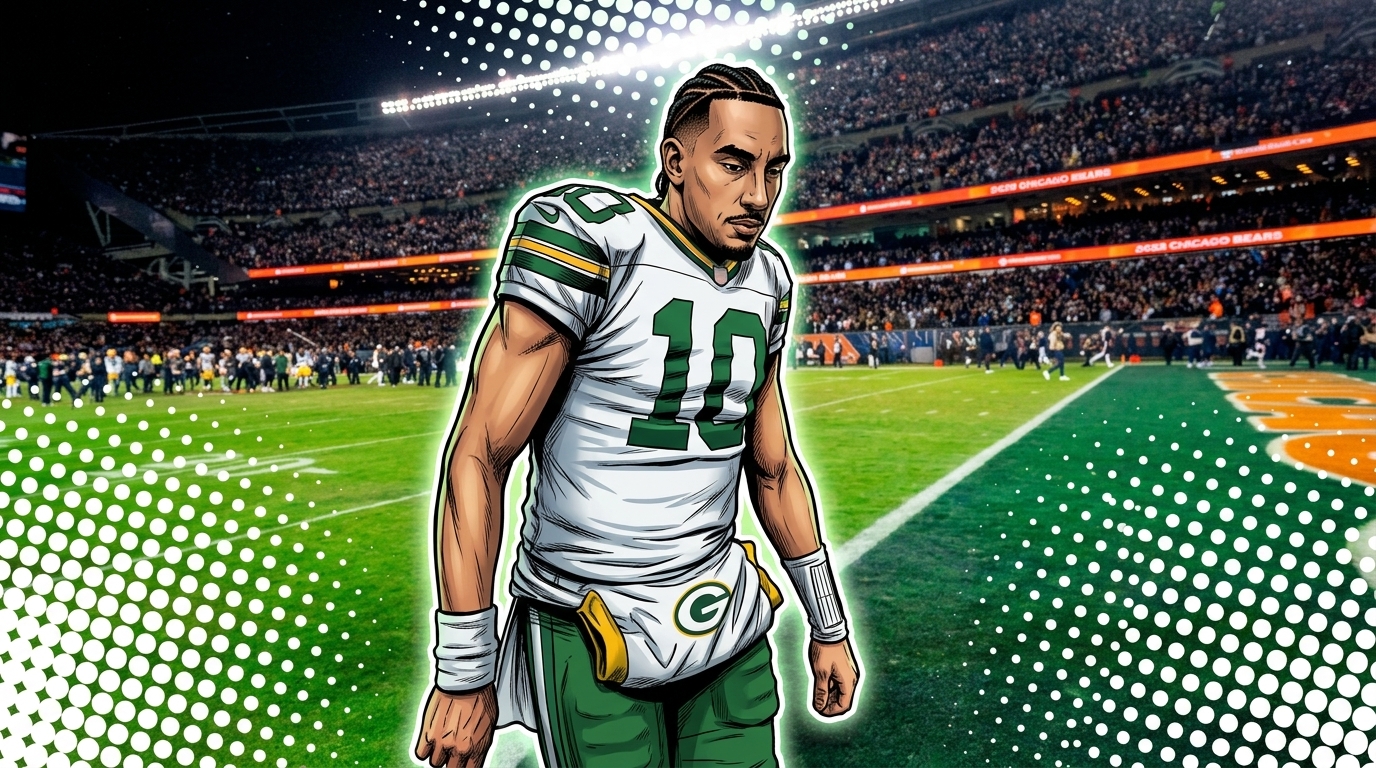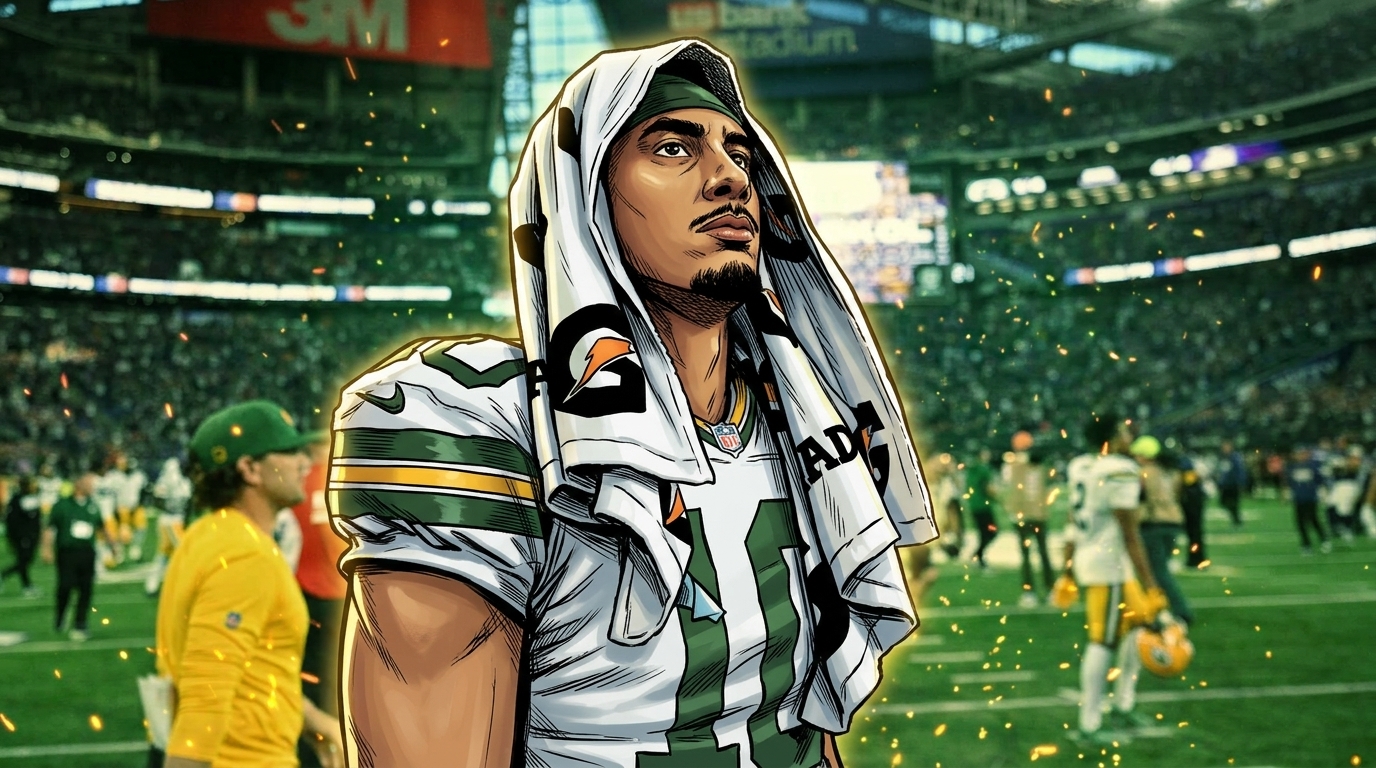

Jordan Love threw for 387 yards and two touchdowns against Minnesota in Week 1. The Green Bay Packers still lost by seventeen points. That gap, between the box score and the final score, is the real story here, not the yardage total by itself.
That box score is exactly what fueled the loudest take of the night:
https://twitter.com/BookOfEli_NFL/status/2099507442535026947
It’s a fair reaction to a box score. It’s a rougher fit once you put the box score back inside the game it came from.
What Jordan Love Actually Did Behind a Broken Line
Start with the part of the tweet that’s actually verifiable. Minnesota pressured Love on 78.3% of his dropbacks, which means on four out of every five throws, a Vikings rusher was already in his face before he could set his feet and step into a read. The Vikings piled up 15 quarterback hits, seven of them from Dallas Turner alone. I checked that pressure number twice because it seemed too high to be real. It wasn’t.
Green Bay didn’t help itself up front. Left guard Aaron Banks was out with an injury, and Donovan Jennings made his first career start in his place, across from a Minnesota front that spent the whole afternoon getting to Love before his protection could pick up the extra rusher. A first career start at guard is already a lot to ask; doing it against a defense that hit the quarterback 15 times is closer to a trial by fire than a normal debut. None of that happened in a vacuum, either. Green Bay’s run game problems predated this game, and they’re a big part of why the offense leaned this hard on Love’s arm instead of balancing the workload. Throwing 42 times in one afternoon is what a quarterback does when the run game can’t buy him easier downs, and it’s also what puts more reps in front of a line that’s already losing its individual matchups.
Love still found receivers. An 81-yard touchdown to Christian Watson supplied the single biggest chunk of the yardage total, and he connected with Matthew Golden, Jayden Reed, and Tucker Kraft on explosive plays throughout the game. The arm talent isn’t the question here. What produced the conditions for that arm talent to show up is.
Is 387 Yards and a Blown Lead a Top-5 QB Week?
No, not by itself. Love’s raw numbers are excellent in isolation, but Green Bay led by 12 points in the third quarter and still lost by 17. A stat line built partly in comeback mode isn’t proof of elite quarterbacking on its own. It’s evidence of a game the Packers were supposed to win and didn’t.
I run three fantasy baseball leagues off my own projection model, and this is the exact trap it falls into every October: counting production without checking what created it. A box score doesn’t know the difference between a quarterback carrying a lead and a quarterback chasing one.
The tweet calls Minnesota’s performance the worst offensive line showing its author has ever watched. Maybe it was. There’s no league-wide ranking that confirms that, so treat it as one fan’s gut reaction in the moment, not a stat. What’s actually measurable is the third-down column: Green Bay converted 3-of-12, while Minnesota converted 8-of-15, more than double the rate on the same down. In plain terms, Green Bay’s offense kept handing the ball back to Minnesota’s, and Minnesota’s defense kept getting extra chances to tee off on Love instead of playing from a stance built to defend a lead. Add penalties to that. Green Bay was flagged 12 times for 98 yards to Minnesota’s 3 for 15, and several of Green Bay’s were defensive penalties, illegal contact and roughing calls among them, that extended a Vikings drive that should have ended. A quarterback can’t fix a penalty count by himself, and 387 passing yards can’t buy back a first down Green Bay’s own defense gave away for free.
The 4th-and-1 That Turned a Winnable Game Into a Blowout
The moment that actually decided this game had nothing to do with garbage time. Green Bay still led in the third quarter when a Vikings penalty handed the Packers a short field. Instead of taking three points and pushing the margin further out of reach, head coach Matt LaFleur went for it on 4th-and-1. The conversion failed, and Minnesota took the game over from there. Green Bay’s lead kept shrinking, down to 22-17 early in the fourth quarter, and that turned out to be the last time the Packers led all night. Minnesota closed it out on a 22-0 run from that point on.
Love’s own fourth quarter didn’t help the cause. A strip-sack and a twice-tipped interception both set up Minnesota scores directly, the kind of detail a 387-yard final line conveniently leaves out.
None of this required Minnesota’s offense to be unstoppable. Minnesota’s own quarterback situation is one of the more unsettled starting jobs in the league right now, and the Vikings still won by 17 without needing a shootout. They won by making Green Bay’s protection collapse and by cashing every mistake that followed.
A Fixable Offense vs. One That Doesn’t Move the Ball
Give the Packers this much: a line that surrenders pressure on four of every five dropbacks isn’t a small, coachable footnote. That much of the tweet’s premise is real, and it’s fair context for anyone judging Love off one game.
But the more useful question isn’t whether Love can produce yardage behind a line that can’t protect him. It’s whether an offense that generates 387 yards and still blows a double-digit lead is actually more fixable than one that never moves the ball in the first place. My money’s on yes. You can coach protection issues, and you can get healthier at guard once Banks is back. You can’t manufacture 387 yards and two touchdowns out of an offense that was never getting them at all. Green Bay already has the harder problem solved. What’s left is discipline: the penalties, the 4th-and-1 call, the two turnovers that turned a tight game into a laugher. Clean those up, and the stat line finally means what the postgame tweets wanted it to mean.