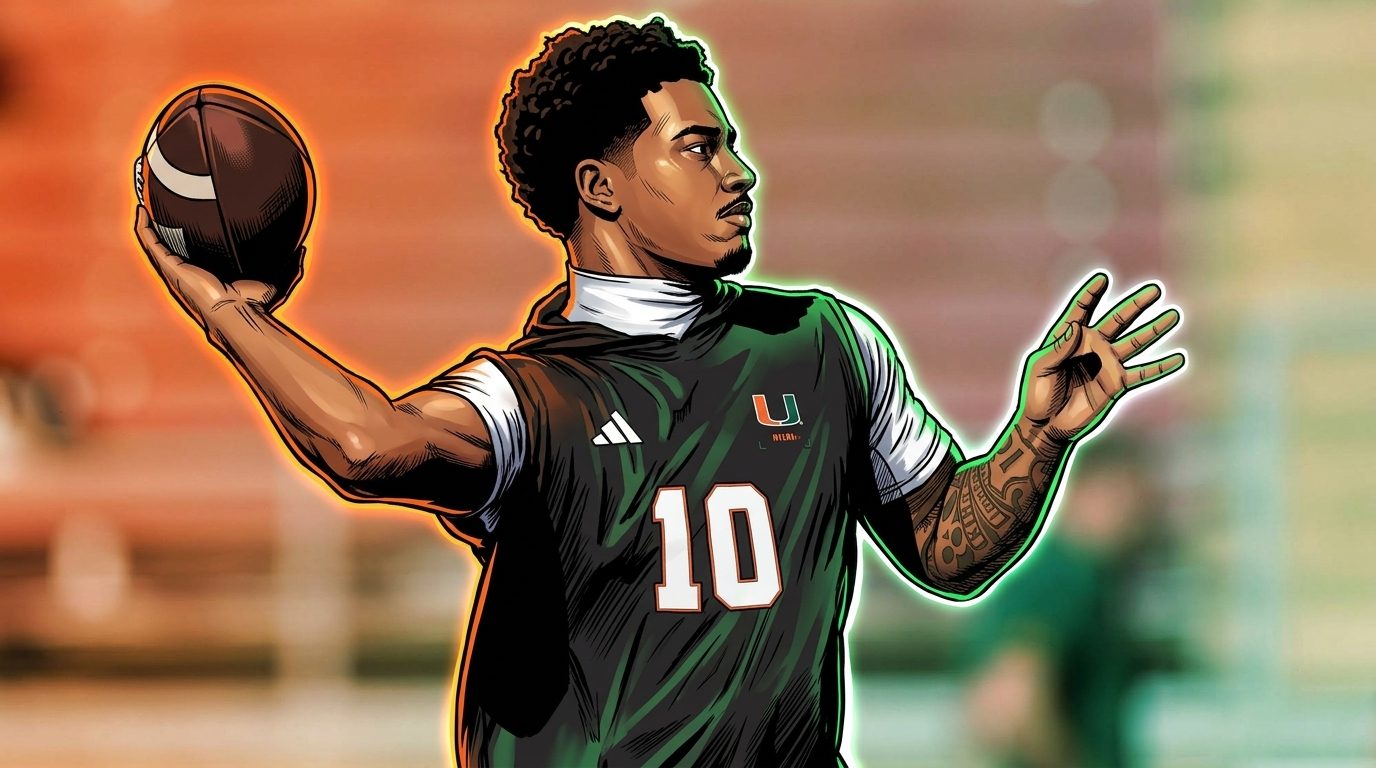

Elija Lofton appeared to catch a fourth-down pass in the end zone with his feet down, and the officials ruled that he never did. The villain is the catch rule that makes such a ruling possible; the crew only applied it. Miami’s early hole is a separate matter, and we will get to it.
With 3:36 left, Notre Dame led 31-24, and a Lofton touchdown would have made it 31-30. Luke Talich knocked the ball away in a breakup that was disputed. The officials ruled no completed catch, Notre Dame took over on downs, and the clock did the rest.
https://x.com/BleacherReport/status/2119283007123042406
Miami coach Mario Cristobal said he was “beyond upset” and, according to Yahoo’s reporting, “really, really disappointed” that the officials “negated” a touchdown “with two hands on the ball.” That is a coach talking about his own team, and it is also the plain-English version of the dispute, the version the rulebook seems unable to answer.
https://x.com/AustinRHough/status/2119287194527416510
Think of the catch rule as a lease with a clause on page nine. You sign, you move in, you carry the couch up three flights, and then a stranger informs you the apartment was never yours because of something that happened after you got the keys. Every step you took was the step of a tenant. The paperwork says you were a visitor.
That is what the ruling does to a receiver. If a defender’s swat can undo a catch the receiver appeared to have, then possession is a loan; the officials hold the note and call it in whenever the next half-second goes badly. Nobody could explain that standard in one sentence to a head coach with a microphone in front of him. A rule that cannot survive being said out loud has a defect.
Now the counterargument, and it is a fair one. Miami trailed 17-3 at the half and 24-3 early in the third quarter. In the second quarter the Hurricanes had first-and-goal at the Notre Dame 1, ran three times, gained nothing, and settled for a field goal. That is a 21-point hole and a missed chance to shrink it, and no ruling in the final minutes created either one. Notre Dame’s CJ Carr threw for 319 yards and three touchdowns, and his team earned every point of that cushion.
The climb out was real, too. Darian Mensah threw three touchdown passes, two to Cooper Barkate and one to Lofton, and the quarterback whose completion streak we covered earlier this season got his offense a fourth-down shot at 31-30. That is the part worth protecting. A team that climbs 21 points back has earned an answer to a simple question, and “it depends on what the defender does next” is not an answer a receiver can use at full speed.
The fix is not complicated. Pick the moment a catch becomes final, write it in a sentence a sophomore can repeat, and apply it the same way in every stadium. Until then every close one will arrive with a second argument stapled to it, and the argument will always be about the rule, because nobody involved can quote it.
Nothing here says the call lost Miami the game. Three runs from the 1 had a say in that. But the two failures are not rival explanations. One was a team that could not score from a yard out, which happens and which the team owns. The other is a sport that cannot tell its own players what a catch is, which does not belong to one crew or one Saturday, and which Notre Dame’s own officiating complaints this season suggest the sport keeps treating as a one-off.
Cristobal’s advice was “Don’t leave it in the hands of the officials.” It may be the only clause in the whole episode anyone can follow, and the rulebook leaves it there anyway.