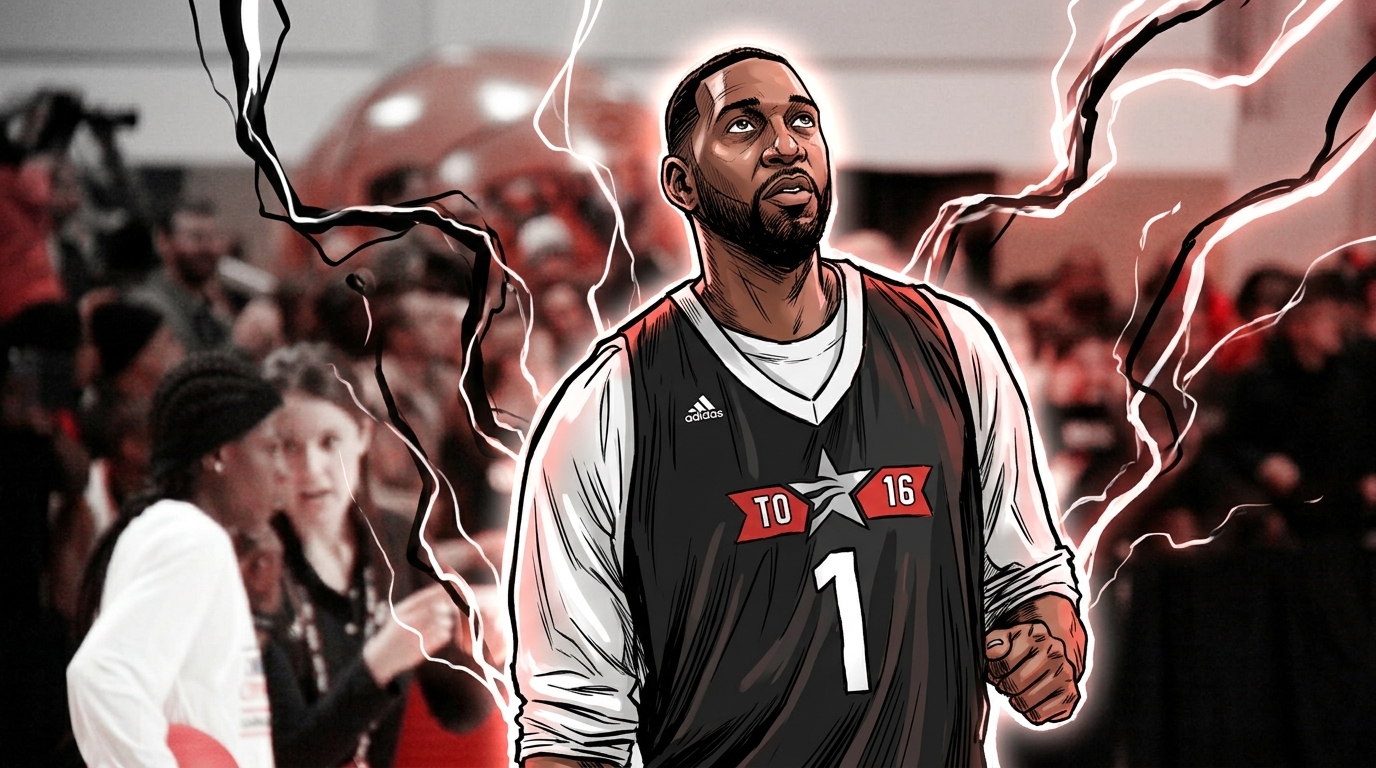

Tracy McGrady played 16 NBA seasons and reached exactly one Finals, a bit-role cameo on the 2013 Spurs team that lost to Miami, so when he said the regular-season MVP means more than a championship, the reaction wrote itself. Run the actual list of MVPs against that year’s champion since 2000, though, and McGrady’s argument holds up far better than the pile-on suggests.
McGrady made the case on Cousins, the podcast he co-hosts with Vince Carter: MVP voting measures what one player did across 82 games, while a championship depends on eleven or twelve other players on the roster — names most fans couldn’t pick out of a lineup. Iman Shumpert went after him for it on Gil’s Arena, and the clip spread the way these things do, stripped of context. The historical record actually backs the statistical half of McGrady’s claim: separating the best regular-season player from the best team in June holds up, and plenty of MVPs never sniff a title that same spring. But Shumpert wasn’t making a statistical argument. He was reacting to a former All-Star telling a room of NBA-obsessed kids that individual hardware carries as much weight as winning, and that’s a completely different fight than the one about whether the numbers support McGrady.
What McGrady Actually Said
McGrady’s exact words, via Yahoo Sports: “The MVP of the regular season has more weight than a championship.” That wasn’t a throwaway line. He built an actual argument around roster dependency. A championship requires health, matchups, coaching decisions, and role players executing a scheme, while an MVP campaign is closer to an individual audit of one guy’s season. McGrady’s underlying point was that fans remember the player who dragged a mediocre roster to 30 wins more vividly than they remember a title team’s ninth man. He’s not wrong about that memory gap, even if you think he’s wrong about which one should matter more.
How Often Does the MVP’s Team Actually Win It All?
Since 2000, per Basketball-Reference, the MVP’s team has also won the championship in only 6 of 27 seasons, about 22 percent. That means in more than three out of every four years, the league’s best regular-season player watched someone else hoist the trophy in June, which is close to the opposite of what the backlash against McGrady assumed.
The full list, year by year:
| Season | MVP | Champion |
|---|---|---|
| 2000 | Shaquille O’Neal, Lakers | Lakers (MATCH) |
| 2001 | Allen Iverson, 76ers | Lakers (Iverson’s own Sixers lost the Finals) |
| 2002 | Tim Duncan, Spurs | Lakers |
| 2003 | Tim Duncan, Spurs | Spurs (MATCH) |
| 2004 | Kevin Garnett, Timberwolves | Pistons |
| 2005 | Steve Nash, Suns | Spurs |
| 2006 | Steve Nash, Suns | Heat |
| 2007 | Dirk Nowitzki, Mavericks | Spurs |
| 2008 | Kobe Bryant, Lakers | Celtics |
| 2009 | LeBron James, Cavaliers | Lakers |
| 2010 | LeBron James, Cavaliers | Lakers |
| 2011 | Derrick Rose, Bulls | Mavericks |
| 2012 | LeBron James, Heat | Heat (MATCH) |
| 2013 | LeBron James, Heat | Heat (MATCH) |
| 2014 | Kevin Durant, Thunder | Spurs |
| 2015 | Stephen Curry, Warriors | Warriors (MATCH) |
| 2016 | Stephen Curry, Warriors | Cavaliers |
| 2017 | Russell Westbrook, Thunder | Warriors |
| 2018 | James Harden, Rockets | Warriors |
| 2019 | Giannis Antetokounmpo, Bucks | Raptors |
| 2020 | Giannis Antetokounmpo, Bucks | Lakers |
| 2021 | Nikola Jokic, Nuggets | Bucks |
| 2022 | Nikola Jokic, Nuggets | Warriors |
| 2023 | Joel Embiid, 76ers | Nuggets |
| 2024 | Nikola Jokic, Nuggets | Celtics |
| 2025 | Shai Gilgeous-Alexander, Thunder | Thunder (MATCH) |
| 2026 | Shai Gilgeous-Alexander, Thunder | Knicks |
Six matches in twenty-seven years. Nash and Jokic combined for five MVPs between them and zero rings in those specific seasons. Even LeBron, the most complete player of his generation, only lined up MVP and a title in the same spring twice, both times in Miami. McGrady’s claim that the award and the trophy measure different things isn’t a hot take. It’s just the record.
The most recent line item is the cleanest illustration of the whole debate. Shai Gilgeous-Alexander won back-to-back MVPs in 2025 and 2026 — the 14th player in league history to pull that off, and dominant enough in year two that he collected 83 of 100 first-place votes. His Thunder didn’t even make the 2026 Finals: San Antonio beat them in seven games in the Western Conference finals, then went on to lose the Finals to the Knicks, who won their first title since 1973 behind Brunson’s unanimous Finals MVP run, capped by a 45-point closeout Game 5 that matched the mark Michael Jordan set in the clinching Game 6 of the 1998 Finals, per ESPN. Jalen Brunson has the ring. Gilgeous-Alexander has the hardware that says he was the best player alive across two straight regular seasons, and this year his own team lost twice before anyone even reached the Finals. Swipe Sports already ran a version of this exact argument, about Brunson’s ring versus Shai’s MVP, and it splits along the same lines here: two real cases, two different categories of achievement, treated like they’re supposed to cancel each other out.
Why Shumpert’s Objection Was Never About the Math
Shumpert’s response, per Fadeaway World, got personal fast: “He’s tripping, and it’s tough because, Mac, I had your shoes… this is why he ain’t get out the first round. I’m blown down.” Then he got to the actual objection: “You don’t get to teach my kids that winning doesn’t matter. It matters, Joe.”
That’s not a rebuttal to McGrady’s stat. It’s a values argument dressed up as one, and the two aren’t interchangeable no matter how the clip got edited together. Shumpert also made a specific counter-case of his own, arguing that Finals MVP carries more lasting value than the regular-season trophy and pointing to Andre Iguodala’s 2015 Finals MVP as an award that means more than a stat line ever could. That’s a debatable position on its own terms — plenty of players would rather have Steve Nash’s two MVPs than a single Finals MVP earned as a complementary piece. But it’s also a separate question from whether McGrady’s original math holds up.
The reaction online mirrored the same split.
https://twitter.com/Thechat101/status/2099579044761071841
Framing this as a dunk contest between two mutually exclusive truths misses what actually happened. McGrady made a claim about individual value that the historical record supports, and Shumpert made a claim about what winning should mean to a kid learning the sport, which the historical record has no way to weigh in on either direction.
A second flare-up hit McGrady the same week, over a different claim entirely:
https://twitter.com/bballunlocked/status/2099819979944214945
Stephen Jackson wasn’t relitigating the MVP debate there. He was calling out a separate McGrady line about swapping himself in for Kobe Bryant and still winning a title. Different specific claim, same reflex from the other side: McGrady keeps reaching for individual-talent arguments, and former players keep answering with the scoreboard.
Olden Polynice piled on too, on a separate broadcast, arguing along similar values-first lines.
Two separate broadcasts, same objection, same category error.
So Who’s Right?
Both of them, just not about the same thing.
McGrady’s claim is a testable historical pattern, and the pattern says he’s closer to correct than wrong: 22 percent is not good odds for connecting MVP-caliber play to a ring, and treating a championship as the only proof of individual greatness ignores two decades of Hall of Fame-caliber seasons that ended in someone else’s parade. Nash, Westbrook, Harden, and Jokic before this year don’t stop being generational talents because a team they didn’t build alone lost in June.
Shumpert’s claim isn’t about McGrady’s spreadsheet at all. It’s about what gets modeled for the next generation of players, and on that point the actual MVP list doesn’t settle anything, because it was never built to. Hold both conclusions at once and nothing breaks: the historical record backs the stat-nerd case, and Shumpert is still right that a Hall of Fame résumé doesn’t excuse telling kids that hardware outweighs winning. The mistake was ever treating this as one argument. It’s two, running side by side, and the internet just needed a villain to pick.